AI Role Play Training: What It Is and Why It Beats Passive E-Learning
Most training still asks people to watch instead of do. AI role play training changes that by letting teams practice real conversations with a responsive AI partner, building confidence through repetition rather than passive slides.
July 31, 2026
Company size 500+
AI is changing how your team learns, but most training still asks you to watch instead of do. Slides and videos hand you knowledge, yet they rarely build the confidence you need for a real conversation. AI role play training flips that around by letting you practice live.
Key takeaways
AI role play training lets you practice real conversations with a responsive AI partner instead of clicking through slides.
It replaces passive e-learning with active repetition, so you build skills by doing rather than watching.
It scales realistic practice across your whole team, and works best when the AI reacts live with emotional realism.
This guide walks you through what AI role play training is, why it beats passive e-learning, and how to get started.
What is AI role play training?
AI role play training is a way to practice real conversations with an AI partner that responds to you in real time. Instead of reading about how to handle an objection, you actually work through it out loud with a simulated buyer, patient, or colleague. The AI plays a role, reacts to what you say, and adapts as the conversation unfolds.
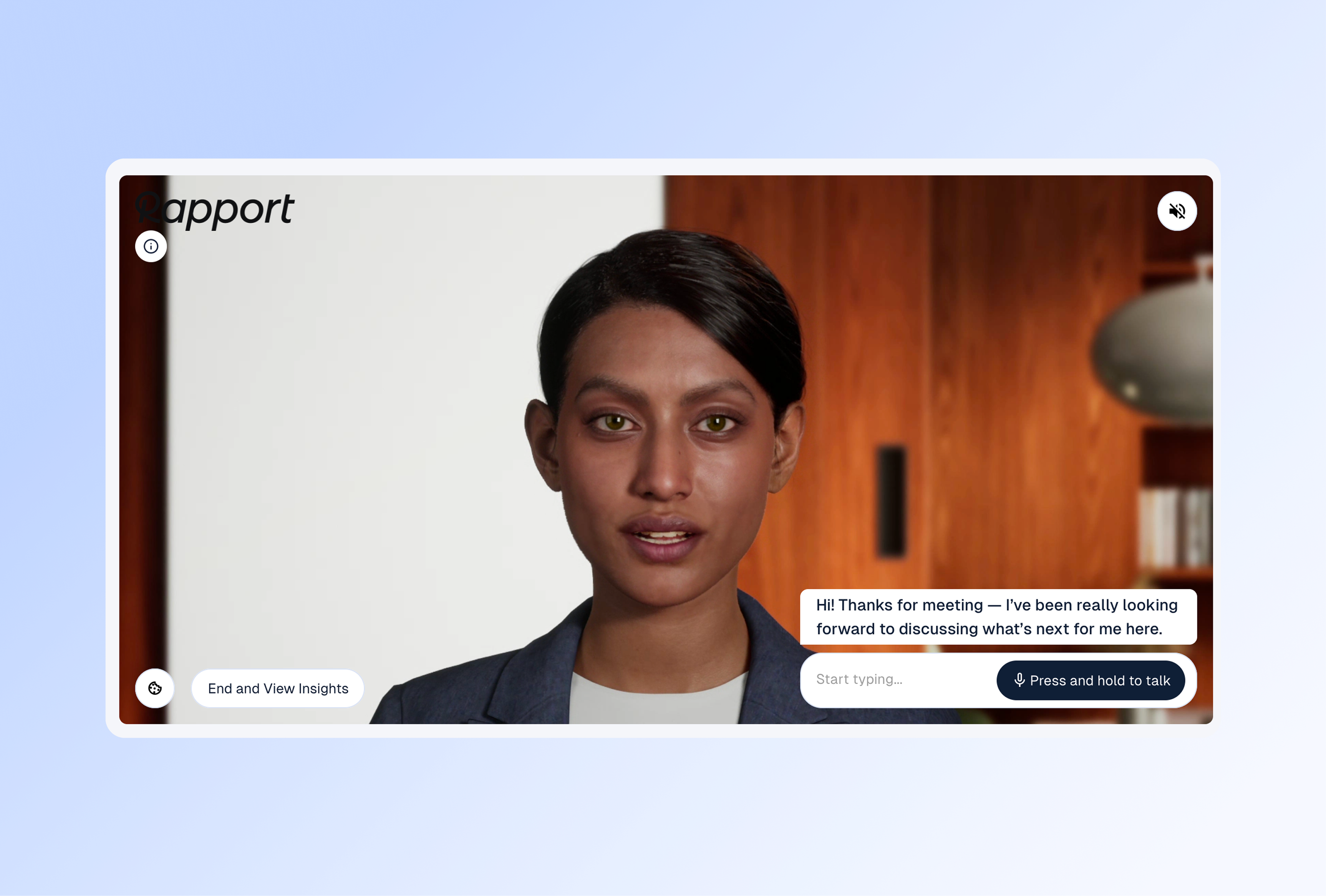
Think of how different this is from a quiz or a branching video. A branching module gives you a fixed set of choices. A live role play responds to your actual words, tone, and decisions, which is much closer to how a real conversation feels.
The idea is simple. You get better at difficult conversations by having them, and AI lets you have those conversations safely, on demand, and as many times as you need.
How is it different from passive e-learning?
Passive e-learning asks you to absorb information. You watch a video, read a module, and answer a few questions to prove you were paying attention. It is efficient for delivering knowledge, but it rarely changes how you actually perform.
The catch is that knowing something and being able to do it are not the same skill. You can pass a quiz on objection handling and still freeze when a real prospect pushes back on price. Confidence comes from repetition under realistic pressure, and slides simply cannot give you that.
AI role play training closes that gap. It moves you from watching to doing, and it does so in a space where mistakes cost you nothing. That mix of realism and safety is what makes the practice actually stick.
Why does active practice work better?
Active practice works because it uses the very same skills you will need on the job. When you rehearse a pricing conversation, you are building the exact muscle you will reach for when a buyer challenges you for real.
Repetition matters just as much. One role play is helpful, but the real gains come when you run a scenario several times, adjust each attempt, and notice what lands. Most training never lets you do this, because human practice partners cannot scale to give you that many reps.
You also get a feedback advantage. A good AI role play can show you what worked and what did not right after the conversation, while it is still fresh in your mind. For a closer look at why this beats traditional courses, see what your LMS cannot show you about soft skills.

How AI role play training compares
If you are weighing up how to train your team, it helps to see how AI role play compares with the methods you are probably using today. Each approach has its place, but they are not equal when it comes to building real skill.
Here is how the common options stack up:
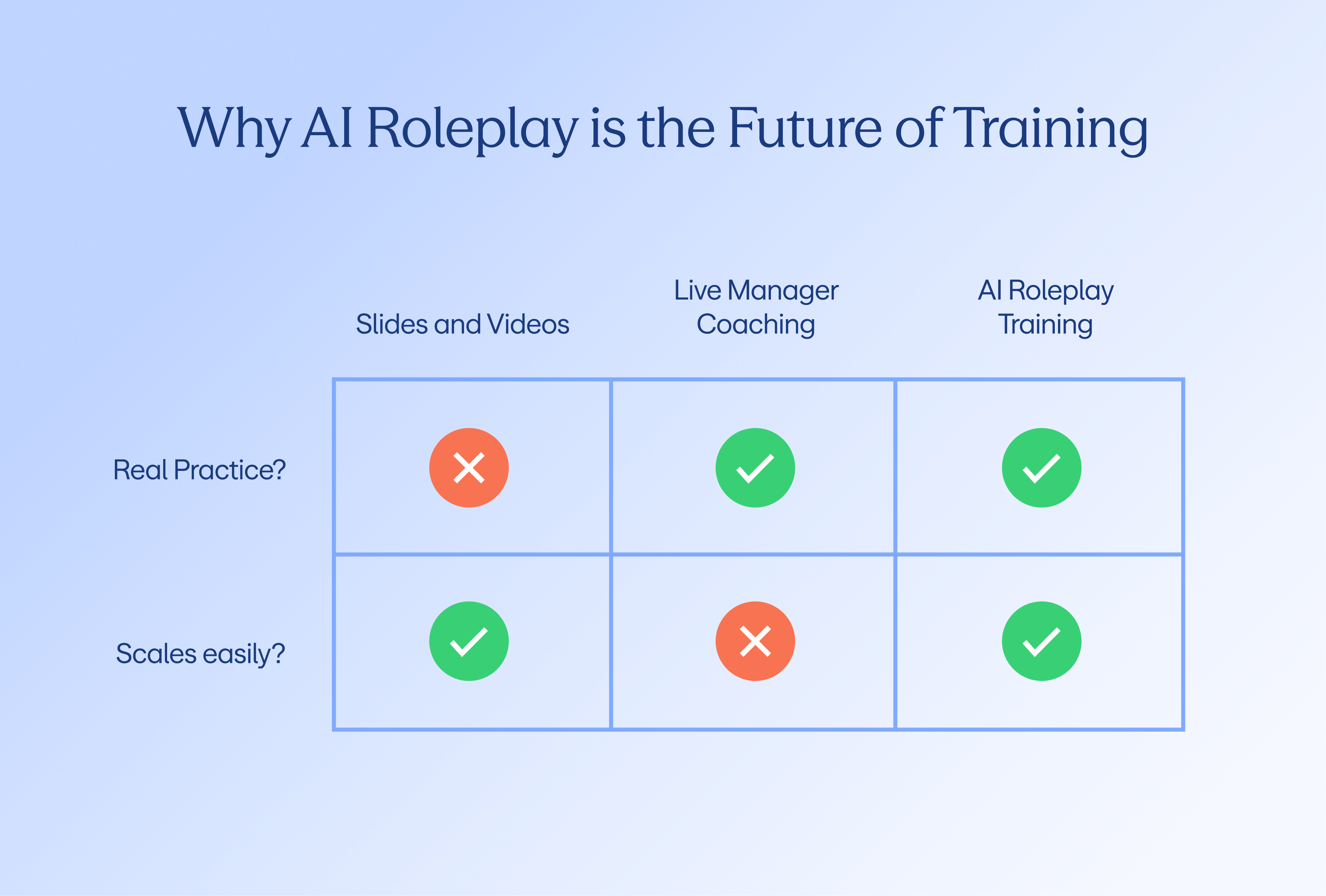
Training method | Real practice? | Scales to all? |
|---|---|---|
Slides and videos | No, you only watch | Yes |
Live roleplay with a manager | Yes | No, limited by time |
AI role play training | Yes, anytime | Yes |
Look at that middle column, because it is the one that changes outcomes. Slides scale beautifully but never let you practice, and a great manager gives you real practice but cannot sit with every rep every day.
AI role play is the only option that gives you both. You get to rehearse the hard moments as many times as you need, and everyone on your team gets the same chance. That is why it closes the gap the other two leave open.
What makes a realistic AI role play?
Not all AI role play is equal. A text-only chatbot that types back at you is a long way from a conversation that feels human. The closer your practice gets to a real interaction, the more it carries over when it counts.
The strongest versions use live, reactive video avatars that respond with emotional realism. That means an avatar that can show hesitation, frustration, or warmth, and that reacts to how you say something, not just what you say. Reading a face and adjusting in the moment is a huge part of any real conversation.
This is where it separates from voice-only or static tools. Rapport focuses on exactly this, and you can see real AI roleplay examples here to get a feel for what emotionally realistic practice looks like.
Where is AI role play training used?
AI role play fits any role where conversations decide the outcome. It is most useful in the moments that are high-stakes, happen often, or are hard to rehearse with a live partner.
You might use it to:
Rehearse discovery calls, objection handling, and negotiations before you face a buyer
Ramp new reps faster by letting them practice real scenarios from day one
Prepare for difficult conversations like giving hard feedback or supporting a distressed employee
Get ready for high-stakes moments in healthcare, customer service, and leadership roles
Whenever you need to be ready for a human moment, practicing it first beats reading about it. If you lead a sales team, you can see how this fits your world on the sales solutions page.
How do you get started with AI role play training?
Start by pinning down the conversations that matter most to you. These are usually the high-stakes, high-frequency moments where a better performance changes your results, like objection handling or onboarding calls.
Next, build realistic scenarios around those moments and practice them again and again. You are not chasing one perfect run, but a series of honest attempts that each get a little better. If you want help designing scenarios that work, take a look at the science of engaging soft skills training.
Finally, make practice a habit rather than a one-off. Skills fade without reinforcement, so if you want the biggest gains, treat role play as an ongoing part of how your team trains, not a box to tick.
Frequently asked questions
Is AI role play training only for sales teams?
No, it works for any role built on conversations. Whether you are in sales, customer service, healthcare, or leadership, you can use it to prepare for the interactions that matter. Anywhere a tough conversation shapes the outcome, practicing it first helps you.
Does AI role play replace human coaching?
No, it works alongside it. The AI handles the high-volume repetition your coaches cannot scale, which frees your managers to focus on the higher-level feedback only they can give. The best programs pair AI practice with human guidance.
How is this different from a chatbot?
A basic chatbot just swaps text with you on a fixed path. AI role play training reacts to what you say and how you say it, and the best versions use reactive video avatars with emotional realism. That makes your practice feel far closer to a real conversation.
How quickly will you see value?
You often see value as soon as your reps start practicing real scenarios before live calls. Because the practice targets the exact conversations they face, the improvement shows up right where you need it. Keep it consistent and those gains compound over time.
The bottom line
AI role play training is a shift from passive learning to actually getting better at the conversations you have. Instead of watching how one should go, you get to have it, refine it, and build real confidence before it counts. That is something slides can never give you.
Adopt it early and you hand your team a genuine edge, because they show up prepared instead of hoping to wing it. Want to see it in action? Book a demo or get started for free.
Related articles

What your LMS can’t show you about soft skills
Completion rates tell you someone clicked through a module, not whether they can handle a difficult customer. Here's how to measure real behavior change with scenario-based practice and reporting that stands up to a CFO's questions.
How to write a strong prompt for your AI avatar
Your avatar is only as good as the brief you give it, and vague prompts produce vague conversations. Here's how to set the scene with context, tone, and purpose so your avatar can think on its feet instead of reading a script.

The science of engaging soft skills training
You can't learn to swim by reading about water, and you can't learn hard conversations by watching a video. This is the learning science behind why passive training fails and what makes experiential practice actually stick.