Rapport vs Hyperbound: Which AI Roleplay Platform Fits Your Team in 2026?
Rapport vs Hyperbound is the comparison most revenue and L&D teams reach when they shortlist an AI roleplay platform. Both let people practice real conversations with AI. Both sell to the enterprise. They were built to solve different halves of the same problem.
September 6, 2026
Key takeaways
The biggest functional difference is the face. Rapport animates an avatar's expression in real time from audio, at roughly 50ms latency. Hyperbound runs a voice-first simulated call with a static persona photo, plus an optional video-call layout with screen sharing.
Hyperbound is priced per seat and quoted. Its published tiers are Free, Practice Enterprise, and Perform Enterprise, with no dollar figures on the pricing page. Rapport publishes real numbers: a free 14-day trial, $19 per month Pro, $99 per month Business, and a quoted Enterprise tier.
The pricing units do not match. Rapport bills usage minutes at an effective $0.19 per minute. Hyperbound bills user licenses, with separate SKUs for Practice and Perform. Comparing headline numbers without modeling your own volume will mislead you.
Hyperbound is the stronger fit for a revenue org that already runs on a CRM and a call recorder. It scores real calls, ties practice to deal signals, and publishes SOC 2 Type II, ISO 27001, GDPR, and HIPAA.
Rapport is the stronger fit for face-to-face and emotionally difficult conversations across L&D, customer experience, healthcare, higher education, and sales, and it is the only one of the two publishing an on-premise or private cloud option.
Rapport vs Hyperbound at a glance
Rapport and Hyperbound are both enterprise AI roleplay platforms, and they solve different halves of the same problem. Rapport simulates the person you are talking to. Hyperbound simulates the call you are running, then scores the real ones. Everything below follows from that.
Comparison point | Rapport | Hyperbound |
Core approach | Interactive AI avatar roleplay with real-time facial animation driven by audio | Voice-first AI buyer calls with scoring, plus real call scoring and coaching agents |
Roots | Facial animation research at Speech Graphics, Edinburgh, founded 2009, spun out as Rapport in 2019 | Y Combinator Summer 2023, product launched January 2024, built for SDR and AE cold call practice |
What the learner faces | A 3D avatar whose expression changes as the conversation moves, rendered live rather than pre-recorded | A named buyer persona with a headshot, a live transcript, and a scorecard filling in as the call runs |
Nonverbal training | Central to the product. Facial reaction, silence, and pressure are part of the practice | Not the focus. Video call layout and screen share exist, but the AI buyer has no animated face |
Scenario setup | Template library today, with custom scenario building on the roadmap and professional services on Enterprise | Self-serve bot builder. First bot and scorecard in under 10 minutes, full persona rollout around two weeks |
Scoring | Overall score plus per-metric scores on competencies such as active listening, empathy, and clarity | Custom scorecards mapped to MEDDPICC, SPIN, Sandler, Challenger, or your own framework, with transcript citations |
Real call analysis | Not offered. Practice and reporting only | Yes, through Hyperbound Perform, with deal coaching and CRM push |
Languages | Supported through speech-to-text and text-to-speech integrations. Site figures range from 35+ to 50+ | 25+ published languages, used in more than 40 countries |
Named customers | KDDI, Qualcomm, NBC, NEC, Boise State University, Heriot-Watt University, UC San Francisco | IBM, LinkedIn, Notion, Autodesk, monday.com, Bloomberg, Klaviyo, Vanta, G2 |
Scale proof | 610,000+ role plays completed by customers | 100,000+ reps on the platform, 4.9 on G2 from 40 reviews |
Security posture | UK GDPR and Data Protection Act 2018, data never sold or used to train models, on-premise and private cloud on Enterprise | SOC 2 Type II, ISO 27001, GDPR, HIPAA, no training on customer data, EU data residency as a paid add-on |
Entry pricing | Free 14 day trial with 50 minutes, then $19 per month | Free tier with 45 prebuilt roleplays, then quoted per user |
Best known for | Believable faces in high-stakes, emotionally loaded conversations | Cold call reps and pipeline execution at scale |
All pricing, customer, and security claims on this page were read from each vendor's own website. Vendors change these pages often, so re-verify before you quote anything in a board deck.
Origin story
A platform's origin story is not marketing trivia. It predicts what the product is good at three years later, because the hardest engineering problem a company solves first tends to stay its moat.
Where Rapport came from
is based inRapport spun out in 2019, launched a self-serve platform in July 2024, and acquired Aquifer Motion in October 2025 to add full-body animation and cinematic camera tools. The company runs from Edinburgh, with offices in San Francisco, Austin, Budapest, and Singapore.
Where Hyperbound came from
Hyperbound went through Y Combinator in the summer of 2023 and launched its product in January 2024. Founders Sriharsha Guduguntla and Atul Raghunathan built it for a specific pain: new sales reps who have nowhere safe to practice a cold call.
It grew fast from there. The company raised a $15 million Series A in September 2025 led by Peak XV Partners, with Y Combinator, Snowflake Ventures, Roble Ventures, and Fellows Fund taking part, and reported adding more than $1 million in new ARR in two consecutive months before the round closed. In December 2025, it launched Kota, an AI sales performance agent with more than 40 prebuilt automations.
Read those two paragraphs again, and the product roadmaps write themselves. One company spent fifteen years on faces. The other spent two years on pipeline.
The core difference: a reacting face vs a voice on the line
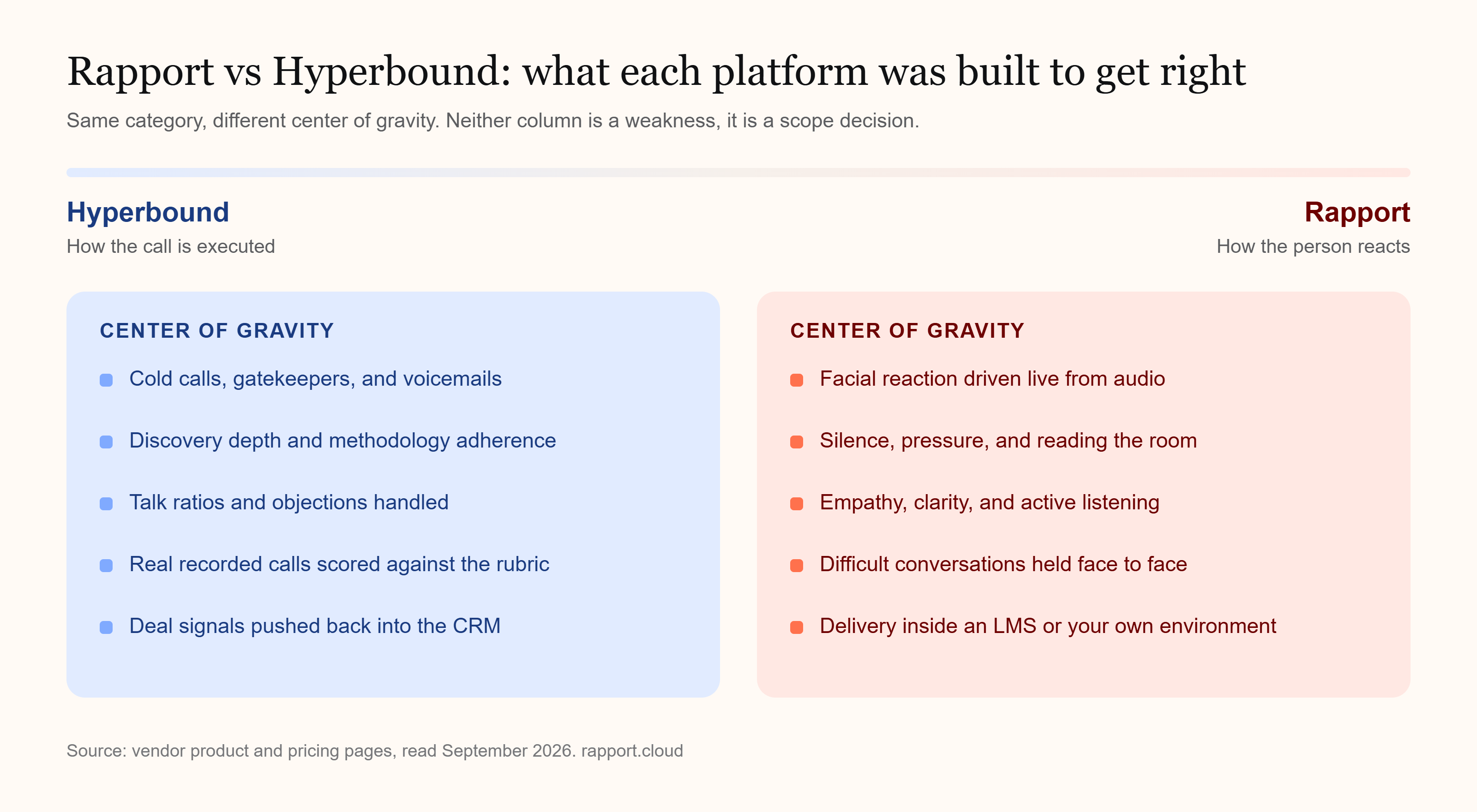
Strip away the feature lists and one difference decides most evaluations. In Rapport, the thing you are talking to has a face that changes. In Hyperbound, the thing you are talking to has a voice and a photo.
What Hyperbound does
Runs a simulated phone or video call against an AI buyer persona with a name, title, company, and tone setting such as nice, formal, or sassy.
Shows a live transcript during the call and a criterion-level scorecard immediately after, with quotes from the transcript attached to each score.
Covers the full call motion: cold calls, gatekeepers, voicemails, warm calls, discovery, demos, slide deck walkthroughs, upsell, renewal, check-in, and manager one-on-ones.
Supports screen sharing where the AI can respond to what is on your slide, and multiparty roleplays that put several AI personas in one session.
Scores real recorded calls through Hyperbound Perform, then generates targeted practice from what it finds.
What Rapport does
Renders a 3D avatar live, with facial animation driven by the audio at roughly 50ms, so the reaction lands while the learner is still speaking.
Uses real-time rendering rather than pre-recorded video, which is why the same avatar can respond differently to the same words said two different ways.
Lets you pick character, voice, language, and AI behavior, with characters from a built-in library, MetaHuman, Ready Player Me, or your own upload.
Scores each attempt on competencies such as active listening, empathy, and clarity, and rolls attempts up into cohort analytics for managers.
Ships as a hosted link, an iframe, a web widget, a SCORM 1.2 package, or an Unreal Engine integration.
What this changes in practice
If your team's hardest moment is getting past a gatekeeper or holding a discovery call, the face is a nice-to-have and Hyperbound is built for exactly that motion. If the hardest moment happens in a room, in front of a person whose expression is changing, the face stops being cosmetic.
A nurse delivering bad news, a manager running a performance conversation, a medical device rep reading a surgeon across a table, a hotel supervisor absorbing an angry guest: in all of these, the learner's job is to notice a reaction and adjust. You cannot practice that against a still image.
The training statistic you should stop quoting
Somewhere in your business case, there is probably a line that says most sales training is forgotten within 30 or 90 days. The usual numbers are 87%, 84%, or 70%. Take it out.
Trace any of those figures, and the trail runs from one vendor blog to another vendor blog, each citing the other, occasionally gesturing at unnamed research from a large company. There is no published study, no sample size, no methodology, and no document anyone can produce. It is folklore wearing a lab coat.
Worth checking before your next business case
The real research it borrows from is Hermann Ebbinghaus's memory work from 1885 (opens in new tab), which measured how quickly a person forgets nonsense syllables they memorized alone. It says nothing about whether a sales rep remembers an objection-handling framework after a quarter of using it on live calls.
Here is the better argument, and it does not need a fake number:
Practice frequency is measurable. Both platforms report attempts per learner, so you can show that reps practiced 40 times instead of once at onboarding.
Improvement between attempts is measurable. Rapport reports first attempt versus last attempt by competency. Hyperbound reports criterion-level movement over time.
Ramp time is measurable. You already know your current time to first closed deal. That is the number your CFO cares about, and it is yours, not a vendor's.
Buy the platform on numbers you can defend in the room. A statistic that dissolves under one search is a liability in a procurement review, not an asset.
The four layers of a conversation, and which layer each platform measures
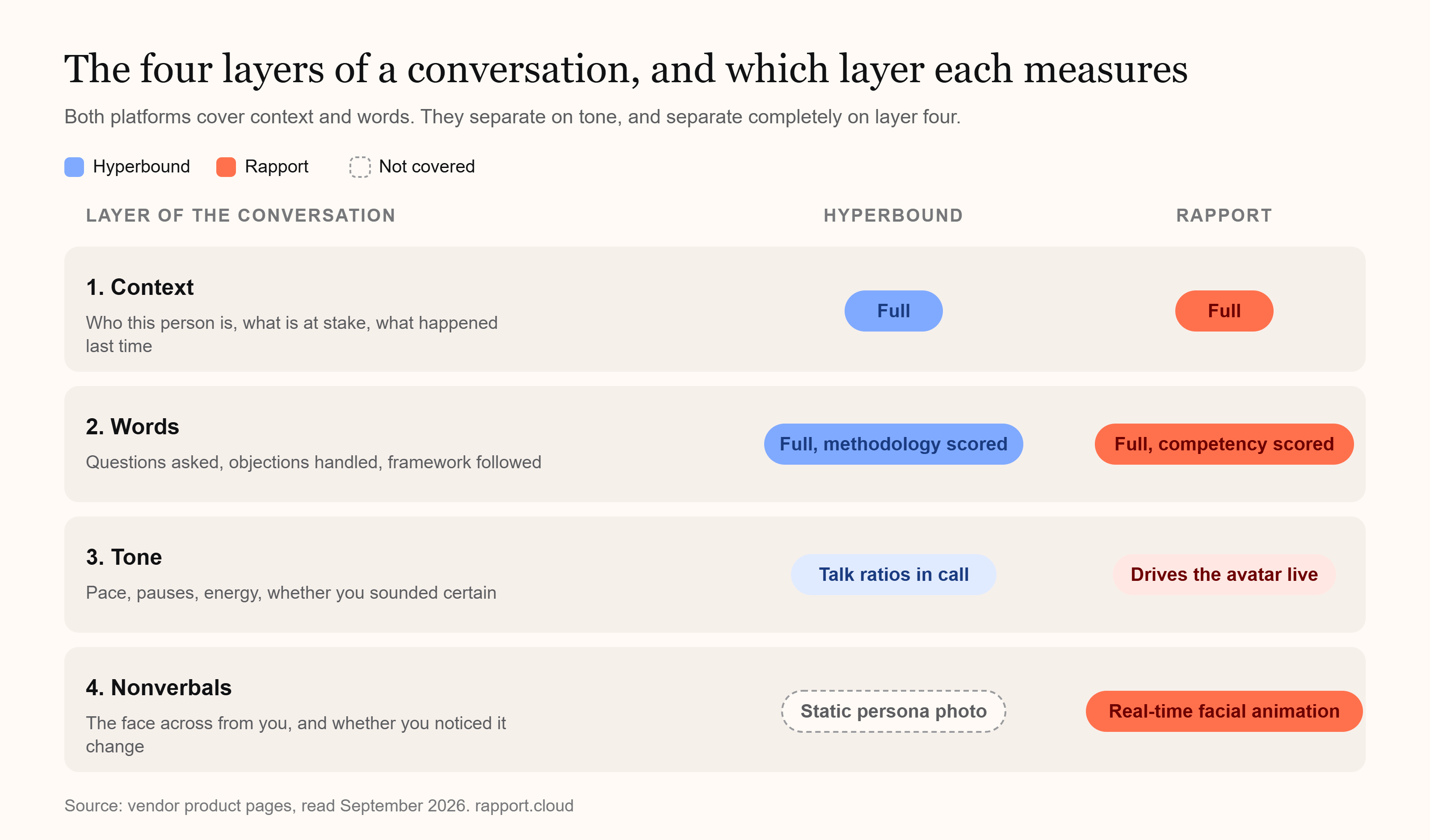
Every conversation runs on four layers at once. Sorting platforms by which layer they measure is faster than sorting them by feature list.
Context. Who is this person, what do they want, what is at stake, what happened last time.
Words. What you actually said, the questions you asked, the objections you handled, the framework you followed.
Tone. Pace, pauses, energy, whether you sounded certain or rattled.
Nonverbals. The face across from you, and whether you noticed it change.
Both platforms cover context and words well. Hyperbound covers them with a sales methodology attached, which matters if your org has standardized on MEDDPICC or Challenger and wants the rubric to say so. Rapport covers them with competency tags such as empathy and clarity, which matters if your program is about behavior rather than deal stages.
Both handle tone, in different ways. Hyperbound tracks talk ratios and objection handling inside the call. Rapport drives the avatar's expression from the learner's audio, so tone changes what comes back at them.
Layer four is where they separate. Rapport is built on it. Hyperbound does not claim it, and its own competitive content describes a visible AI face as something other platforms offer. That is not a knock on Hyperbound. It is a scoping decision, and it is the single fastest way to work out which tool belongs in your stack.
Scenario building and who owns it
Scenario ownership is the quietest line item in an AI roleplay contract and the one most likely to hurt you in month four. Ask who builds scenario number 40, not scenario number one.
How Hyperbound builds a scenario
Hyperbound is self-serve and admin-owned. An enablement lead can build a buyer bot and a scorecard in under ten minutes, and the company puts full persona and module rollout at about two weeks on average.
Upload a transcript from a real call and the builder generates a bot from it, described as roughly 85 percent ready before you touch it.
Build a bot from a LinkedIn profile through a Chrome extension, with three to five minutes of research.
Configure job title, industry, company, objections, priorities, and emotional tone, then spawn variants of a base persona.
Build custom scorecards against your own methodology, group bots into learning modules, and gate progress with certifications and leaderboards.
Implementation services exist, but they are a paid add-on rather than something bundled into the tier.
How Rapport builds a scenario
Rapport is where you should ask the hardest questions on this topic, because the marketing site and the product documentation do not currently agree.
The platform ships a scenario template library sorted by domain, covering learning and development, sales, and customer experience, and templates save to a personal library.
The documentation states that scenario configuration fields are visible but not yet editable, with custom scenario creation listed as a roadmap item.
Enterprise contracts include professional services and prompt engineering support, which is how bespoke scenarios get built today.
Scenario fields, once editable, cover character, learner, and avatar roles, situation context, learner objectives, and the competencies to measure.
What this means for your evaluation: if you need 50 scenarios that your own team writes and edits weekly without a services ticket, get a written date for self-serve scenario editing before you sign.
If you need a smaller set of very high-fidelity scenarios that a specialist configures well, the Enterprise services model is a reasonable trade, and it is the model many regulated buyers prefer anyway.
Analytics: call execution metrics vs behavior metrics
Both platforms produce reports. They answer different manager questions, and the difference is easiest to see side by side.
Question a manager asks | Hyperbound answers with | Rapport answers with |
Did the rep follow our methodology? | Criterion-level scoring against MEDDPICC, SPIN, Sandler, Challenger, or a custom framework, with transcript citations | Per-metric competency scores such as active listening, empathy, and clarity |
Is anyone actually improving? | Skill trends over time and methodology adherence at the criterion level, across practice and real calls | A first attempt versus last attempt view, plus average overall score and attempts per learner by cohort |
Where is the team weakest? | Coaching opportunities surfaced automatically, plus pattern and signal analysis across deals | Performance by metric, top competencies, and improvement areas across the cohort |
Did the practice change the real call? | Yes. Perform scores real recorded calls and rolls the result up across the deal | Not answered inside the platform. Practice scores only |
Is the program being used? | Analytics dashboard with performance widgets, data export, and a separate rep dashboard | Scenarios completed, attempts per learner, and average duration, filtered by cohort, scenario, and timeframe |
The honest summary: Hyperbound measures whether a seller executed a sales process. Rapport measures whether a person handled a human moment. If your program manager reports to a CRO, the first is easier to defend. If they report to a head of L&D or a clinical education lead, the second is closer to the job.
Deployment, integrations and LMS reality
This is where deals slow down. Both vendors will say yes to LMS delivery. The details differ, and the details are what your IT team will ask about.
Requirement | Rapport | Hyperbound |
LMS delivery | SCORM 1.2 package, uploaded or linked like any other course, with completion and progress flowing into existing dashboards. Published reach of 100+ LMS systems, including Canvas, Blackboard, and Moodle | Embeds into an existing LMS or CMS through SCORM, including Seismic. Gated to the Enterprise tiers, not available on Free |
Identity management | SSO stated on the platform page. Protocol, providers, and tier gating are not published, so confirm in writing | SSO and SCIM bundled on Enterprise tiers, with SAML providers including Okta, Entra, Google, OneLogin, Duo, JumpCloud, Rippling, and Workday |
Fits the revenue stack | Not the design goal. Integrations are AI, speech, and 3D engine oriented: OpenAI, Gemini, Groq, ElevenLabs, AWS Polly, Azure, Speechmatics, Whisper, Unity, Unreal, MetaHuman, Reallusion | 25+ integrations across Salesforce, HubSpot, Microsoft Dynamics, Gong, Chorus, Clari Copilot, Zoom, Google Meet, Teams, Outreach, Salesloft, Orum, Seismic, Highspot, Mindtickle, Allego, and WorkRamp |
Embedding | Hosted public link, iframe, web widget via an HTML and JavaScript snippet, or a game engine build with deploy tokens | Browser and mobile app, plus a Chrome extension for bot building. LMS embedding through SCORM |
Hosting options | Cloud, on-premise, or private cloud on the Enterprise tier | Cloud only in published materials. EU data residency is a paid add-on. No published on-premise option |
Two things to take from that table. Hyperbound is the one that already speaks to your CRM and your call recorder, which is the whole point if you are buying it for a revenue team. Rapport is the one that will run inside a hospital network or a defense contractor's own environment, which is the whole point if your security review starts with where the data physically lives.
Security, data and compliance
Be straight with your security team about this one, because the two vendors publish very different amounts of detail. This is the section where Hyperbound is currently ahead on paper, and knowing that early makes the review shorter rather than harder.
Hyperbound security
Publishes SOC 2 Type II, ISO 27001, GDPR, and HIPAA across its enterprise and use case pages, and states it is independently audited to those standards. The four are not all listed in one place, so ask for a single current certificate list.
States plainly that customer data is not used to train its models, and that its models are pre-trained on its own datasets.
Names its AI subprocessors in the privacy policy: Anthropic, AWS AI, OpenAI, and Microsoft Azure AI.
Certified under the EU-U.S. Data Privacy Framework and the UK Extension.
Publishes a 99 percent uptime commitment, enterprise SSO and SIEM, and a trust center.
Gaps to press on: EU data residency is a paid add-on rather than standard, encryption is described only as strong encryption, and the privacy policy sets no defined retention periods.
Rapport security
States that your data stays yours, is encrypted, stored securely, and is never sold or used to train AI models.
Publishes technical detail in the developer documentation, including HTTPS and TLS, certificate issuance, and encrypted WebRTC media over DTLS. See the Rapport cyber security details.
Operates under UK GDPR and the Data Protection Act 2018 as Speech Graphics Ltd, registered in Scotland, with an outsourced data protection officer.
Uses EU Standard Contractual Clauses with the UK Addendum for international transfers.
States it does not collect special category data, children's data, or criminal conviction data, and does not use personal data for automated decision-making or profiling.
Offers on-premise and private cloud hosting on the Enterprise tier, which is the strongest control available in this comparison for regulated buyers.
Gaps to press on: no SOC 2, ISO 27001, or HIPAA certification is published on the public site, and there is no trust center. Ask for the current security pack and any audit reports under NDA rather than assuming either way.
How to handle this in a real evaluation: if your procurement team treats SOC 2 Type II as a hard gate, put that question to Rapport in writing at the start of the process instead of at the end. If your gate is sovereignty, meaning the data cannot leave your environment at all, Rapport is the only one of the two publishing an answer today.
What each one actually costs
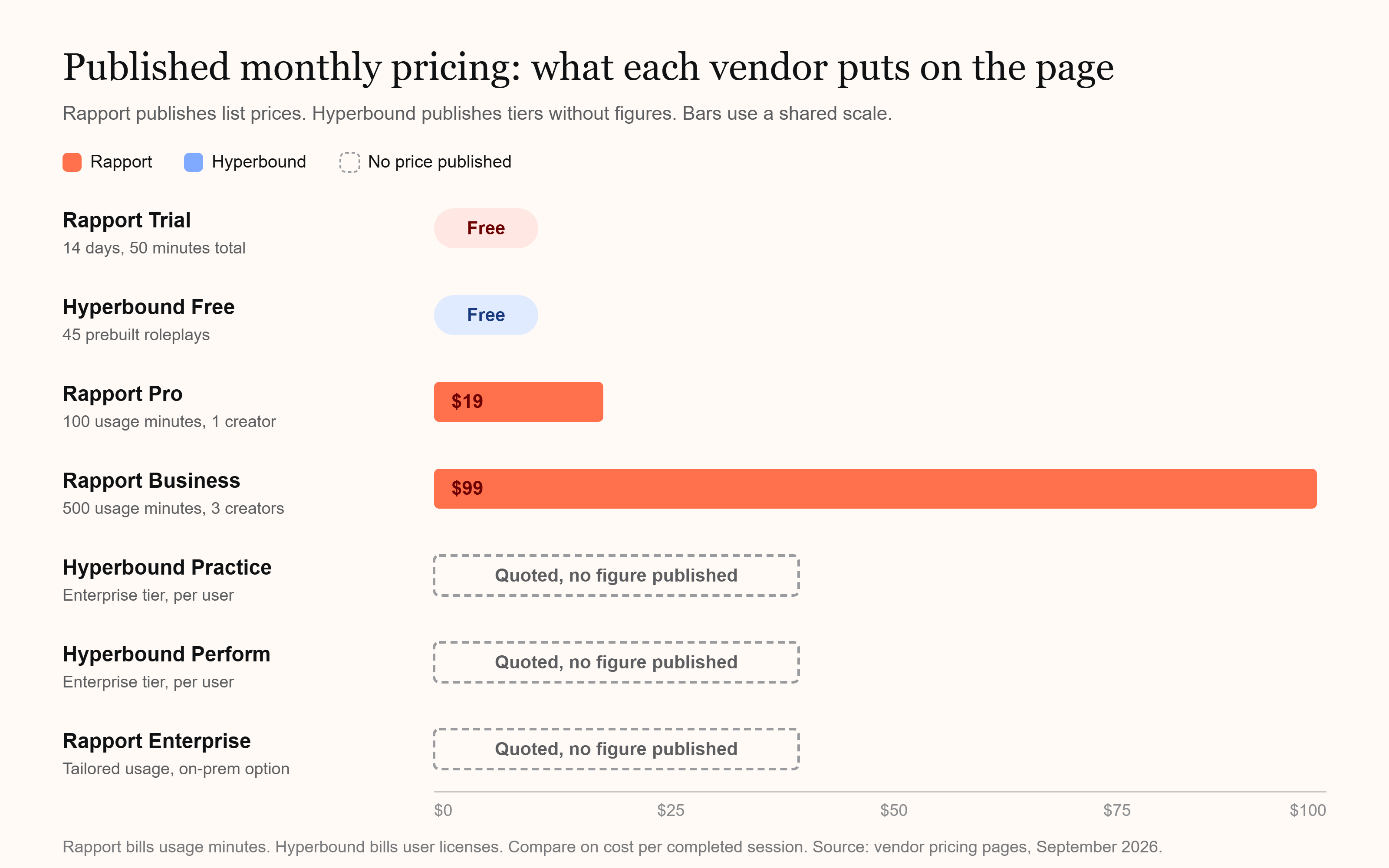
One of these vendors publishes prices. The other does not. That is not a scandal; it is a go-to-market choice, but it changes how you run the evaluation.
Hyperbound pricing
Free: 45 prebuilt AI roleplays and prebuilt example scorecards. Almost everything else, including the bot builder, analytics, integrations, SSO, and LMS delivery, sits outside this tier.
Practice Enterprise: AI roleplays, buyer bot customization, custom scorecards and coaching, Kota assistance, analytics, dedicated account and success management. Price on request.
Perform Enterprise: everything in Practice plus real call scoring, deal coaching, CRM intelligence, conversation intelligence, and call capture. Price on request.
Model: priced per user, with separate licenses for Practice and Perform. Volume discounts and multi-year savings are offered.
Add-ons that cost extra: live call coaching, data export API, EU data residency, and implementation services.
You will find third-party blogs quoting a starting figure of around $15,000 a year. Hyperbound does not publish that number, and the sites that repeat it label it as user-reported. Treat it as a rumor and get your own quote.
Rapport pricing
Trial: free for 14 days, 50 minutes of avatar conversation, no credit card.
Pro: $19 per month, 100 usage minutes, 1 creator, up to 5 workspaces.
Business: $99 per month, 500 usage minutes, 3 creators, unlimited workspaces, Rapport branding removed, role-based control, custom character uploads.
Enterprise: quoted. Tailored usage packages, unlimited creators and workspaces, professional services, prompt engineering support, custom branding and reporting, dedicated CSM, and on-premise or private cloud hosting.
Overage: $0.21 per minute above your allowance, against an effective included rate of $0.19 per minute.
How to compare two different pricing units
Rapport sells minutes. Hyperbound sells seats. A 200-rep team that practices twice a month looks cheap on minutes and expensive on seats. A 20-person team that practices daily flips that around. Run your own numbers before either vendor runs them for you.
Use this as your model:
Take your learner count, the number of practice sessions per learner per month, and average session length in minutes.
For a minutes-based quote, multiply all three, then multiply by the per-minute rate. Add expected overage at $0.21 per minute.
For a per-seat quote, multiply learner count by the quoted annual license, and ask whether managers, admins, and view-only reviewers consume a seat.
Add the extras that sit outside the tier on both sides: implementation, data residency, professional services, and any real call scoring licenses.
Divide both totals by the number of completed practice sessions you expect in year one. That single cost-per-completed-session number is the only fair comparison.
Bring that model to both demos. Vendors respond very differently to a buyer who already knows their own volume.
Use case fit, team by team
Forget the category name for a moment. Find the row that matches what your team actually does badly.
Your team | What you are actually training | Stronger fit |
SDRs and cold callers | Opening lines, gatekeepers, voicemails, and objection volume at speed | Hyperbound |
AEs running complex deals | Discovery depth, multi-stakeholder calls, methodology adherence, deal risk | Hyperbound |
Medical device and pharma reps | Reading a clinician in the room, value analysis committee pressure, credibility under scrutiny | Rapport |
Frontline managers | Performance conversations, conflict, delivering news someone does not want | Rapport |
Customer service and CX | De-escalation, empathy under pressure, staying steady with an angry person | Rapport |
New hire onboarding, revenue org | Ramp to first meeting and first closed deal, certification before live calls | Hyperbound |
New hire onboarding, non-sales | Policy, tone, and human handling in the first customer or patient interaction | Rapport |
Higher education and clinical programs | Bedside manner, counseling practice, interview preparation, language practice | Rapport |
Revenue ops and enablement leaders | Proving practice changed real call behavior and pipeline outcomes | Hyperbound |
If more than half your rows point one direction, you have your answer. If they split evenly, read the next section carefully, because you may be looking at two budgets rather than one decision.
Pick Rapport if, pick Hyperbound if, and when you need both
Pick Rapport if
The conversations you are training happen face to face, and noticing a reaction is the skill.
Your program covers more than sales: L&D, customer experience, clinical readiness, higher education, or leadership development.
Your security review starts with where the data lives, and an on-premise or private cloud option is the difference between a yes and a no.
You want published pricing you can budget against without a sales cycle, and usage-based billing suits a team that practices in bursts.
You need the avatar to carry your brand, your character design, or a specific language and voice pairing.
Pick Hyperbound if
You are buying for a revenue org, and the job is ramp time, cold call confidence, and methodology adherence.
You want practice and real call scoring in one place, with coaching that reacts to what happened on live deals.
Your stack already runs on Salesforce or HubSpot plus Gong or a similar recorder, and you want the roleplay data to land there.
Procurement treats SOC 2 Type II and ISO 27001 as a hard gate.
Your enablement team wants to build and edit scenarios themselves, weekly, without opening a services ticket.
When you genuinely need both
Some organizations do. A medical device company is the clearest example: the inside sales team needs cold call reps at volume, and the field team needs to hold a surgeon's attention across a table. A large bank is another: the contact center needs de-escalation practice with a face, and the commercial lending team needs deal execution scored against a methodology.
If that is you, do not try to force one tool to do both jobs badly. Split by audience, run both on annual terms, and revisit at renewal once you have a year of completion and improvement data from each.
How to evaluate both platforms: scorecard and demo questions
Score both platforms on the same ten criteria, weight them for your own program, and run the same nine questions on both demos. It takes an afternoon, and it removes most of the guesswork.
The 10-point evaluation scorecard
Criterion | What a 5 looks like | Suggested weight |
1. Conversation realism | The learner forgets it is a simulation within two minutes, and the AI reacts to how something was said, not just what was said | High |
2. Scenario ownership | Your own team builds and edits a new scenario end-to-end, in the demo, without vendor help | High |
3. Rubric control | You can define the scoring criteria in your own language and see exactly why a score was given | High |
4. Manager reporting | A manager sees improvement per person over time, not just completion counts | High |
5. LMS and delivery | Runs inside your existing LMS with completion data flowing back, no second login | Medium |
6. Identity and admin | SSO and automated provisioning with your identity provider, named in writing | Medium |
7. Data handling | Written answers on training use, retention periods, subprocessors, and residency | High |
8. Hosting fit | The deployment model matches what your security team will actually approve | Varies |
9. Cost modeling | The vendor can price your real volume, not a generic team, and shows the overage math | High |
10. Use case coverage | Covers every audience you plan to add in the next 18 months, not just the pilot group | Medium |
9 questions to ask on both demos
Build me a new scenario right now, from scratch, using my product and my buyer. How long did that take, and who did it?
Show me the scoring rubric as an admin sees it. What can I change, and what is fixed?
Play the same roleplay twice, once calm and once rattled, and show me what changed in the response and the score.
What happens when the learner goes completely off script or tries to break the simulation?
Show me the exact LMS delivery path, including SCORM version, what data comes back, and which tier it requires.
Is my data used to train your models, how long do you retain it, who are your subprocessors, and where does it sit?
Price my actual volume: this many learners, this many sessions a month, this long each. Show the overage or the seat math.
Show me the manager view for a team of 30 after two months, with real-looking improvement data.
What does implementation include, what costs extra, and who owns scenario building in month six?
Ask question seven in writing. Verbal answers on data handling do not survive a security review.
Switching from Hyperbound to Rapport
Most teams that move are not unhappy with Hyperbound. They outgrew the scope of it, usually because the training program expanded past the sales floor into managers, service teams, or clinical staff.
A switch that goes well looks like this:
Export what you already have. Pull your scorecard criteria, your persona definitions, and your completion data out of Hyperbound before the contract ends. The criteria are the valuable part, because they encode what good actually looks like at your company.
Map criteria to competencies. Hyperbound criteria are usually written as call behaviors. Rapport scores competencies such as active listening, empathy, and clarity. Rewrite each criterion as the underlying behavior, then confirm how it will be scored.
Rebuild your top five scenarios first. Not all 40. The five that account for most of the practice volume, so you can compare like for like against your Hyperbound baseline.
Run both for one quarter. Keep the sales floor on Hyperbound while the new audience runs on Rapport. Compare completion rate, attempts per learner, and improvement between first and last attempt.
Confirm delivery early. Get the SCORM package into your LMS in week one, not week ten. Delivery is where migrations stall, not content.
Decide at renewal with data. By then you will know whether you have one program or two, and the answer is often two.
Going the other direction works the same way, and there is no shame in it. If your program narrowed to pure pipeline execution, the tool built for pipeline execution is the right tool.
Want to see how your own scenario behaves with a face on the other side of it? Try a live role play or book a demo and bring one real conversation your team keeps getting wrong.
Frequently asked questions
Is Rapport a good Hyperbound alternative?
It depends on what you are training. Rapport is a strong alternative when the conversations happen face-to-face, and the skill is reading a person: manager conversations, de-escalation, clinical communication, and field sales.
It is a weaker alternative if you specifically want cold call volume practice wired into a CRM, which is what Hyperbound was built for.
What is the main difference between Rapport and Hyperbound?
Rapport animates a 3D avatar's face in real time, from audio, so the learner practices against a reaction.
Hyperbound runs a voice-first simulated call with a static persona photo, and adds real call scoring on top. One trains the human moment, the other trains the sales motion.
Does Hyperbound have a free plan?
Yes. The free tier includes 45 prebuilt AI roleplays and prebuilt example scorecards. The bot builder, analytics, integrations, SSO, and LMS delivery are not included in it.
How much does Hyperbound cost?
Hyperbound does not publish prices. Both paid tiers, Practice Enterprise and Perform Enterprise, are quoted, and the model is per user with separate licenses for practice and real call scoring.
Third-party blogs quote a starting figure around $15,000 a year, but Hyperbound does not confirm it, so get your own quote.
How much does Rapport cost compared to Hyperbound?
Rapport publishes its pricing: a free 14-day trial with 50 minutes, $19 per month for Pro with 100 usage minutes, $99 per month for Business with 500 usage minutes, and a quoted Enterprise tier.
Because Rapport bills minutes and Hyperbound bills seats, compare them on cost per completed practice session rather than on headline price.
Can you use Rapport and Hyperbound together?
Yes, and some organizations should. A common split is Hyperbound for the inside sales floor and Rapport for field teams, managers, and customer-facing staff whose hardest moments happen in person. Split by audience rather than trying to make one platform cover both jobs.
Is Hyperbound SOC 2 compliant?
Hyperbound publishes SOC 2 Type II along with ISO 27001, GDPR, and HIPAA, and states that customer data is not used to train its models. Rapport does not publish a SOC 2 certification on its public site, and operates under UK GDPR and the Data Protection Act 2018. Ask both vendors for their current security pack in writing.
Which platform is better for sales enablement?
For inside sales and pipeline execution, Hyperbound. For field sales where the buyer is sitting in front of you, and for regulated selling such as medical devices, Rapport. The deciding question is whether your reps lose deals on the phone or in the room.
What can teams practice with Rapport?
Sales conversations and objection handling, leadership and manager readiness, difficult employee conversations, customer complaint handling, employee onboarding, clinical and bedside communication, counseling practice, language practice, and interview preparation.