Rapport vs Zenarate: Which AI Roleplay Platform Works Best for Your Business?
Rapport vs Zenarate comes down to one question: do you want a vendor that builds the avatar, or one that integrates someone else's? Both run AI role play. Only one owns the face your learner is reading.
September 1, 2026
Key takeaways
Zenarate does not build its own avatars. Its avatar simulations run on integrations with HeyGen and Synthesia. Rapport builds the animation itself, driving a 3D face from the learner's audio at roughly 50ms. That is a difference in what each company owns, not just in what each product shows.
Zenarate's default is voice and chat, not a face. It ships three simulation engines: branching NLP, generative, and avatar-based, with the avatar mode positioned for roles where reading the room matters. Most contact center deployments run on the first two.
Zenarate is the broader platform. Four products cover simulation, real call QA across up to 100 percent of calls, coaching in the flow of work, and production AI agents. Rapport does one thing and delivers it in more places.
Read the security wording carefully. Zenarate says it follows the SOC 2 framework, which is not the same as holding a SOC 2 Type 2 report, and its data is stored in the United States only. Rapport publishes no certifications either, and offers on-premise and private cloud hosting.
Only one of them publishes a price. Rapport lists a free 14 day trial, $19 per month Pro, and $99 per month Business. Zenarate publishes no pricing, no tiers, and no free trial.

Rapport vs Zenarate at a glance
These two products are aimed at different buyers, and comparing them fairly means saying so early.
Zenarate sells a frontline performance platform to large contact centers. Rapport sells a believable face you can put almost anywhere. Everything below follows from that.
Comparison point | Rapport | Zenarate |
Core approach | Interactive AI avatar roleplay with real-time facial animation driven by audio | A four-product frontline platform: simulation, real call analysis, coaching, and production AI agents |
Roots | Facial animation research at Speech Graphics, Edinburgh, founded 2009, spun out as Rapport in 2019 | Founded 2016 in Palo Alto by Brian Tuite and Rab Govil, built for contact center agent training |
Who builds the avatar | Rapport does. The animation engine is its own technology | Third parties. Avatar simulations run on integrations with HeyGen and Synthesia |
Default learner experience | A 3D avatar whose expression changes as the conversation moves | Voice or chat simulation, with optional software simulation running at the same time. Avatars are a separate mode |
Simulation engines | One. Generative conversation driving live facial animation | Three. Branching NLP for controlled or restricted environments, generative, and avatar-based |
Real call analysis | Not offered. Practice and reporting only | Yes, through Zenarate Analyze, with automated QA across up to 100 percent of calls |
Languages | Supported through speech-to-text and text-to-speech integrations. Site figures range from 35+ to 50+ | 79 languages across the interface, transcription, coaching, and text-to-speech |
Named customers | KDDI, Qualcomm, NBC, NEC, Boise State University, Heriot-Watt University, UC San Francisco | Nationwide, Comcast, Verizon, Marriott, Capital One, USAA, CVS, HSBC, Foundever, Teleperformance |
Scale proof | 610,000+ role plays completed by customers | 10 million+ AI simulations delivered, 4.9 on G2 from 33 reviews |
Integrations | 18 published, oriented to AI, speech, and 3D engines | Claims 100+ across HRIS, LMS, WFM, and CRM, but names only HeyGen, Synthesia, Teams, Slack, and Credly publicly |
Security posture | UK GDPR and Data Protection Act 2018, no certifications published, on-premise and private cloud on Enterprise | Follows the SOC 2 framework rather than holding a stated certification, GDPR compliant, data stored in the United States only |
Entry pricing | Free 14-day trial with 50 minutes, then $19 per month | Nothing published. No tiers, no figures, no free trial |
Best known for | Believable faces in high-stakes, emotionally loaded conversations | Certifying thousands of contact center agents before they take a live call |
All pricing, customer, and security claims on this page were read from each vendor's own website. Vendors change these pages often, so re-verify before you quote anything in a board deck.
Origin story
A platform's origin story is not marketing trivia. It predicts what the product is good at three years later, because the hardest engineering problem a company solves first tends to stay its moat.
Where Rapport came from
Speech Graphics was founded in Edinburgh in 2009 and spent a decade solving one problem: making a digital face move correctly from audio. That work shipped in blockbuster games, and it is why the avatar reacts instead of miming.
Rapport spun out in 2019, launched a self-serve platform in July 2024, and acquired Aquifer Motion in October 2025 to add full-body animation and cinematic camera tools. The company runs from Edinburgh with offices in San Francisco, Austin, Budapest, and Singapore.
Where Zenarate came from
Zenarate was founded in 2016 in Palo Alto by Brian Tuite and Rab Govil, and the original product was AI Coach: a branching simulation an agent could run in a browser with a headset and no IT involvement. That constraint shaped the product, and it is why so much of the platform still works without a face.
It raised a $15 million round led by Volition Capital in June 2023, bringing total funding to about $18 million, and acquired the immersive learning vendor Bright in September 2024.
Bright is where the current Learn experience came from, and Bright's founder became Zenarate's chief product and marketing officer. The company now runs roughly 150 people across Palo Alto, Denver, Maryland, London, India, and Uruguay.
Read those two paragraphs again and the roadmaps write themselves. One company spent fifteen years making a face behave correctly. The other spent nine years making a training program work at contact center scale, and buys its faces in.
The core difference: an animation engine vs an integration
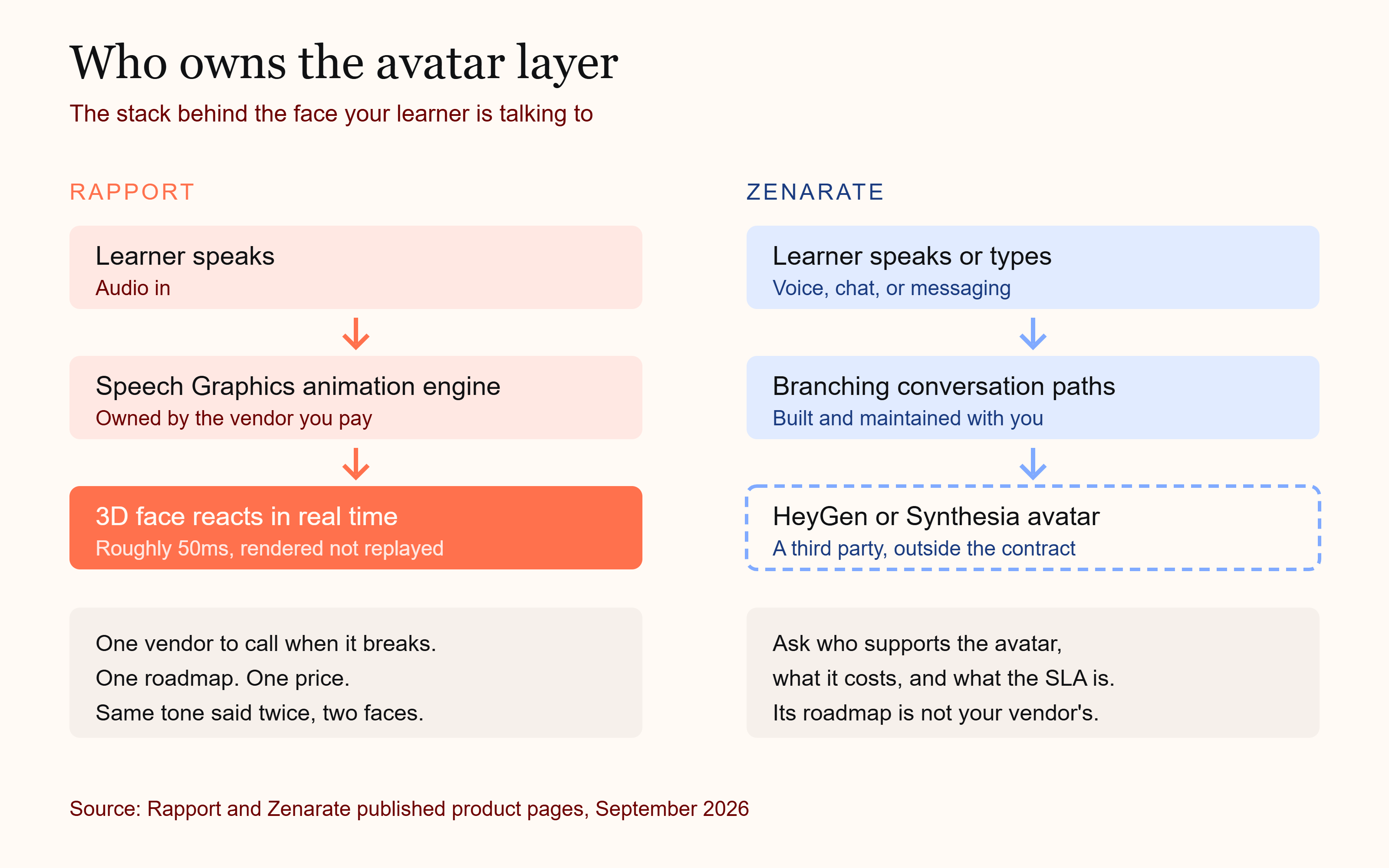
Strip away the feature lists, and one difference decides most evaluations. Rapport builds the avatar. Zenarate integrates one.
What Zenarate does
Runs AI Coach simulations in voice, chat, or messaging, with branching conversation paths built on natural language understanding for contact center and customer-facing roles.
Supports 79 languages, which is the widest published language coverage in this comparison and the reason many global BPOs shortlist it.
Adds avatar-based simulations through integrations with HeyGen and Synthesia rather than through an engine Zenarate owns.
Scores real recorded customer calls through Analyze, then points agents back into targeted practice based on what the QA found.
Bundles a learning experience platform, Learn, from its 2024 acquisition of Bright, so courses, simulations, and QA sit in one system.
What Rapport does
Renders a 3D avatar live, with facial animation driven by the learner's audio at roughly 50ms, so the reaction lands while the learner is still speaking.
Owns the animation engine outright, through Speech Graphics, which is the same technology used in AAA game production.
Uses real-time rendering rather than pre-rendered video, so the same sentence said calmly and said sharply produces two different faces.
Lets you pick character, voice, language, and AI behavior, with characters from a built-in library, MetaHuman, Ready Player Me, or your own upload.
Ships as a hosted link, an iframe, a web widget, a SCORM 1.2 package, or an Unreal Engine integration.
Why owning the engine matters
An integrated avatar is a video asset. It plays a face while audio runs. A rendered avatar is a live character whose expression is generated from the sound of the learner's voice in the same moment.
That distinction is invisible on a feature checklist and obvious in a demo. Ask both vendors to run the same script twice, once steady and once flustered, and watch whether the face changes. If it does not, you are training words and tone, not the moment.
It also matters commercially. When a third party owns the avatar layer, its pricing, its language list, its uptime, and its roadmap sit outside your vendor's control. Ask who you call when the avatar breaks.
The statistic to take out of your business case
Almost every customer experience business case contains a version of this line: 86 percent of buyers will pay more for a better customer experience. It shows up in agent training decks constantly. Take it out.
Trace it, and the trail runs from vendor blog to vendor blog, each citing the other, most eventually gesturing at a survey commissioned by a software company more than a decade ago.
The sample, the wording of the question, and the industries covered are almost never quoted alongside the number, because almost nobody repeating it has read the source.
Worth checking before your next business case
The problem is not that customer experience fails to matter. It plainly does. The problem is that a stated willingness to pay more, collected in a survey, is not evidence that your contact center will move revenue by changing how agents talk.
Your CFO knows the difference, and a number that dissolves under one search weakens the rest of your case.
Here is the stronger argument, built on numbers you already own:
Speed to proficiency is measurable. You know your current ramp time to full productivity. Both platforms report practice volume per agent, so you can show what changed.
Improvement between attempts is measurable. Rapport reports first attempt versus last attempt by competency. Zenarate reports simulation scores over time and, through Analyze, movement on real calls.
Attrition is measurable. Contact center attrition is expensive and already tracked. Confidence before the first live call is a defensible lever on it.
Quality scores are measurable. Your QA program already scores real calls. That baseline is the honest before-and-after.
Buy the platform on numbers your own systems produce. Borrowed statistics are a liability in a procurement review, not an asset.
The four layers of a conversation, and which one each platform measures
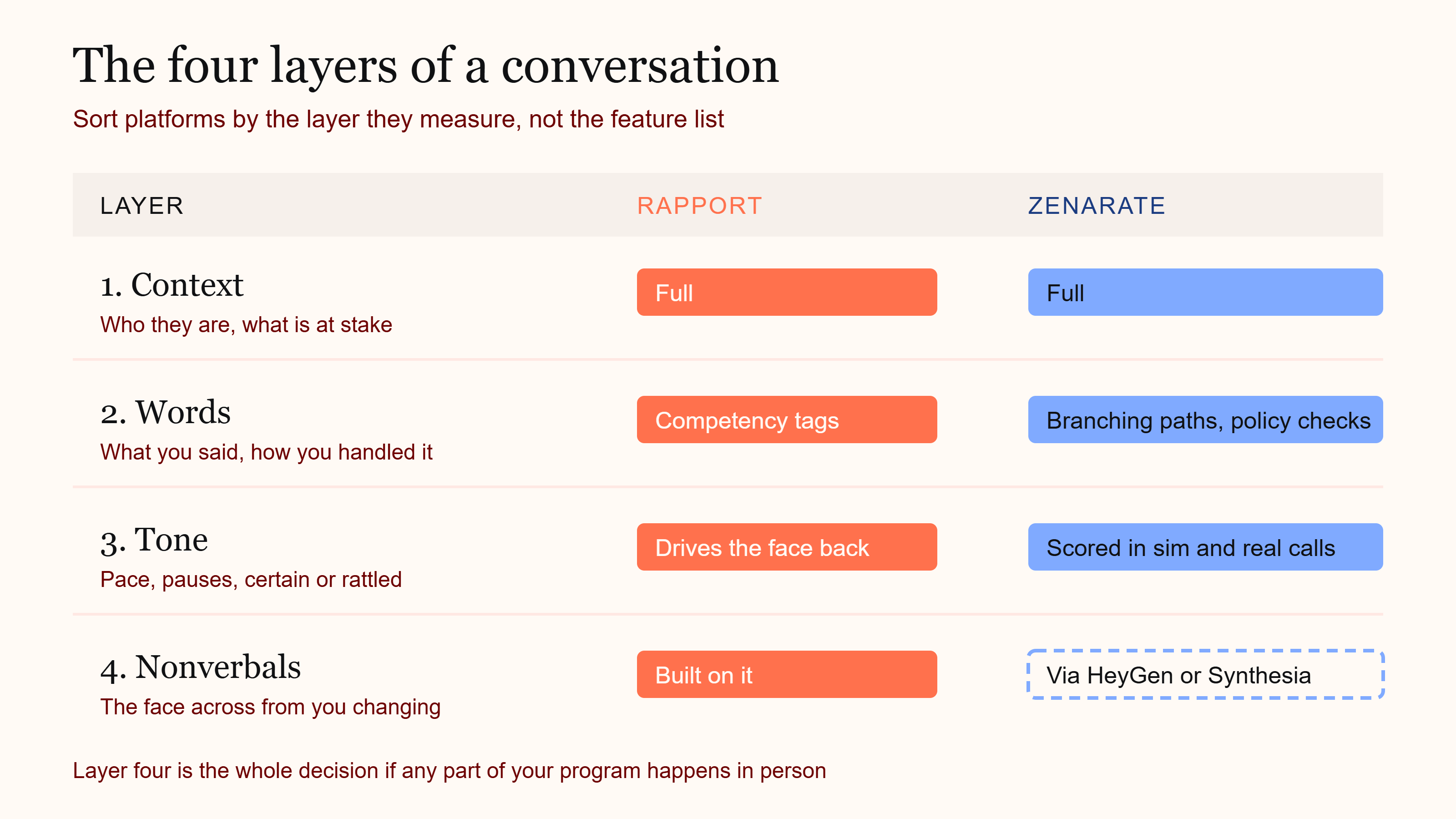
Every conversation runs on four layers at once. Sorting platforms by which layer they measure is faster than sorting them by feature list.
Context. Who is this person, what do they want, what is at stake, what happened last time.
Words. What you actually said, the questions you asked, the objections you handled, the process you followed.
Tone. Pace, pauses, energy, whether you sounded certain or rattled.
Nonverbals. The face across from you, and whether you noticed it change.
Both platforms cover context and words well.
Zenarate covers them with branching conversation paths and role-specific scenario libraries built for contact center work, which matters when the job is policy accuracy and process adherence.
Rapport covers them with competency tags such as active listening, empathy, and clarity, which matters when the job is behavior.
Both handle tone. Zenarate scores speech attributes inside the simulation and inside real calls. Rapport drives the avatar's expression from the learner's audio, so tone changes what comes back at them rather than only what gets scored afterward.
Layer four is where they separate. Rapport is built on it. Zenarate reaches it through HeyGen and Synthesia integrations, which delivers a face on screen but not a face that reacts to how something was said.
If your agents work by phone and chat only, layer four may not matter to you at all, and that is a legitimate reason to prefer Zenarate.
If any part of your program is face to face, it is the whole decision.
Who builds and maintains the scenarios
Scenario ownership is the quietest line item in an AI roleplay contract and the one most likely to hurt you in month four. Ask who builds scenario number 40, not scenario number one.
How Zenarate builds a scenario
Zenarate is a services-supported enterprise platform. Its published model leans on a dedicated team building and maintaining simulations with you rather than an enablement lead building them alone in an afternoon.
Simulations are built as branching conversation paths, so a scenario is a designed decision tree rather than a free-form prompt.
Zenarate publishes a large prebuilt library across contact center, sales, and customer service roles, in 79 languages.
Customers get a named customer success team, and content build support is part of how the platform is sold.
The trade-off appears in public reviews. Recurring themes on G2 include simulations feeling rigid or linear, and content maintenance being a real ongoing effort as products and policies change.
How Rapport builds a scenario
Rapport is where you should ask the hardest questions on this topic, because the marketing site and the product documentation do not currently agree.
The platform ships a scenario template library sorted by domain, covering learning and development, sales, and customer experience, and templates save to a personal library.
The documentation states that scenario configuration fields are visible but not yet editable, with custom scenario creation listed as a roadmap item.
Enterprise contracts include professional services and prompt engineering support, which is how bespoke scenarios get built today.
Scenario fields, once editable, cover character, learner and avatar roles, situation context, learner objectives, and the competencies to measure.
What this means for your evaluation
Neither platform is currently a self-serve scenario builder in the way a sales enablement tool is. Both lean on services. So the question is not who lets you build faster, it is whose services model fits your program.
If you need hundreds of process-accurate simulations across many languages and you want a vendor team maintaining them, Zenarate's model is the one built for that.
If you need a smaller set of very high-fidelity human moments configured well, Rapport's Enterprise services model fits, and regulated buyers often prefer it.
Either way, get a written answer on turnaround time for a scenario change. Ask how long a policy update takes to reach production.
Analytics and reporting compared
Both platforms produce reports. They answer different manager questions, and the difference is easiest to see side by side.
Question a manager asks | Zenarate answers with | Rapport answers with |
Did the agent follow our process? | Scoring against branching conversation paths and role-specific criteria, plus policy and compliance checkpoints inside the simulation | Per-metric competency scores such as active listening, empathy, and clarity |
Is anyone actually improving? | Simulation scores over time per agent, with practice volume and completion tracked in the Learn LXP | A first attempt versus last attempt view, plus average overall score and attempts per learner by cohort |
Where is the team weakest? | Aggregate performance across cohorts and skills, with QA findings from real calls feeding the gaps | Performance by metric, top competencies, and improvement areas across the cohort |
Did the practice change the real call? | Yes. Analyze scores real recorded customer conversations and links them back to practice assignments | Not answered inside the platform. Practice scores only |
Is the program being used? | Learn LXP reporting across courses, simulations, and certifications in one place | Scenarios completed, attempts per learner, and average duration, filtered by cohort, scenario, and timeframe |
Two honest caveats...
Zenarate's reporting is broader, because it spans practice, QA, and formal learning, but reviewers on G2 repeatedly describe the reporting itself as basic and ask for deeper drill-down.
Rapport's reporting is narrower on purpose, covering practice only, and it does not claim to score live customer calls.
The summary: Zenarate measures whether an agent executed a process, across the whole training lifecycle. Rapport measures whether a person handled a human moment.
If your program manager reports to a head of contact center operations, the first is easier to defend. If they report to a head of L&D or a clinical education lead, the second is closer to the job.
Deployment, delivery, and integrations
This is where deals slow down. Both vendors will say yes to enterprise delivery. The details differ, and the details are what your IT team will ask about.
Requirement | Rapport | Zenarate |
LMS delivery | SCORM 1.2 package, uploaded or linked like any other course, with completion and progress flowing into existing dashboards. Published reach of 100+ LMS systems, including Canvas, Blackboard, and Moodle | Ships its own LXP, Learn, from the Bright acquisition, so it can replace an LMS rather than plug into one. Confirm in writing what integration exists with an LMS you intend to keep |
Identity management | SSO stated on the platform page. Protocol, providers, and tier gating are not published, so confirm in writing | SSO and SCIM provisioning published, which suits large agent populations with high turnover |
Language coverage | Multiple languages with voice and character pairing, count not published as a headline figure | 79 languages, the widest published coverage in this comparison |
Avatar layer | Owned. Real-time 3D rendering through Speech Graphics | Delivered through HeyGen and Synthesia integrations rather than an in-house engine |
Embedding | Hosted public link, iframe, web widget via an HTML and JavaScript snippet, or a game engine build with deploy tokens | Browser-based platform. Embedding options are not published in detail, so ask |
Hosting options | Cloud, on-premise, or private cloud on the Enterprise tier | Cloud, with customer data stored in the United States according to its published security page |
Two things to take from that table.
Zenarate is the one built for scale across a large, multilingual agent population, with the identity plumbing to match.
Rapport is the one that will run inside a hospital network or a defense contractor's own environment, and the one that slots into an LMS you already have rather than asking you to adopt another platform.
One question worth asking Zenarate directly: if you already run Cornerstone, Docebo, or Workday Learning, what does the integration look like, and does Learn become a second system your admins maintain?

Security and compliance
Be straight with your security team about this one, because the two vendors publish different amounts of detail, and neither publishes everything.
Knowing the gaps early makes the review shorter rather than harder.
Zenarate security
Its security page states that Zenarate follows the SOC 2 framework. Read that wording carefully. Following a framework is not the same as holding a completed SOC 2 Type II attestation, so ask for the report itself and the audit date.
Publishes SSO and SCIM provisioning, which matters for large agent populations.
States that customer data is stored in the United States, which is a clear answer and a limitation depending on where you operate.
Gaps to press on: no published ISO 27001 certification, no published HIPAA claim, and no public statement on whether customer data is used to train models. That last one belongs in your first email, not your last.
Rapport security
States that your data stays yours, is encrypted, stored securely, and is never sold or used to train AI models.
Operates under UK GDPR and the Data Protection Act 2018 as Speech Graphics Ltd, registered in Scotland, with an outsourced data protection officer.
Uses EU Standard Contractual Clauses with the UK Addendum for international transfers.
States it does not collect special category data, children's data, or criminal conviction data, and does not use personal data for automated decision-making or profiling.
Offers on-premise and private cloud hosting on the Enterprise tier, which is the strongest control available in this comparison for regulated buyers.
Publishes its cybersecurity details in the product documentation. Gaps to press on: no SOC 2, ISO 27001, or HIPAA certification is published on the public site, and there is no public trust center. Ask for the current security pack under NDA rather than assuming either way.
How to handle this in a real evaluation
If your procurement team treats a completed SOC 2 Type II report as a hard gate, ask both vendors for the report in writing at the start of the process. Neither one publishes it openly.
If your gate is model training, Rapport publishes a direct answer, and Zenarate does not. Get Zenarate's answer in a contract clause, not an email.
If your gate is sovereignty, meaning data cannot leave your environment or your region, Rapport is the only one of the two publishing an on-premise option, and Zenarate's US-only storage is a fixed constraint to check against your policy.
What each one costs
One of these vendors publishes prices. The other does not. That is not a scandal, it is a go-to-market choice, but it changes how you run the evaluation.
Zenarate pricing
No published pricing. There are no tiers, no per-seat figure, and no per-simulation figure on the Zenarate site.
No free trial or free tier is published. Access starts with a demo and a sales conversation.
Deals are enterprise-shaped, typically annual, sized to agent population, language coverage, and which modules you take: AI Coach, Analyze, and Learn are separate capabilities.
Third-party figures you may find quoted online are not confirmed by Zenarate. Treat them as rumor and get your own quote.
Ask specifically whether avatar simulations carry a separate cost, since that layer runs on HeyGen or Synthesia rather than Zenarate's own engine.
Rapport pricing
Trial: free for 14 days, 50 minutes of avatar conversation, no credit card.
Pro: $19 per month, 100 usage minutes, 1 creator, up to 5 workspaces.
Business: $99 per month, 500 usage minutes, 3 creators, unlimited workspaces, Rapport branding removed, role-based control, custom character uploads.
Enterprise: quoted. Tailored usage packages, unlimited creators and workspaces, professional services, prompt engineering support, custom branding and reporting, dedicated CSM, and on-premise or private cloud hosting.
Overage: $0.21 per minute above your allowance, against an effective included rate of $0.19 per minute.
How to compare two different pricing units
Rapport sells minutes. Zenarate sells an enterprise contract sized to headcount and modules. A 2,000 agent contact center looks impossible on minutes and normal on an enterprise agreement. A 30-person leadership program flips that around completely.
Use this as your model:
Take your learner count, the number of practice sessions per learner per month, and average session length in minutes.
For a minutes-based quote, multiply all three, then multiply by the per-minute rate. Add expected overage at $0.21 per minute.
For an enterprise quote, ask for the price at your headcount, then ask what happens at plus 20% and minus 20% headcount, since contact center volume moves.
Add the extras that sit outside the base on both sides: implementation, professional services, content build and maintenance, additional languages, avatar simulations, and QA module licensing.
Divide both totals by the number of completed practice sessions you expect in year one. That single cost-per-completed-session number is the only fair comparison.
Bring that model to both demos. Vendors respond very differently to a buyer who already knows their own volume.
Which platform fits your use case
Forget the category name for a moment. Find the row that matches what your team actually does badly.
Your team | What you are actually training | Stronger fit |
Contact center agents at scale | Policy accuracy, process adherence, and handling volume across many languages | Zenarate |
Global BPO operations | Consistent quality across sites and languages, with QA tied to practice | Zenarate |
New agent onboarding | Confidence and competence before the first live customer call | Zenarate |
Medical device and pharma reps | Reading a clinician in the room, committee pressure, credibility under scrutiny | Rapport |
Frontline managers | Performance conversations, conflict, delivering news someone does not want | Rapport |
Field sales teams | In-person discovery, reading the room, adjusting when a face changes | Rapport |
Higher education and clinical programs | Bedside manner, counseling practice, interview preparation, language practice | Rapport |
Quality and compliance teams | Scoring real customer calls and closing the loop into targeted practice | Zenarate |
L&D teams building a broad program | Human skills across many roles, delivered through an LMS you already own | Rapport |
If more than half your rows point one direction, you have your answer. If they split evenly, read the next section carefully, because you may be looking at two budgets rather than one decision.
The decision guide
Pick Rapport if
The conversations you are training happen face-to-face, and noticing a reaction is the skill.
You want the avatar layer owned by the vendor you are paying, with real-time facial animation rather than a third-party video integration.
Your program covers more than the contact center: L&D, field sales, clinical readiness, higher education, or leadership development.
Your security review starts with where the data lives, and an on-premise or private cloud option is the difference between a yes and a no.
You want published pricing you can budget against without a sales cycle, and delivery into the LMS you already run.
Pick Zenarate if
You are training a large contact center population, and consistency across sites matters more than nonverbal nuance.
You need broad language coverage. 79 languages is a real differentiator, and nobody else in this comparison publishes a number close to it.
You want practice, real-call QA, and formal learning in one platform rather than three.
You have high agent turnover and need SCIM provisioning and SSO to keep up with it.
You want a vendor team building and maintaining simulation content with you rather than owning that work internally.
When you genuinely need both
Some organizations do. A large bank is the clearest example: the contact center needs thousands of process-accurate simulations in several languages, and the commercial banking team needs to hold a room.
A health system is another: patient access agents work by phone, and clinical staff deliver news face to face.
If that is you, do not try to force one tool to do both jobs badly.
Split by audience, run both on annual terms, and revisit at renewal once you have a year of completion and improvement data from each.
Your evaluation scorecard and demo questions
Score both platforms on the same ten criteria, weight them for your own program, and run the same nine questions on both demos. It takes an afternoon, and it removes most of the guesswork.
The 10-point evaluation scorecard
Criterion | What a 5 looks like | Suggested weight |
1. Conversation realism | The learner forgets it is a simulation within two minutes, and the AI reacts to how something was said, not just what was said | High |
2. Who owns the avatar | The vendor owns the rendering layer, or can name the third party, its cost, and who you call when it breaks | High |
3. Scenario ownership | You know exactly who builds scenario 40, how long a policy change takes to reach production, and what it costs | High |
4. Rubric control | You can define the scoring criteria in your own language and see exactly why a score was given | High |
5. Manager reporting | A manager sees improvement per person over time, not just completion counts, and can drill into a single attempt | High |
6. Delivery fit | Runs inside your existing LMS with completion data flowing back, or replaces it cleanly. No second system nobody maintains | Medium |
7. Identity and admin | SSO and automated provisioning with your identity provider, named in writing | Medium |
8. Data handling | Written answers on model training, retention periods, subprocessors, and residency | High |
9. Cost modeling | The vendor can price your real volume, not a generic team, and shows what happens when headcount moves | High |
10. Use case coverage | Covers every audience you plan to add in the next 18 months, not just the pilot group | Medium |
9 questions to ask on both demos
Play the same simulation twice, once calm and once rattled, and show me what changed in the response and the score.
Who renders the avatar? If it is a third party, what does it cost, what is the SLA, and who supports it?
Build me a new scenario using my product, my policy, and my customer. How long did that take, and who did it?
A policy changes on Monday. When is the updated simulation live, and does that come out of my budget?
Show me the scoring rubric as an admin sees it. What can I change, and what is fixed?
Is my data used to train your models, how long do you retain it, who are your subprocessors, and where does it sit?
Show me your completed SOC 2 Type II report and its audit date, not a statement about following a framework.
Price my actual volume: this many learners, this many sessions a month, this long each. Show me the number at plus and minus 20 percent headcount.
Show me the manager view for a team of 30 after two months, with real-looking improvement data, and let me drill into one attempt.
Ask questions six and seven in writing. Verbal answers on data handling do not survive a security review.
Switching from Zenarate to Rapport
Most teams that move are not unhappy with Zenarate.
They outgrew the scope of it, usually because the training program expanded past the contact center into managers, field teams, or clinical staff whose hardest moments happen in person.
A switch that goes well looks like this:
Export what you already have. Pull your scoring criteria, your simulation scripts, and your completion data out of Zenarate before the contract ends. The criteria are the valuable part, because they encode what good actually looks like at your company.
Separate the branching logic from the behavior. Zenarate scenarios are decision trees. Rapport scores competencies such as active listening, empathy, and clarity. Rewrite each branch as the underlying behavior you wanted the agent to show, then confirm how it will be scored.
Rebuild your top five scenarios first. Not all 200. The five that account for most of the practice volume, so you can compare like for like against your Zenarate baseline.
Decide what happens to Learn. If your courses live in Zenarate's LXP, plan where they land. This is the step that surprises people, and it is worth mapping in week one.
Run both for one quarter. Keep the agent floor on Zenarate while the new audience runs on Rapport. Compare completion rate, attempts per learner, and improvement between first and last attempt.
Confirm delivery early. Get the SCORM package into your LMS in week one, not week ten. Delivery is where migrations stall, not content.
Decide at renewal with data. By then you will know whether you have one program or two, and the answer is often two.
Going the other direction works the same way, and there is no shame in it.
If your program narrowed to high-volume contact center practice across many languages, the tool built for that is the right tool.
Want to see how your own scenario behaves with a face on the other side of it? Try a live role play or book a demo and bring one real conversation your team keeps getting wrong.
Rapport vs Zenarate FAQ
Is Rapport a good Zenarate alternative?
It depends on what you are training. Rapport is a strong alternative when the conversations happen face-to-face, and the skill is reading a person: manager conversations, field sales, clinical communication, and leadership development.
It is a weaker alternative if you need thousands of contact center simulations across dozens of languages, which is what Zenarate was built for.
What is the main difference between Rapport and Zenarate?
Rapport owns its avatar engine and animates a 3D face in real time from the learner's audio, so the learner practices against a reaction.
Zenarate is a voice, chat, and branching simulation platform for contact centers, and delivers avatar simulations through HeyGen and Synthesia integrations rather than an engine it built.
Does Zenarate have a free plan or a free trial?
No free plan or free trial is published on the Zenarate site. Access starts with a demo request.
Rapport publishes a free 14-day trial with 50 minutes of avatar conversation and no credit card required.
How much does Zenarate cost?
Zenarate does not publish pricing. There are no tiers or per-seat figures on its site, and deals are quoted as enterprise agreements sized to agent population, language coverage, and which modules you take.
Any figure you find on a third-party blog is unconfirmed, so get your own quote.
How much does Rapport cost compared to Zenarate?
Rapport publishes its pricing: a free 14-day trial with 50 minutes, $19 per month for Pro with 100 usage minutes, $99 per month for Business with 500 usage minutes, and a quoted Enterprise tier.
Because Rapport bills minutes and Zenarate quotes an enterprise contract, compare them on cost per completed practice session rather than on headline price.
Is Zenarate SOC 2 certified?
Zenarate's security page states that it follows the SOC 2 framework, which is not the same as publishing a completed SOC 2 Type II attestation.
Ask for the report and the audit date. Zenarate also does not publish an ISO 27001 certification, a HIPAA claim, or a statement on whether customer data is used to train models.
Rapport does not publish a SOC 2 certification either, and states that customer data is never used to train AI models.
How many languages does Zenarate support?
Zenarate publishes support for 79 languages, the widest coverage in this comparison. If multilingual delivery is your main constraint, that number is the strongest single argument in its favor.
Can you use Rapport and Zenarate together?
Yes, and some organizations should. A common split is Zenarate for the contact center floor and Rapport for field teams, managers, and clinical staff whose hardest moments happen in person.
Split by audience rather than trying to make one platform cover both jobs.
Which platform is better for contact center training?
Zenarate, in most cases. It was built for that population, it has the language coverage, the provisioning, and the real-call QA loop through Analyze.
Rapport becomes the better answer when your contact center program extends into supervisor coaching, in-person escalation, or a wider L&D program.
What can teams practice with Rapport?
Sales conversations and objection handling, leadership and manager readiness, difficult employee conversations, customer complaint handling, employee onboarding, clinical and bedside communication, counseling practice, language practice, and interview preparation.