How to Sell to a Hospital Value Analysis Committee (And How to Practice It First)
A value analysis committee is the last room your device has to survive before it gets on contract. Six people, six different definitions of value, one meeting. Here is what each seat is actually weighing, where reps lose the room, and how enablement teams rehearse the panel before it is real.
August 28, 2026
Key takeaways
A value analysis committee is a multidisciplinary hospital panel that reviews and approves new medical products before they can be purchased.
The committee is not one audience. A surgeon is weighing clinical outcome, finance is weighing cost per case, and supply chain is weighing contract fit. The same slide lands differently in each seat.
Most submissions do not fail at the vote. They fail the completeness screen, get returned, and lose a full committee cycle.
Four failure modes recur: pitching clinical benefit to an economic seat, quoting list price, having no answer on training burden, and treating the panel as a presentation rather than a cross-examination.
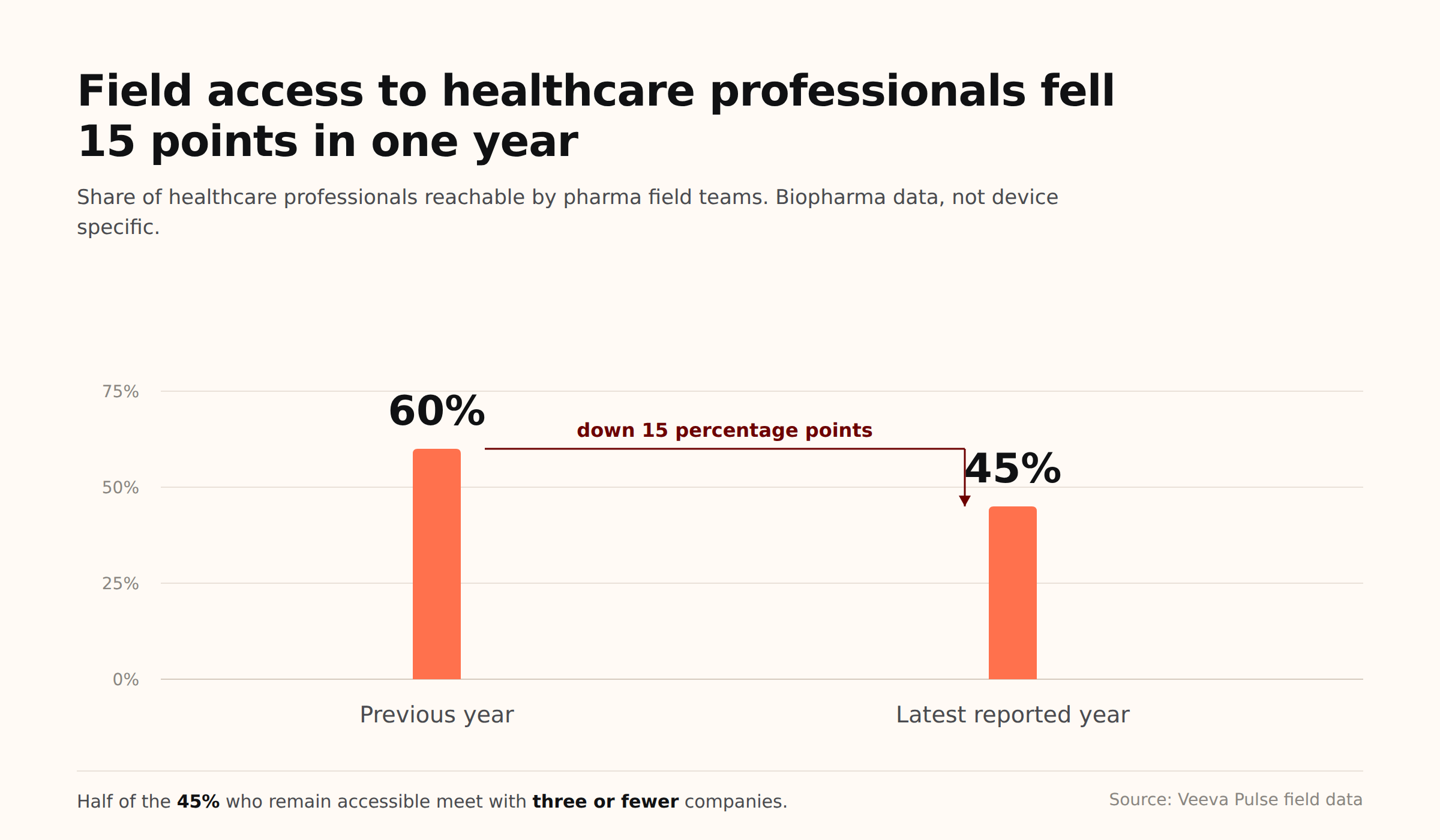
Field access is contracting. Veeva Pulse data puts healthcare professional accessibility at 45%, down from 60% the previous year, and half of those who are still accessible meet with three or fewer companies.
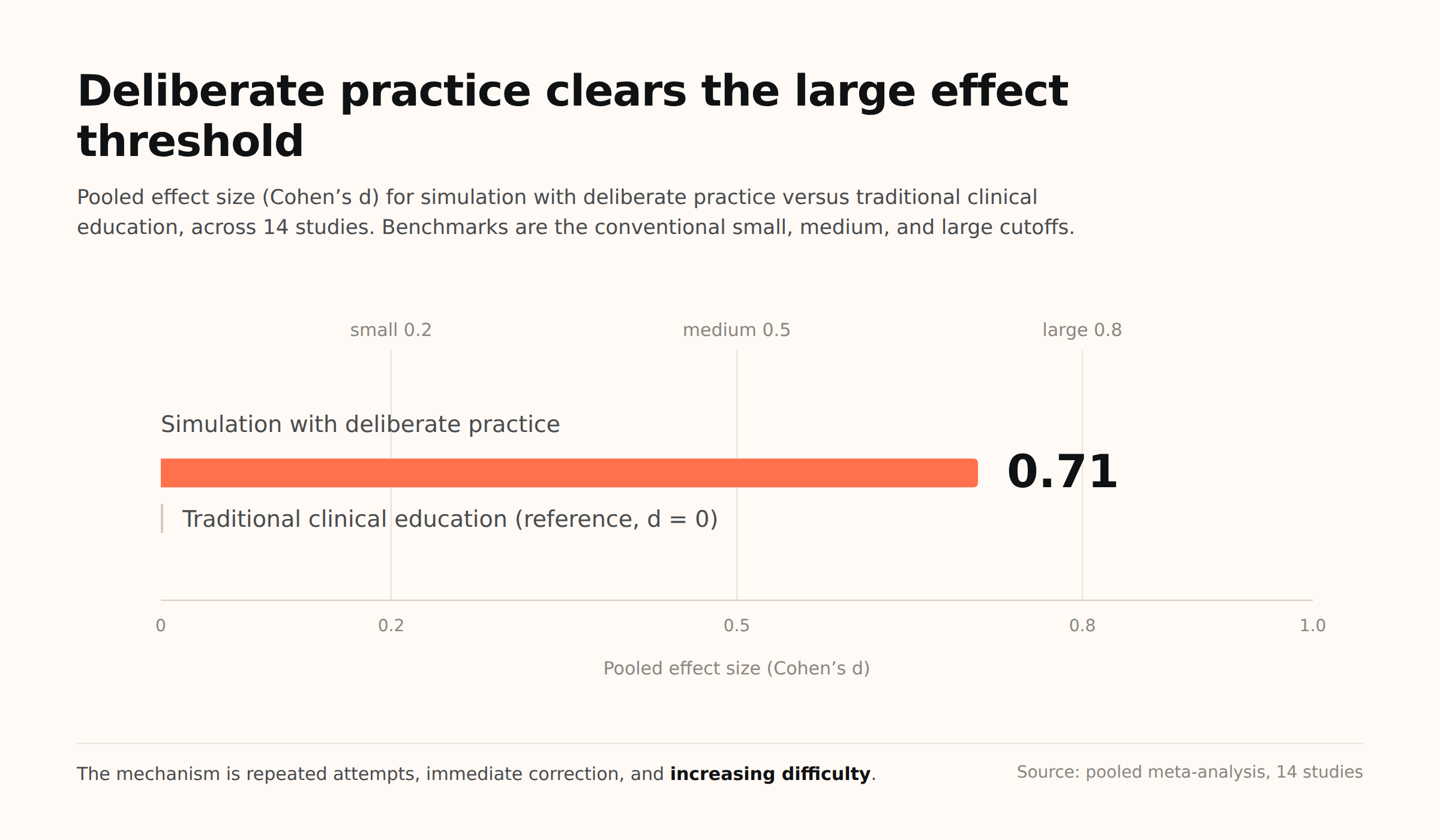
Preparation that works is rehearsal, not a briefing. Simulation with deliberate practice carries a pooled effect size of 0.71 against traditional clinical education across 14 studies.
What a value analysis committee is
A value analysis committee (VAC) is a multidisciplinary hospital panel that reviews and approves new medical products before they can be purchased.
A VAC seats clinical, nursing, supply chain, finance, and infection prevention representatives, and it judges a device on clinical evidence, total cost, workflow impact, and contract fit rather than on product features.
That definition matters more than it looks. A value analysis committee is not a procurement rubber stamp, and it is not a clinical review board. It is the point where those two conversations are forced into the same room and made to agree.
A device can be clinically superior and still be rejected because it adds a SKU that supply chain has spent two years removing. It can be cheaper per unit and still be rejected because nursing cannot absorb the training.
Committees go by other names in different health systems, like:
New product committee
Technology assessment committee
Product standardization committee
Clinical value analysis team.
The structure is consistent even when the label is not. And note the difference in terminology: your commercial team probably calls this group the buying committee. The hospital does not. If you want to be understood in the room, use the room's term.
The one-line version. A value analysis committee decides whether a device gets on contract, using a formal submission, a staged review, and a vote, and it weighs clinical, economic, and operational value together rather than separately.
Who sits on the committee and what each seat wants
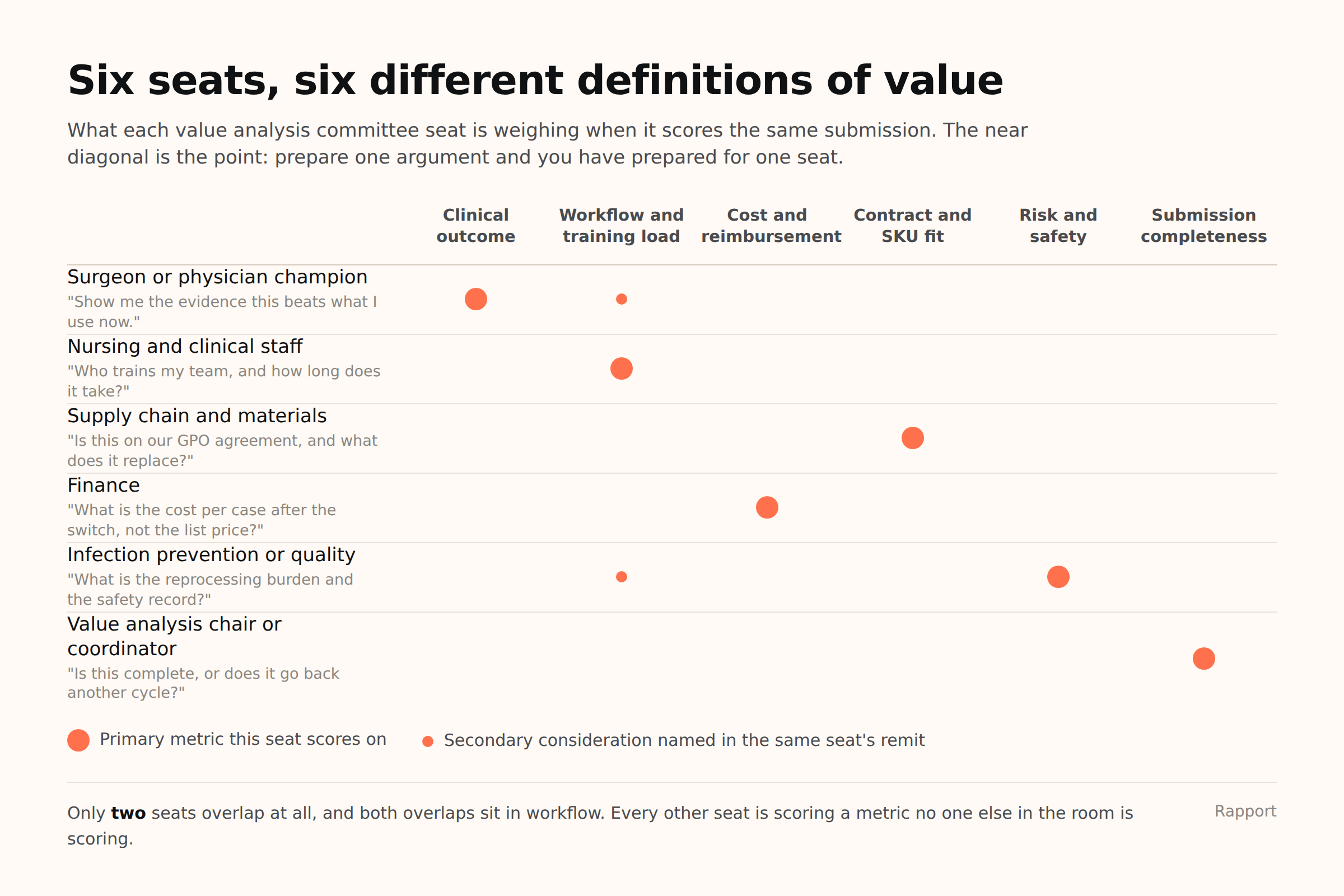
Every seat on a value analysis committee votes on the same submission and scores it against a different metric. That single fact explains most lost VAC deals. A rep who has prepared one argument has prepared for one seat and will be handed to the other five unprepared.
Committee seat | What they are actually weighing | The question that loses the room |
|---|---|---|
Surgeon or physician champion | Clinical outcome, case time, handling, whether it changes technique | "Show me the evidence this beats what I use now." |
Nursing and clinical staff | Workflow disruption, setup and handling, training load on an already stretched team | "Who trains my team, and how long does it take?" |
Supply chain and materials management | Contract fit, SKU proliferation, GPO status, what the product displaces | "Is this on our GPO agreement, and what does it replace?" |
Finance | Total cost of care, reimbursement pathway, budget impact, cost per case | "What is the cost per case after the switch, not the list price?" |
Infection prevention or quality | Risk, sterilization and reprocessing burden, adverse event history | "What is the reprocessing burden and the safety record?" |
Value analysis chair or coordinator | Process discipline, completeness of the submission, comparability across requests | "Is this complete, or does it go back another cycle?" |
Two seats deserve extra attention because reps consistently underweight them.
The chair is not an administrator. The value analysis coordinator controls whether your submission is heard this month or next quarter. They are measured on process integrity, not on clinical enthusiasm.
A submission that arrives with missing reimbursement codes, no comparator pricing, or an unsigned clinician sponsor is a problem for them personally, and they will send it back.
Nursing is the quiet veto. Nursing rarely argues about evidence, but a nursing seat that expects a training burden it cannot staff will express that as a delay rather than a rejection.
Delay is functionally a rejection when the committee meets monthly and the fiscal year is closing. If your team already maps the informal buying group, the VAC is the formal version of the same problem.
Our breakdown of the four people in every med device deal covers the private-practice equivalent, and diagnosing the room before you pitch covers reading the seats you did not expect.

The VAC review process, stage by stage
The VAC review process moves a product request through six stages: submission by a clinician sponsor, a completeness screen, clinical review, economic review, an optional trial or evaluation, and finally a vote followed by contract loading. Timelines vary widely by health system, so treat this as sequence rather than schedule.
1. Request submitted
A clinician sponsor files the new product request. You do not submit it. This is the first structural fact reps miss: the committee hears from its own clinician, not from you, so your champion has to be able to carry the argument in a room you are not in. Arm them accordingly.
2. Completeness screen
The coordinator checks the submission against the committee's own template. Missing evidence, absent comparator pricing, no reimbursement codes, unclear contract status: any of these sends it back. This is where the largest volume of avoidable delay happens, and it is entirely within your control.
3. Clinical review
Outcomes evidence, comparator selection, and the strength of the claim are challenged. Expect the comparator question: not "is your device good" but "is it better than the specific product we already use, in our patient population, at our volumes".
4. Economic review
Cost per case, reimbursement pathway, budget impact, and any downstream cost offsets are modeled. Note that a length-of-stay or complication-rate argument only counts here if you can source it. An unsourced economic claim in front of a finance seat costs you the clinical credibility you just built.
5. Trial or evaluation
Limited-use evaluation, where workflow and training burden are observed rather than described. This stage is where nursing's earlier question gets answered empirically, and where an under-resourced launch plan becomes visible.
6. Vote and contracting
Approval, then loading onto the GPO or IDN agreement. Approval is not availability. A device approved but not contract-loaded cannot be ordered, and that gap is a common source of forecast slippage.
Where the cycle actually goes. Stages three through six are all conversations. Every one of them can be rehearsed in advance. Stage two is a document problem, and it is the one that costs the most time.
Where reps lose the room
Reps lose value analysis committee deals in four recurring ways, and none of them is a knowledge gap. Each is a delivery failure under challenge, which is why more product training does not fix it.
Failure mode 1: clinical benefit delivered to an economic seat
The trigger language is "improved patient outcomes" with no number attached. The surgeon has already accepted the premise.
Finance has not, and hears an unquantified claim. The fix is not a different slide; it's the ability to switch registers mid-answer: state the clinical claim, then immediately convert it into the economic term the finance seat uses.
Failure mode 2: list price instead of cost per case
The trigger language is "our price is competitive at". Hospitals do not buy at list, and the finance seat knows what the incumbent actually costs after rebate. Answering price with price concedes the frame.
The stronger answer builds cost per case, including consumables, reprocessing, disposal, and any procedure-time difference.
Failure mode 3: no answer on the training burden
The trigger language is "training is straightforward" or "we provide full support". Nursing hears an unfunded commitment.
A specific answer names who trains, how many sessions, over what period, on whose time, and what happens at staff turnover.
Failure mode 4: treating the panel as an audience
The trigger is a rep who delivers a presentation, takes questions at the end, and answers each one to the person who asked it. A value analysis committee is a cross-examination in which the seats are listening to each other's questions.
An answer to finance that undercuts what you told the surgeon four minutes ago is the single most damaging thing you can do in the room, and it happens constantly.
All four are behaviors under pressure. They surface only when someone pushes back in real time, which is precisely what a slide deck, a certification quiz, and a manager walkthrough cannot produce.

Why it Matters
The stakes per conversation have gone up because the number of conversations has gone down. Veeva Pulse field data puts healthcare professional accessibility at 45% (opens in new tab), down from 60% the year before, and half of those who remain accessible meet with three or fewer companies.
Those figures are biopharma, not device-specific, and should be cited that way. The direction is what matters. Fewer meetings, more competition for each one, and a formal committee process that gives you one scheduled slot rather than a series of informal touches.
Under those conditions, the marginal value of rehearsing a specific conversation is far higher than the marginal value of one more piece of approved content.
There is a second pressure worth naming. CMS published $14.67 billion in industry payments to US clinicians (opens in new tab) under Open Payments for 2025.
Every interaction between a manufacturer and a clinician is now a matter of public record, which raises the cost of an unprepared or off-label remark in a room that includes a compliance-minded chair.
What good preparation looks like
Good value analysis committee preparation has three parts: a submission built to survive the completeness screen, a one-page answer for every seat in the room, and rehearsal of the meeting as a panel rather than a presentation.
Build the submission to the committee's template, not yours
Ask the coordinator for the actual submission form before you write anything. Fill every field, including the ones that feel adversarial:
comparator product, current contract status, expected annual volume, what this displaces. A submission that answers the completeness screen in advance saves a cycle, and saving a cycle is worth more than any slide you could add.
Write one page per seat
Not one deck for the committee. One page each for surgeon, nursing, supply chain, finance and infection prevention, each written in that seat's vocabulary and each ending with the number or the source that seat will want. Your clinician sponsor should be able to hand these out. The chair does not need a page. The chair needs a complete form.
Rehearse the room, not the pitch
This is the part almost nobody does, and it is the part with the strongest evidence behind it.
In clinical education, simulation with deliberate practice carries a pooled effect size of 0.71 (opens in new tab) against traditional teaching across 14 studies.
That is a large effect by conventional benchmarks, and it's the same mechanism at work here: repeated attempts, immediate correction, and increasing difficulty.
What that looks like in practice for a device team:
Run the meeting as a panel with four or five challengers, not one manager playing "the customer".
Make the challengers argue with each other. The rep has to hold a consistent position while finance and the surgeon pull in opposite directions.
Run it more than once. The first attempt tells you almost nothing except who is nervous.
Score the specific failure modes above, not general "confidence".
Record which objection each rep fails most often, and use that to direct coaching rather than repeating the whole program.
The practical constraint is that live mock panels need four or five senior people in a room at the same time, which is why most teams run them once a year for a launch and never again.
That constraint is what AI roleplay training removes: the panel can be run on demand, by one rep, as many times as it takes, with each seat played by a distinct avatar with its own agenda and its own objections.
We cover the trade-offs honestly in AI roleplay versus manager roleplay, including where a human manager is still the better option.
For device teams building this into onboarding rather than launch prep, see our companion piece on stage-gated medtech onboarding and ramp.
If you are evaluating tools specifically, AI roleplay for medical device sales teams covers what to ask vendors in a demo.
Key takeaways
A value analysis committee is a chartered hospital panel with a submission process, staged review and a vote. Learn its name for itself and use it.
Six seats each score the same submission against a different metric. Prepare per seat, not per deck.
The completeness screen causes more delay than the vote does. Fill the committee's own form before you write a slide.
The four failure modes are register-switching, list price, training burden and treating the panel as an audience. All four are behaviors under challenge.
Access is contracting and every interaction is public record, which raises the value of rehearsal relative to more content.
Deliberate practice has a large, published effect size in clinical education. Apply the same method to the commercial conversation.

Frequently asked questions
What is a value analysis committee?
A value analysis committee is a multidisciplinary hospital panel that reviews and approves new medical products before they can be purchased.
It seats clinical, nursing, supply chain, finance, and infection prevention representatives and evaluates a device on clinical evidence, total cost, workflow impact, and contract fit rather than on product features alone.
Who sits on a hospital value analysis committee?
Composition varies by health system, but the recurring seats are a surgeon or physician champion, a nursing or clinical staff representative, supply chain or materials management, finance, infection prevention or quality, and a value analysis chair or coordinator who runs the process.
Larger integrated delivery networks may add a system-level category manager.
How long does the value analysis committee process take?
There is no single published benchmark, because cycle length depends on how often the committee meets and how complete the submission is.
The practical driver is the completeness screen: an incomplete submission is returned and waits for the next scheduled meeting, which is where most avoidable delay comes from.
Why do medical device reps lose value analysis committee deals?
Four failure modes recur: pitching clinical benefit to an economic seat, quoting list price instead of cost per case, having no specific answer on training and workflow burden, and treating the committee as one audience rather than six people with different definitions of value.
Each is a delivery failure under challenge rather than a knowledge gap.
How do you prepare for a value analysis committee meeting?
Prepare the submission so it survives the completeness screen, build a one-page answer for each seat in the room, and rehearse the meeting as a panel rather than a presentation.
Enablement teams increasingly run mock committee panels, either with internal role-players or with AI roleplay avatars, so a rep faces surgeon, finance, and supply chain challenge in one sitting before the real meeting.
What is the difference between a value analysis committee and a buying committee?
Buying committee is vendor vocabulary for the group of people involved in a purchase decision. Value analysis committee is the hospital's own name for the formal, chartered body with a submission process, review stages and a vote. If you are selling into a US hospital, use the hospital's term.