AI Roleplay vs. Manager Roleplay: When to Use Which
Somewhere in your buying committee, someone is asking the fair question: “Why do we need AI roleplay when managers already run roleplays?” It deserves a fair answer, not a strawman.
August 9, 2026
Manager roleplay is genuinely better at several things, and pretending otherwise is how vendors lose credibility. Here is the honest comparison, dimension by dimension, and the blended model the best AI role play training programs actually run.
The short answer
AI roleplay and manager roleplay solve different problems. AI roleplay wins on practice volume, consistency, psychological safety, and objective scoring at scale: it is how reps get their repetitions. Manager roleplay wins on deal-specific strategy, trust, and career development: it is how reps get judgment.
The teams that improve fastest use AI for weekly practice and cohort data, then aim their managers’ limited coaching hours exactly where that data points.

What manager roleplay does best
Manager roleplay is at its best when the coaching depends on context only a human holds. Ride-alongs, call reviews, and live-deal rehearsals give a manager evidence and history no simulation can reach, and the debrief afterward carries weight because it comes from the person responsible for the rep’s career.
Start with the concessions, because they’re real.
Deal-specific strategy. When the rehearsal is for one live opportunity, the manager who knows the account, the champion, and the history beats any simulation. No AI persona knows that the CFO got burned by a similar vendor last year.
Trust and career coaching. A great role-play debrief is also a development conversation. That relationship, and the willingness to hear hard feedback inside it, is built human to human.
Reading organizational politics. Managers coach the meta-game: who to bring to the meeting, when to escalate, and how this buyer’s committee actually decides.
Modeling by demonstration. Sometimes the fastest teaching is “watch me do it.” A skilled manager switching chairs mid-roleplay is a masterclass no scorecard replaces.
The problem was never quality. It’s arithmetic. A manager with eight reps and a pipeline to run cannot give each rep the weekly, repeated, safe practice that skill-building requires.
Coaching time is the scarcest resource in the org chart, and role-play as a practice partner is a low-leverage way to spend it.
What AI roleplay does best
AI roleplay is at its best when the bottleneck is repetition rather than insight. It gives every rep the same scored practice on demand without consuming a manager’s calendar, and it turns what used to be an anecdote about who is ready into readiness data leadership can act on.
Six advantages do most of the work.
Unlimited repetitions. Skill change needs spaced, repeated practice, and research replicating the Ebbinghaus forgetting curve (opens in new tab) shows unreinforced learning decays within days. AI practice is available at 7am before the call, in any language your team sells in.
Psychological safety. Reps hold back in front of the person who writes their review. Decades of research on psychological safety (opens in new tab) say people take fewer learning risks when the stakes feel evaluative. Against an avatar, reps try the bold discovery question, flub it, and try again.
Consistency. Every rep in every region rehearses against the same persona and the same rubric. Manager roleplays vary with the manager’s mood, skill, and calendar.
Objective, rubric-based scoring. Attempts are scored skill by skill against your definition of good, not a manager’s gut feel on a Friday afternoon.
Cohort-level insight. Aggregate dashboards show which skills, teams, and regions are ready and which aren’t: evidence managers and executives can act on, not anecdotes.
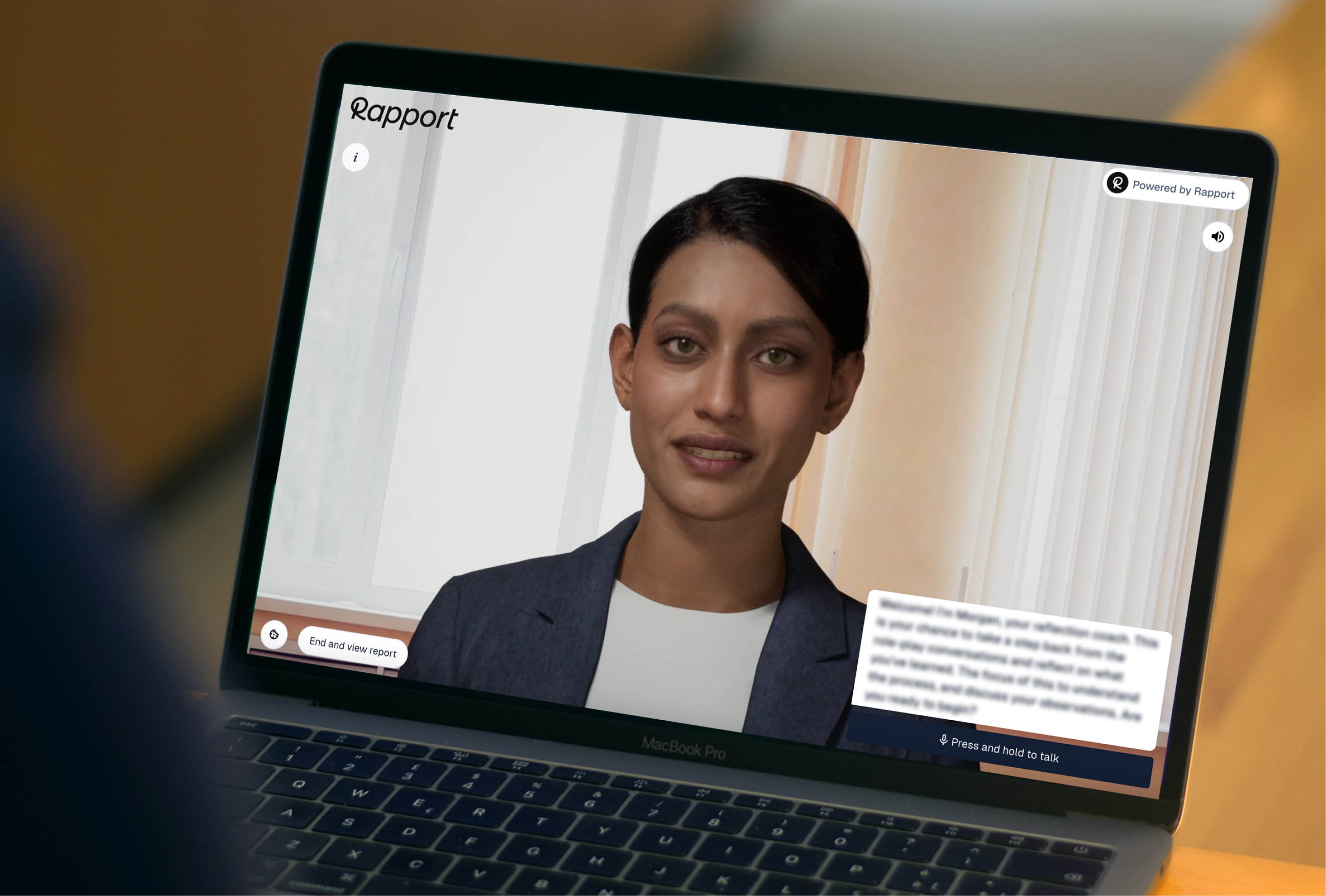
Emotional realism, if the platform has it. This is the line between rehearsing words and rehearsing conversations. Live, reactive video avatars that hesitate, push back, and visibly respond, the kind Rapport builds, make practice feel enough like the real room for the skill to transfer.
There is an operational argument as well.
Scored practice that pushes completions and results into your LMS through SCORM keeps enablement, HR, and compliance reporting in one place, and multilingual personas let a single global program run in-market instead of in English with subtitles.
Rapport has now carried more than 1.1 million practice minutes for teams at Teva, GSK, WB Games, and Liberty Global, on avatar technology with research lineage from Speech Graphics and the University of Edinburgh.
AI roleplay vs. manager roleplay: the side-by-side
Across nine dimensions that matter to a sales organization, AI roleplay wins five, manager roleplay wins three, and one depends entirely on the platform you buy.
Scored honestly, the table argues for using both, not for replacing any of them.
Dimension | AI roleplay | Manager roleplay | Winner |
|---|---|---|---|
Practice volume | Unlimited, on demand, any timezone | Rationed by calendars | AI |
Consistency | Same persona, same rubric, every rep | Varies by manager skill and mood | AI |
Psychological safety | Fail freely, retry instantly | Evaluative stakes suppress risk-taking | AI |
Feedback objectivity | Rubric-scored, skill by skill | Subjective, varies session to session | AI |
Readiness data | Cohort dashboards by team, region, skill | Lives in the manager’s head | AI |
Deal-specific strategy | Generic to the account | Knows the deal, the history, the politics | Manager |
Trust and development | A tool, not a mentor | Career coaching inside the debrief | Manager |
Modeling by example | Shows personas, not seller technique | “Watch me do it” demonstrations | Manager |
Emotional realism | Platform-dependent: live reactive avatars come close, chatbots don’t | Real human, but a colleague playing pretend | Depends |
Five dimensions to AI, three to managers, one platform-dependent. The conclusion isn’t “AI wins.” It’s “stop using managers for what AI does better, and vice versa.”
Two things the table deliberately does not score.
It does not score cost, because the real comparison is a license fee against manager hours, and every organization values those differently.
It does not score effort either, because the honest answer is that a blended model asks more of enablement up front: someone has to write the rubrics, build the personas, and hold the cadence.
Both are worth arguing about internally. Neither changes which method is better for which job.
When to use which: 5 common scenarios
Use AI roleplay whenever repetition builds the skill, and use a manager whenever context and judgment decide the outcome. Here is how that rule resolves across the five situations enablement teams ask about most.
1. New-hire onboarding
Verdict: AI roleplay
Ramp is a volume problem. New reps need dozens of safe attempts at discovery, objections, and pitch delivery before they touch a real prospect. Save manager sessions for milestone check-ins.
2. Product launch readiness
Verdict: AI first, manager certifies
Every rep drills the new messaging against AI personas until they clear the rubric bar, and managers then run one certification roleplay per rep. The cohort dashboard tells you who’s ready before launch day, not after the first lost deal.
3. Big-deal preparation
Verdict: Manager roleplay
One meeting, one account, real stakes and real history. This is the manager’s home turf. Use AI beforehand to warm up the general skill, then rehearse the actual meeting with the person who knows the deal.
4. Skill remediation
Verdict: AI practices, manager coaches
The dashboard shows a rep consistently scoring low on, say, handling pricing pushback. The rep drills that scenario with AI, and the manager reviews the scored attempts and coaches the pattern, not the anecdote.
5. Ongoing certification and compliance
Verdict: AI roleplay
Quarterly message certification across hundreds of reps in multiple languages is operationally impossible manager by manager. Scored AI roleplay with cohort reporting is built for exactly this. Your ICP criteria scoring even tells you which personas to certify against first.
A pattern runs through all five. The moment a decision depends on knowing this account, this rep, or this quarter, the manager wins. Everything else is repetition, and repetition is what the machine is for.
For a regulated-industry version of this decision, where MLR review and physician access change the calculus, see our comparison of AI roleplay for pharmaceutical sales teams.
See what “reactive” actually means
Watch a live Rapport avatar hesitate, object, and push back mid-conversation. Two minutes of a real practice session tells you more than any comparison table.
The blended model: how the best teams run both
The teams getting the most from roleplay don’t choose. They sequence.
AI handles practice volume. Reps run short, scored sessions weekly: personas drawn from your real ICP tiers, rubrics drawn from your definition of good. Nobody waits for a manager’s calendar to get better.
Dashboards find the gaps. Cohort views show readiness by skill, team, and region. Managers stop guessing where to spend coaching time, because the data points to it.
Managers coach where it counts. Freed from being practice partners, managers spend their hours on deal strategy, certification sign-offs, and the development conversations only they can have.
Notice what this does to the original objection. “Managers already do roleplays,” becomes the argument for AI roleplay: every hour a manager spends as a rehearsal dummy is an hour not spent on the coaching that actually requires them.
Give the repetitions to the machine and the judgment to the human.
In practice, the cadence is weekly, not quarterly. Reps complete one or two scored scenarios a week; enablement reviews the cohort dashboard on the same rhythm it reviews pipeline; and each manager picks one skill gap per rep per month to coach in a live session.
Success isn’t practice minutes logged. It’s whether readiness scores move before a launch, and whether the conversations reps have in the field start to sound like the ones they rehearsed.
Frequently asked questions
Is AI roleplay better than manager roleplay?
Neither wins outright. AI takes practice volume, consistency, psychological safety, scoring, and readiness data. Managers take deal strategy, trust and development, and modeling by example. The blended model beats either alone.
Can AI roleplay replace sales managers?
No. It replaces the practice bottleneck, not the manager. It returns coaching hours to managers and hands them cohort data showing exactly where those hours should go.
What does manager roleplay do better than AI?
Deal-specific strategy on live opportunities, trust and career coaching, reading account politics, and teaching by demonstration. When the rehearsal is for one specific high-stakes meeting, use the manager.
When should reps practice with AI instead of a manager?
Whenever repetition builds the skill: onboarding, launch certification, objection drills, difficult-conversation practice. Reps also experiment more freely without their evaluator in the room.
How do you combine AI roleplay with manager coaching?
Weekly scored AI practice, cohort dashboards to locate the gaps, and manager coaching aimed at exactly those gaps plus the deal-specific sessions AI can’t do. Practice scales with AI, judgment stays human.
Does AI roleplay feel realistic enough to change behavior?
Platform-dependent. Text and voice-only tools rehearse words. Live, reactive video avatars with emotional realism rehearse conversations, and conversations are where deals are won.
Give the reps their reps. Give the managers their judgment back.
Rapport’s live, emotionally realistic avatars run the weekly practice your managers can’t scale, scored on your rubrics, rolled up in cohort dashboards, in 50+ languages.