AI Language Learning: Revolutionizing Conversation Practice
AI conversational language learning uses speech recognition, natural language processing, and adaptive feedback to help learners practice real dialogue instead of only tapping through drills. The real value is not that an app “sounds smart”; it is that language learning AI can notice recurring patterns in your speech, respond in context, and turn practice into a more personal learning loop. For learners comparing AI language apps, traditional tutors, and language learning software, the best choice is usually a balanced mix: frequent AI practice, deliberate review, and occasional human feedback.
September 22, 2026
How does AI detect language patterns in conversation?
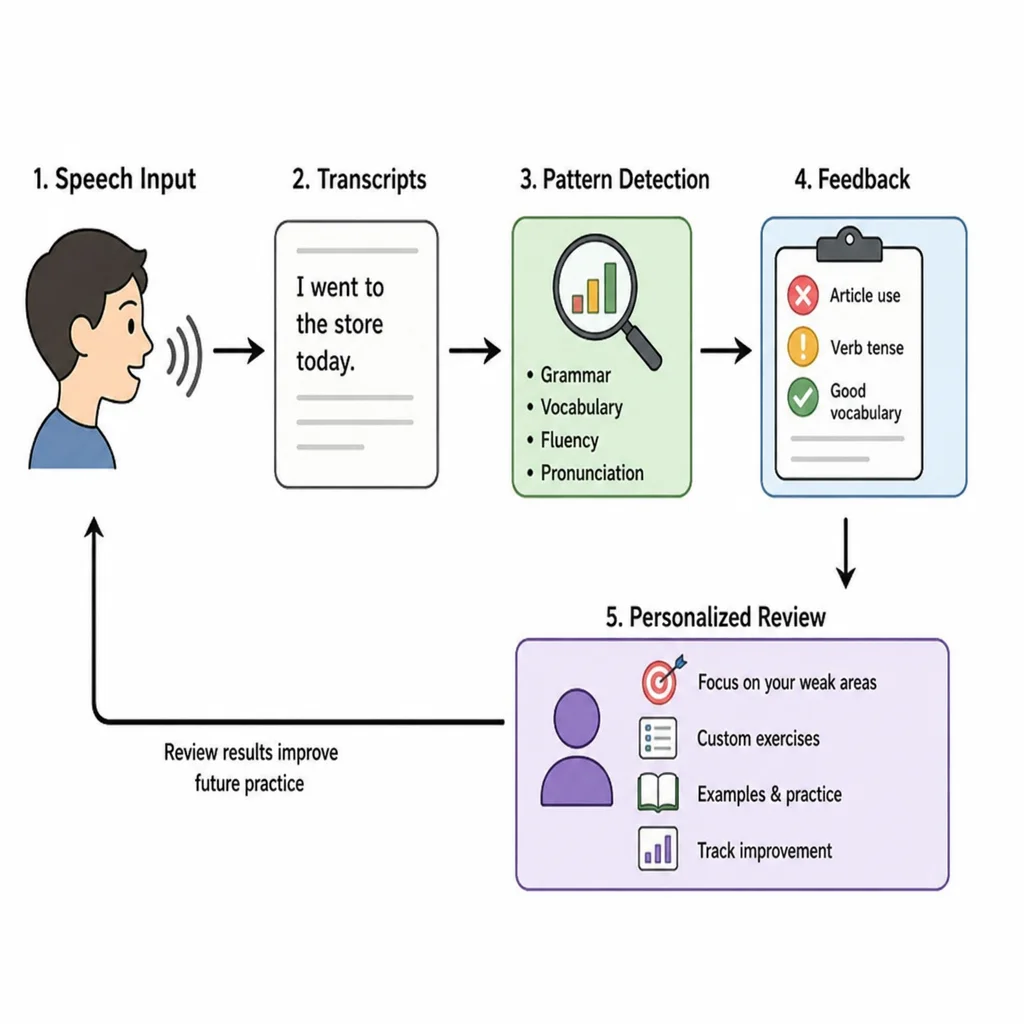
AI detects language patterns by turning your spoken or typed input into data, comparing it with likely target-language structures, and identifying repeated signals: pronunciation habits, grammar errors, vocabulary gaps, hesitation points, and phrases you overuse. In practical terms, what people sometimes describe as AI fingerprint detection language patterns machine learning is less like a single fingerprint scanner and more like a profile of recurring language behavior built from many small interactions.
A modern conversational tutor typically starts with automatic speech recognition. Your voice is transcribed, then natural language processing analyzes what you meant, how you formed the sentence, and where the sentence differs from a more natural version. A language model can then keep the conversation moving while another layer decides whether to correct you immediately, save the issue for later, or adapt the next prompt.
That pattern detection matters because language mistakes are rarely random. A Spanish speaker learning English may repeatedly omit certain auxiliary verbs. An English speaker learning French may struggle with gender agreement. A beginner may need survival phrases, while an intermediate learner may need help sounding less translated. Machine learning helps the app notice those tendencies over time and create practice that feels less generic.
Why conversational AI feels different from older language learning software?
Conversational AI feels different because it can respond to open-ended input rather than forcing every learner through the same fixed path. Traditional language learning software can be excellent for structure, vocabulary exposure, and habit-building, but it often depends on prewritten exercises, multiple-choice answers, or scripted dialogues. AI conversation practice adds a more flexible layer: you can ask for clarification, change topics, make mistakes, and still keep speaking.
That does not make older tools obsolete. Many learners still benefit from language learning apps without AI, especially when they want predictable lessons, clear progression, or distraction-free memorization. Flashcard systems, grammar courses, textbooks, audio lessons, and language learning apps that don’t use AI can build a strong foundation. The difference is that they usually cannot improvise a conversation around your last answer.
The most useful setup is often a stack, not a single app. Use structured software to learn forms, vocabulary, and rules. Use AI to practice producing language in realistic situations. Then use a teacher, exchange partner, or native speaker to catch cultural nuance, pragmatic tone, and subtle errors an app may miss.
What AI language tutors can do well
The best AI tools for language learning in 2026 are not just chatbots with a microphone. Strong tools combine voice practice, correction, review, and personalization so that every conversation leaves behind something useful.
Here is what to look for:
- Real conversation practice: The app should let you speak in full sentences, not only repeat isolated phrases.
- Context-aware correction: Good feedback explains what sounded unnatural and offers a better version, instead of simply marking an answer wrong.
- Vocabulary recycling: Saved words should reappear in future chats, stories, or review activities so they move into active memory.
- Level adaptation: The tutor should simplify, slow down, or increase complexity based on your performance.
- Pronunciation support: Voice tools should help you notice sounds, rhythm, or stress patterns that affect intelligibility.
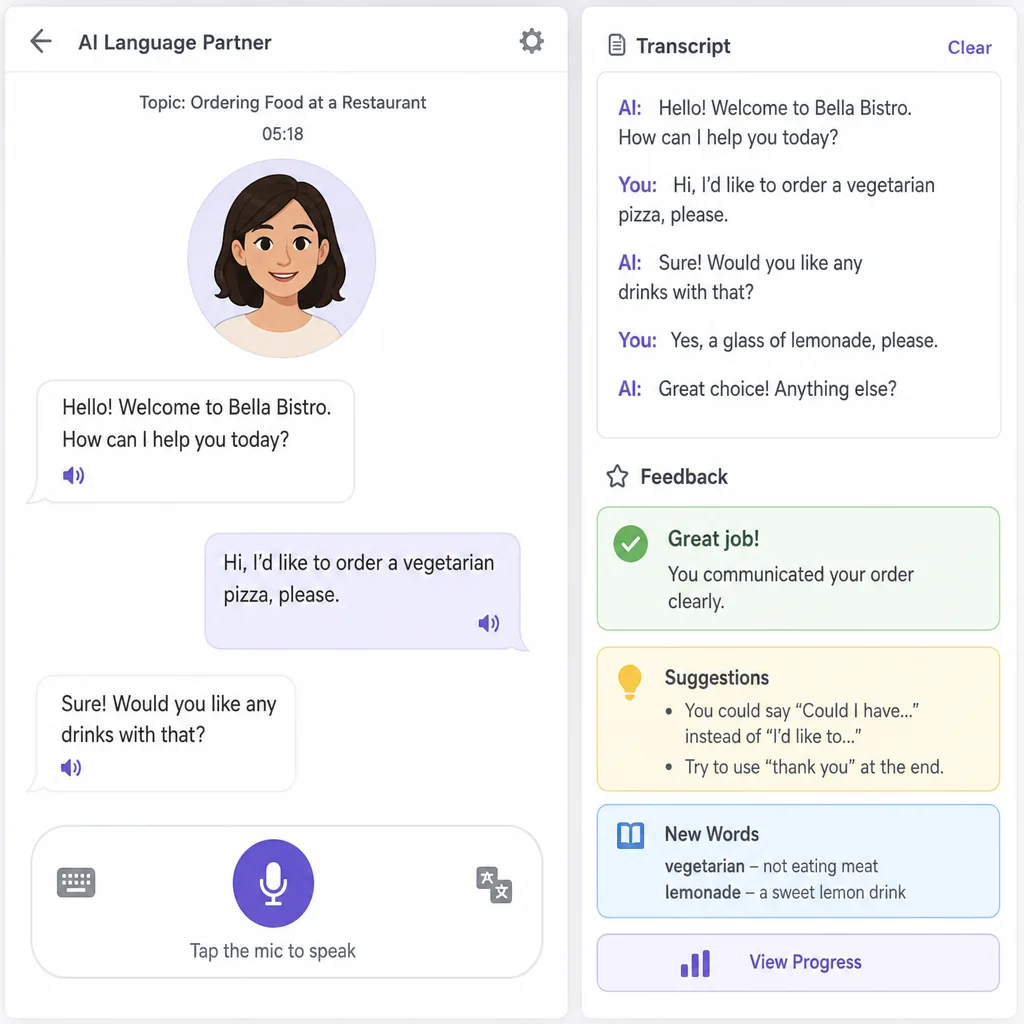
- Useful transcripts: A written record helps you review mistakes after the conversation rather than interrupting every sentence.
- Privacy clarity: Because speaking practice can involve personal data, check how recordings, transcripts, and account information are handled.
Langua, for example, describes conversation practice powered by multiple AI models, AI characters with cloned voices from real people, spaced repetition flashcards, saved vocabulary, feedback, and conversation history features. Its public materials also emphasize native voices and accents, colloquial expressions, dialect-specific language, and modes such as role plays, debates, vocabulary practice, and grammar practice. (support.languatalk.com)
Pingo positions itself as an AI language learning app focused on real-life conversation, level adaptation, real-time correction, and natural language use. Its site describes personalized lessons and conversation practice designed around the learner, while Y Combinator’s company profile says Pingo adapts to level and gives real-time corrections. (pingo.ai)
Duolingo has also added AI conversation features, including Video Call with Lily and Roleplay in Duolingo Max. Duolingo says these features are designed for real-time, spontaneous chats, with Lily adapting as the conversation goes; its product materials also describe AI-powered features for roleplay and explanations. (blog.duolingo.com)
AI language apps and non-AI apps serve different jobs
AI language apps are strongest when you need output: speaking, improvising, responding, recovering from mistakes, and building confidence. Non-AI tools are often strongest when you need controlled input: grammar sequencing, curated lessons, spaced flashcards, pronunciation drills, or exam-style practice. The question is not whether AI is “better,” but which job you need done today.
A beginner might use a structured app or course to learn greetings, verb basics, and core vocabulary, then use an AI tutor for short, guided role plays. An intermediate learner might ask an AI tutor to run a restaurant scenario, interview simulation, or travel problem, then save unknown words for review. An advanced learner might use AI for debate practice, accent exposure, or switching between formal and casual registers.
A simple comparison helps clarify the choice:
| Learning need | AI conversational tutor | Non-AI software or course |
|---|---|---|
| Speaking confidence | Strong for frequent, low-pressure practice | Limited unless audio-heavy |
| Grammar sequencing | Helpful, but can feel uneven | Often clearer and more structured |
| Pronunciation feedback | Useful when voice analysis is built in | Varies widely by tool |
| Cultural nuance | Improving, but imperfect | Strong if designed by experts |
| Motivation | Engaging through interaction | Strong when gamified or goal-based |
| Reliability | Can make mistakes | More predictable when content is curated |
The limits learners should understand
AI conversation practice is powerful, but it is not magic. Speech recognition can mishear accents, background noise, or beginner pronunciation. A language model can give a correction that is acceptable but not the most natural option. Some conversations still feel too agreeable, too scripted, or too quick to move on from an error.
Feedback depth is another issue. A human tutor may notice that your sentence is grammatically correct but too blunt for a workplace setting. They may also understand your personal goals, emotional blocks, or cultural context better than software. AI can imitate parts of that experience, but it cannot fully replace a skilled teacher who listens closely and adjusts in the moment.
This is why learners should treat AI feedback as a guide, not a final authority. If an app flags a phrase, compare it with examples from native content. If you are preparing for a high-stakes interview, exam, relocation, or professional conversation, involve a human tutor or qualified instructor when possible.
A practical way to use conversational AI each week
The fastest gains usually come from consistent, focused sessions rather than long, random chats. AI makes it easy to practice often, but you still need intention. A ten-minute conversation can be useful if it produces clear review material and one behavior to improve next time.
Try this weekly rhythm:
- Choose one real scenario. Practice ordering food, explaining your job, booking a hotel, making small talk, or describing a problem.
- Add target vocabulary. Give the app five to ten words or phrases you want to use naturally.
- Speak before reading. Start with voice input so you train retrieval, not just recognition.
- Ask for delayed feedback. Let the conversation flow, then review corrections at the end.
- Save recurring mistakes. Turn repeated grammar or pronunciation issues into a short review list.
- Repeat the same scenario. Run it again two days later and aim for smoother, more natural responses.
- Bring one issue to a human. If a correction confuses you, ask a tutor, teacher, or native speaker to explain the nuance.
Choosing the best AI tools for language learning in 2026
The best AI tools for language learning 2026 will depend less on hype and more on fit. A great app for pronunciation may not be the best for grammar explanations. A tool built for English conversation may not support the dialect, language pair, or script you care about. Before subscribing, test the specific situation you want to improve.
Use this checklist during a free trial or first week:
- Does the voice feel natural enough that you want to keep speaking?
- Can you control difficulty, speed, correction style, and topics?
- Does the app remember your goals, level, saved words, and repeated errors?
- Are transcripts, summaries, or reports easy to review?
- Does it support the language, dialect, or accent you need?
- Can you practice realistic scenarios instead of only generic small talk?
- Is pricing, cancellation, and privacy information easy to understand?
If you are comparing Langua, Pingo, Duolingo, and other AI language apps, focus on the practice loop: conversation, correction, review, and reuse. The flashiest voice is not always the best teacher. The strongest app is the one that helps you notice your patterns, fix them, and speak again with less hesitation.
The takeaway
AI conversational language learning is changing the role of practice. Instead of waiting for a class, a tutor slot, or a patient conversation partner, learners can now speak daily, make mistakes safely, and receive instant feedback. Machine learning makes that feedback more personal by detecting repeated language patterns and adapting future practice around them.
Still, fluency comes from a mix of methods. Use AI for volume, confidence, and realistic repetition. Use structured language learning software for foundations. Use people for nuance, culture, and accountability. When those pieces work together, language learning AI becomes more than a novelty; it becomes a practical bridge between knowing a language and actually using it.