Improve Conversation Skills: Online Tips & Practice
Improving your conversation skills online is less about finding one perfect app and more about building a repeatable practice system. With the right mix of listening, speaking, feedback, and real human interaction, you can become more confident in English conversations from anywhere. This guide shows you how to use online resources to strengthen verbal communication, practice effective speaking, and build the social skills that make dialogue feel natural instead of forced.
October 6, 2026
What is the best way to improve conversation skills online?
The best way to improve conversation skills online is to combine active practice with feedback. Watching videos or reading tips can help, but conversation improves fastest when you actually speak, listen, respond, and adjust. A strong routine includes real-time speaking practice, listening to natural English, reviewing your own performance, and joining spaces where conversation feels purposeful rather than random.
If you are searching for how to improve your English conversation skills, start by thinking in layers. First, build comfort with everyday speech. Then work on clarity, flow, listening, and cultural awareness. Finally, practice with different people so you can handle accents, personalities, and conversation styles without freezing.
Online resources make this easier because they remove many barriers. You can join a language exchange from home, record yourself on your phone, take a structured course, or practice with a tutor in short sessions. The key is consistency: small, focused practice several times a week usually works better than occasional long sessions.
Build a simple online practice routine
A useful routine gives you enough structure to stay consistent while leaving room for natural conversation. You do not need to spend hours each day. You need a plan that touches the main parts of communication skills: listening, speaking, questioning, and reflection.
Try this weekly rhythm:
- Listen daily for 10–15 minutes. Choose podcasts, interviews, short videos, or conversations made for English learners. Focus on tone, pauses, phrases, and how speakers respond to each other.
- Speak out loud three or four times a week. Summarize what you heard, answer a discussion prompt, or describe your day. Speaking alone still trains fluency and confidence.
- Have one live conversation each week. Use a tutor, language exchange, online speaking club, or virtual meetup. Real-time interaction teaches you to think, listen, and respond under gentle pressure.
- Review one recording. Record a short answer or conversation practice. Notice unclear pronunciation, repeated filler words, or places where you stopped developing your point.
- Learn five useful phrases. Add phrases for agreeing, disagreeing, asking follow-up questions, changing topics, and clarifying meaning.
This routine works because it turns “I want to know how to improve my English conversation skills” into specific actions. You are not just hoping to become better. You are training the habits that make better conversation possible.
Choose resources that make you speak, not just study
Many learners spend too much time consuming English and not enough time using it. Grammar lessons, vocabulary apps, and videos are helpful, but they should support conversation, not replace it. If your goal is effective speaking, prioritize resources that require response.
Good online options include:
- Language exchange platforms, where you speak with people who want to learn your language or practice English together.
- Online tutors or conversation coaches, especially if you want correction, structure, and personalized topics.
- Virtual speaking clubs, where small groups discuss prompts, current events, books, hobbies, or professional themes.
- Interactive courses, which may include modules on mindset, rapport, listening, questions, and speaking confidence.
- Voice-note practice, using messaging apps or learning communities to exchange short spoken responses.
- AI conversation tools, useful for low-pressure practice, role-play, and repetition before speaking with real people.
The best resource depends on your needs. If you feel nervous, start with recording and AI role-play. If you need real fluency, add live calls. If your conversations stay shallow, join discussion groups with themes that invite opinions and stories.
Which conversation skills should you practice first?
Practice active listening first, because conversation is not only about what you say. Active listening means giving focused attention, noticing emotion and context, avoiding interruption, and responding to what the other person actually meant. When you listen well, your replies become more relevant, your questions improve, and the whole exchange feels more natural.
After listening, focus on asking better questions. Many conversations fade because the questions are too closed or predictable. Instead of relying only on “What do you do?” or “Where are you from?”, use open-ended questions that invite a fuller answer.
Try these examples:
- “What was that experience like for you?”
- “How did you get interested in that?”
- “What surprised you about it?”
- “What do you usually enjoy about that kind of work?”
- “You mentioned moving recently. How has that been?”
You can also mirror a key word or idea. If someone says, “The project was stressful, but exciting,” you might answer, “Exciting in what way?” This simple habit can enhance dialogue because it shows attention without forcing a completely new topic.
Next, work on clarity. Clear speech does not mean perfect grammar or an accent-free voice. It means your listener can follow your message. Use shorter sentences when you are unsure, organize your thoughts with phrases like “The main reason is…” or “For example…,” and pause instead of rushing.
Strengthen verbal communication with listening and body language
Verbal communication includes words, tone, pace, and how you structure ideas. In online conversation, it also includes small signals that show you are present: looking toward the camera, nodding, smiling naturally, and leaving space for the other person to speak. These details matter because online calls can feel colder than face-to-face conversations.
When practicing online, pay attention to your speaking rhythm. Many learners speak too fast because they are nervous, or too quietly because they are afraid of mistakes. A steady pace helps both you and the listener. If you lose your thought, use a recovery phrase instead of going silent.
Helpful phrases include:
- “Let me think about how to say that.”
- “What I mean is…”
- “Can I rephrase that?”
- “I’m not sure of the exact word, but it’s similar to…”
- “That’s a good question. My first thought is…”
Non-verbal communication also supports your message. In video calls, sit where your face is visible, reduce distractions, and avoid multitasking. You do not need dramatic gestures. You simply want your expression and posture to match your interest in the conversation.
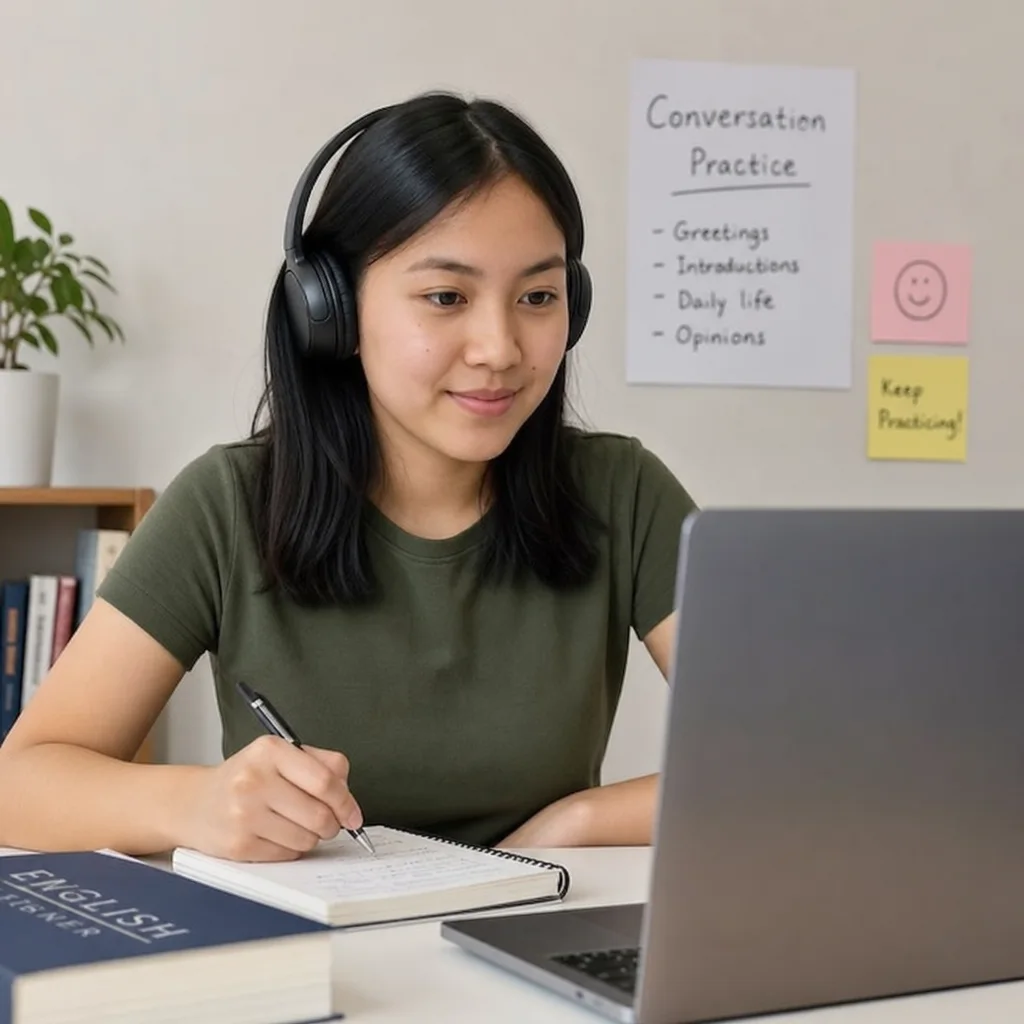
Practice deeper conversations, not only small talk
Small talk is useful, but it should not be the only thing you practice. If every conversation stays at “How are you?” and “What do you do?”, you may never learn how to express opinions, tell stories, handle disagreement, or respond with empathy. Deeper conversation builds confidence because it gives you more flexible language.
Use online prompts to move beyond basic topics. Choose themes such as travel, food, work, family traditions, technology, books, habits, goals, or cultural differences. Then prepare a few words and examples before the conversation starts. Preparation does not make you fake; it gives your brain a path to follow.
A simple conversation structure can help:
- Start with a broad topic. “I’ve been thinking about how people stay motivated.”
- Share a short personal example. “For me, routines help more than motivation.”
- Ask for their view. “What helps you stay consistent?”
- Follow up. “Was that always true for you, or did it change over time?”
- Reflect or connect. “That makes sense. I’ve noticed something similar when I study.”
This approach makes conversation feel less like an interview. It balances speaking and listening, which is one of the most important social skills in any language.
Learn cultural flexibility while practicing English globally
Online English practice often connects you with people from different countries, backgrounds, and communication styles. That is a strength, but it can also create confusion. Some people speak directly; others soften opinions. Some enjoy personal questions; others prefer to build trust first. Good communication skills include noticing these differences and adapting respectfully.
When you are unsure, use gentle language. Instead of saying “You are wrong,” try “I see it a little differently.” Instead of asking a very personal question immediately, begin with shared topics and let the conversation become more personal over time. If you do not understand a reference, ask with curiosity: “I haven’t heard that expression before. What does it mean?”
This kind of cultural flexibility helps you enhance dialogue because you are not only practicing English words. You are practicing connection. Over time, you become better at reading tone, choosing suitable topics, and making people feel comfortable speaking with you.
How do you overcome nervousness and awkward pauses?
You overcome nervousness by lowering the pressure and practicing recovery, not by waiting until you feel completely confident. Awkward pauses, forgotten words, and imperfect sentences are normal parts of learning. The goal is to keep the conversation moving with patience, curiosity, and a few prepared strategies.
Start with low-stakes practice. Record yourself before joining a live call. Practice with one friendly partner before entering a group. Choose familiar topics first, then gradually add harder ones. Confidence grows when your brain learns, “I can handle this.”
Use a quick reset when you feel stuck:
- Take one slow breath.
- Smile or acknowledge the pause naturally.
- Use a phrase such as “Let me explain that another way.”
- Ask a question back to create space.
- Return to the main idea instead of chasing perfect wording.
It also helps to prepare “conversation bridges.” These are phrases that connect ideas when you do not know what to say next: “That reminds me of…,” “Another example is…,” “I’ve had a different experience…,” or “I’d like to hear more about that.” Bridges make you sound more fluent because they reduce long silences.
Track progress in a way that keeps you motivated
If you want to know how to improve conversation skills over time, measure the right things. Do not judge progress only by whether you made mistakes. Mistakes are part of practice. Instead, notice whether you can speak longer, ask better follow-up questions, understand more accents, recover faster, and enjoy conversations more.
Use a short reflection after each practice session:
- What topic did I discuss?
- What phrase or word did I use well?
- Where did I hesitate?
- What question helped the conversation continue?
- What will I practice next time?
This turns every online conversation into useful feedback. You can also keep a phrase bank with expressions you want to reuse. Review it before calls so your learning moves from notes into real speech.
A practical takeaway for better conversations
Learning how to improve your conversation skills online is a practical process: listen actively, speak regularly, ask thoughtful questions, and reflect on what happened. Use digital tools, tutors, communities, and recordings to create more chances for real interaction. The more you practice with intention, the more natural your English conversations will feel.
You do not need perfect English to connect with people. You need curiosity, patience, and a willingness to participate. Start with one small online practice session this week, and build from there.