8 ways to use interactive AI avatars for face-to-face conversation practice
By Fara Rosenzweig March 24, 2026
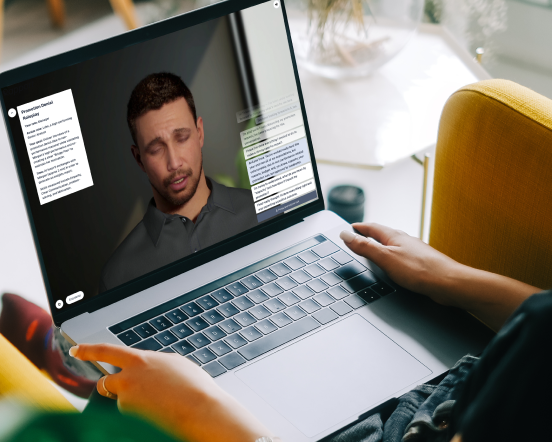
Here’s something every L&D leader knows but few training programs address: in face-to-face conversation, words are only part of the message. Tone of voice, eye contact, posture, and facial expression carry the emotional weight of what’s being communicated — often more than the words themselves. You can have the perfect thing to say and still lose the room if your body language contradicts it.
That’s the gap most corporate training never closes. It teaches people what to say. It rarely gives them enough practice with how to say it under pressure — and almost never for the kinds of charged, high-stakes conversations where it matters most.
AI avatars change that. Interactive, lifelike, and available on demand, they give employees a realistic face-to-face practice environment for the conversations that are hardest to rehearse (and most costly to get wrong). Here’s how forward-thinking teams are using them.
Fun fact: U.S. businesses lose an estimated $1.2 trillion every year to poor communication — including lost deals, stalled projects, and preventable employee turnover, according to The Harris Poll (opens in new tab). The root cause, consistently, is people who weren’t prepared for the conversations they needed to have.
Practice difficult conversations before they happen
Performance reviews. Terminations. Peer-to-peer conflict. Upward feedback to a defensive manager. Negotiations with a difficult stakeholder. These are the conversations people dread, avoid, and often handle poorly — not because they don’t care, but because they have never actually practiced them face to face.
AI avatars let employees rehearse these moments with a responsive, realistic persona who reacts the way a real person might: getting defensive, going quiet, pushing back, or showing visible frustration. Practicing that dynamic — including managing your own body language and composure under mild pressure — is something no e-learning module can replicate.
Negotiations that require more than a backup plan
Skilled negotiators understand their BATNA (Best Alternative to a Negotiated Agreement) — AKA their best alternative if a deal falls through — but knowing your leverage is only the foundation. The harder part is the face-to-face dynamic: reading a shift in posture, noticing when silence signals consideration versus discomfort, staying calm when the other party applies pressure. Those are in-person skills, and they only develop through repetition.
Avatar-based practice lets employees run the same negotiation scenario repeatedly — vendor discussions, salary conversations, contract renewals, scope disputes — building the ability to stay grounded and read the room, not just recite a framework.
Customer-facing teams who represent your brand in person
For anyone whose role involves face-to-face customer interaction — retail, hospitality, financial services, healthcare, field sales, account management — how they show up physically is as important as what they say. A dismissive tone or averted eye contact can undo an otherwise strong interaction in seconds.
AI avatar practice helps front-line teams develop the presence and composure that creates great customer experiences: staying warm under pressure, de-escalating a frustrated customer, delivering difficult news with genuine empathy, and maintaining confident eye contact when it counts.
Sales rep onboarding that actually prepares people
New reps can watch hours of recorded calls and still freeze in their first live discovery conversation. Observing isn’t the same as doing. Avatar practice bridges that gap — giving reps simulated face-to-face conversations where they have to listen, respond, and handle objections on the spot, before they’re on a real call with a real quota on the line.
The result: shorter ramp times, more consistent first impressions, and reps who show up to their first real conversations already warmed up instead of hoping for the best.
Objection handling as muscle memory, not recall
When a prospect says “we’re locked into a competitor” or “now’s not a great time,” reps don’t fail because they don’t know the response. They fail because they haven’t said it out loud enough times for it to feel natural when someone is looking them in the eye. Objection handling is a motor skill as much as a knowledge skill — it lives in the body, not just the brain.
Avatar practice makes repetition frictionless: the same scenario, ten times in a row, face to face with a realistic persona, no scheduling required. The right response stops feeling like something you have to remember and starts feeling like something you just say.
Manager development that goes beyond frameworks
Most leadership training is long on models and short on practice. We teach managers about psychological safety and growth mindset and send them back to their teams having never actually rehearsed a hard conversation face to face. The results are predictable — and the stakes are high.
Avatar practice gives managers a realistic space to work on the in-person skills that define great leadership: making eye contact when the message is uncomfortable, staying composed when a team member becomes defensive, and delivering upward or downward feedback in a way that lands without damaging the relationship.
Fun fact: About 70% of the variance in team engagement comes down to the manager. Not company policy, not perks, not pay. And yet manager engagement itself fell from 30% to 27% in 2024, the steepest decline of any worker category globally, according to Gallup, State of the Global Workplace Report, 2025 (opens in new tab). The gap between getting promoted and being prepared is still wide.
Subscribe to our newsletter
Keep updated with Rapport and receive blog posts direct to your inbox
Consistent, scalable practice (without the logistics)
The biggest reason roleplay doesn’t happen enough in corporate training is because it’s logistically painful and nearly impossible to scale consistently. AI avatar roleplay removes those barriers. Practice is available on demand — before a big pitch, after a rough customer interaction, during onboarding, or as a regular skill-building habit.
A 2025 peer-reviewed literature review (opens in new tab) in JMIR Medical Education — drawing from 35 studies across PubMed and Web of Science — found that virtual avatar-based simulation consistently improved communication skills and confidence across professional contexts. The same principle applies directly to corporate training: people who practice in realistic simulated conversations show up better in real ones.
The competitive edge is a conversation
Every high-stakes conversation has a before and an after. Communication breakdowns cost U.S. businesses $1.2 trillion a year — but behind every one of those failures is a conversation someone wasn't ready to have. The fix isn't more content or longer onboarding. It's realistic, repeatable face-to-face practice at scale.
The best communicators aren't born that way. They practice. And the organizations that give their people a place to rehearse the hardest conversations — before they're in the room, on the call, or across the table — are the ones building cultures where feedback lands, deals close, and relationships hold. AI avatar roleplay doesn't replace the human moments that matter. They make sure your people are ready for them.
Want to learn more on how you can adopt avatar roleplay within your organization? Reach out to discover more.

Fara Rosenzweig, VP of Marketing
Fara Rosenzweig is the VP of Marketing at Rapport.