AI role play training: avatar vs. voice role play
By Fara Rosenzweig May 4, 2026
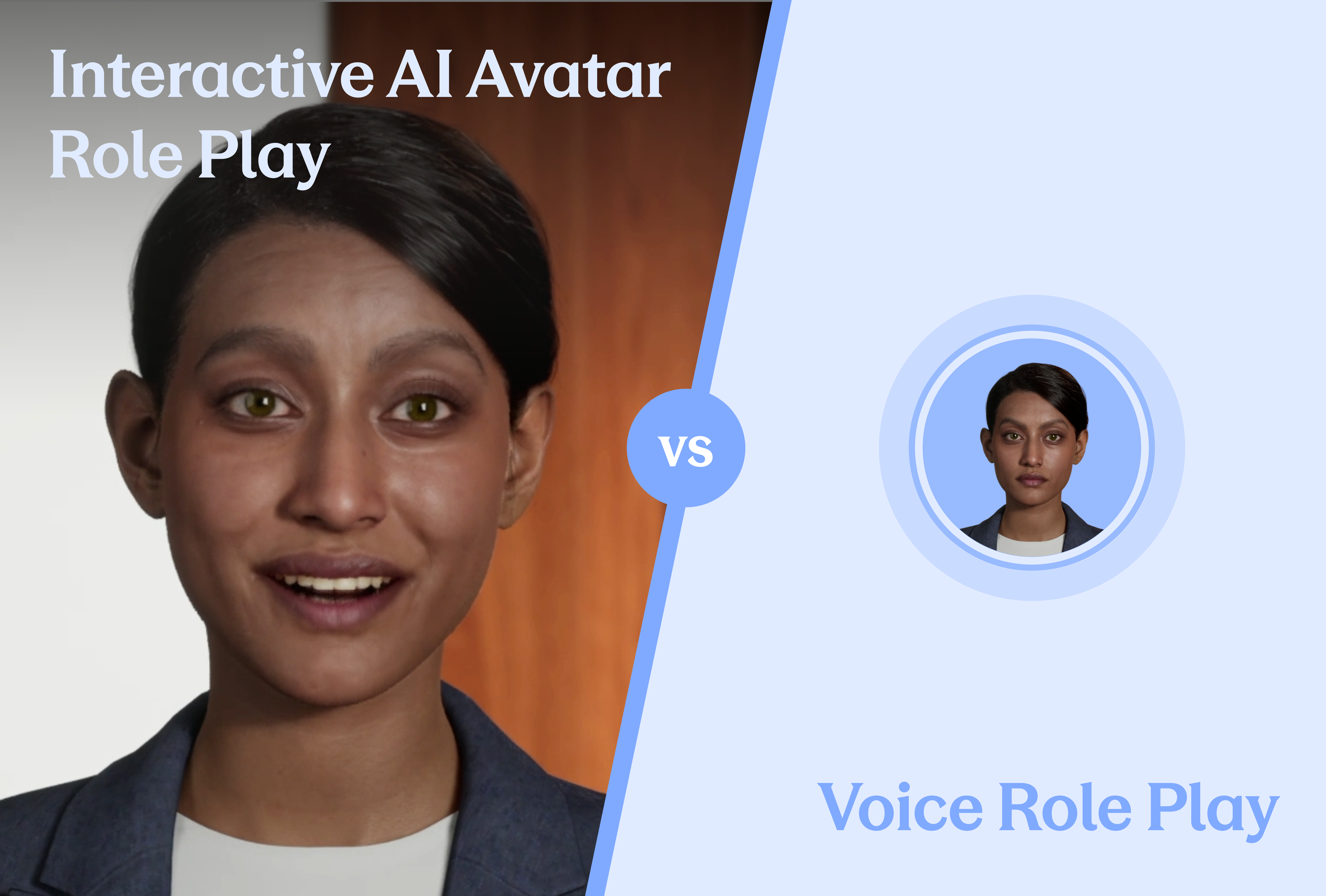
Let's say you're training a new manager on how to handle a tough performance conversation. You could hand them a script, run them through an audio simulation, or put them face-to-face with a realistic avatar. Which do you think sticks?
If your gut says the avatar, you're onto something. And it's not just intuition. There's a reason why embodied, visual role play changes the learning experience in ways that audio alone simply can't match.
Discover why avatar-based role play is becoming the go-to for serious educators, employee development managers, and sales trainersand what makes it genuinely different from voice-only alternatives.
Avatar vs. voice role play
Here's a number worth knowing: 55%. Researchers have long estimated that a significant portion of human communication is nonverbal (opens in new tab). Eye contact, facial expression, posture, micro-expressions, these aren't decorative extras. They're core to how we read each other, build trust, and navigate difficult conversations. About 55 percent of communication is nonverbal.
Voice-only role play strips all of that out.
When your learners practice a sales call or a patient consultation through audio alone, they're working with an incomplete picture. They're not learning to read the room. They're not picking up on the visual cues that, in the real world, will tell them when someone is confused, defensive, or about to disengage.
Avatar role play puts those cues back in. Learners have to pay attention to more than words, and that's exactly the kind of full-picture awareness that transfers to real-world performance.
Avatar vs. voice role play: a side-by-side comparison
Here's how the two formats compare across the factors that matter most for skill development:
Voice-only role play | Avatar role play | |
|---|---|---|
Realism | Audio only, no body language or environment | On-screen character with facial expressions and a setting that mirror the real world |
Feedback quality | Limited to what's said; misses visual cues | Captures verbal and nonverbal reads (about 55% of communication is nonverbal) |
Psychological safety | Safer than practicing with a person | Safe, non-judgmental and immersive, the easiest place to rehearse hard conversations |
Cost / setup | Lightweight and quick to stand up | Higher production, but reusable across scenarios |
Best use case | Phone calls and quick audio drills | Face-to-face, high-stakes conversations (sales, consultations, difficult talks) |
What is voice role play?
Voice role play is an audio-only practice simulation where the learner speaks out loud and an AI (or another person) responds verbally, but there's no visual component.
Think of it like:
A phone call simulation
An audio-only coaching conversation
A back-and-forth dialogue you hear and speak, but don't see
For conversations where body language, facial expressions, and reading the room matter, audio alone can't replicate what learners will actually face. That's where avatar role play comes in.
What is avatar role play?
Avatar role play is an immersive, visual practice simulation where learners interact with an on-screen character in a scenario that mirrors the real world. Unlike audio-only formats, it adds the layer that most high-stakes conversations actually require a face, expressions, and an environment that reflects what learners will encounter when it counts.
Think of it like:
A job interview simulation where the "hiring manager" reacts to how you show up
A difficult conversation with a direct report who pushes back
A sales pitch where the prospect's body language tells you as much as their words
A frustrated hotel guest you need to de-escalate before the situation gets worse
It's the closest thing to real-life practice without the real-life consequences.

Social presence and how we practice
There's a psychological concept called social presence, the feeling that you're actually interacting with another person (or a convincing representation of one). Higher social presence leads to higher engagement, more authentic emotional responses, and better learning outcomes.
Voice-only simulations score relatively low on social presence. You know you're talking to a recording or a system. The stakes feel theoretical.
A well-designed avatar changes that. When a learner can see their conversation partner react, nod, look uncertain, shift body language, something clicks. The brain starts treating the interaction as real. Stress responses activate. Empathy engages. And that emotional engagement is exactly what encodes the learning deeply.
In training contexts, this matters enormously. You want learners to feel the pressure of a difficult conversation during practice, not for the first time on the job.
Receiving feedback for employee development
One of the biggest practical advantages of avatar role play is the richness of feedback it enables.
With voice-only, feedback is limited to what you can observe from speech: tone, pacing, word choice, filler words. That's valuable, but it's not telling the full story.
With avatar role play, you can layer in:
Eye contact patterns: Are learners maintaining appropriate engagement, or avoiding the avatar's gaze when things get uncomfortable?
Nonverbal mirroring: Are they picking up on the avatar's emotional cues and adjusting?
Turn-taking and pacing: Not just what they say, but when and how they say it in response to visual signals.
For educators training people in counseling, healthcare communication, sales, leadership, or customer service, this additional dimension of feedback is game-changing. You're not just coaching the words. You're coaching the whole person.
Psychological safety: a surprising advantage
Here's something that might seem counterintuitive: many learners actually find it easier to practice difficult conversations with an avatar than with a human, even in voice-only formats.
But avatar role play takes this further. The combination of a safe, non-judgmental environment (opens in new tab) and a realistic visual presence helps learners:
Take more risks in their responses (they're not worried about embarrassing themselves in front of a colleague)
Stay in the discomfort of a hard conversation longer (because the stakes feel real but not catastrophic)
Revisit the same scenario multiple times without social awkwardness
This is especially powerful when you're training on sensitive topics: mental health conversations, equity and inclusion discussions, conflict resolution. Learners need a space to be imperfect before they're ready to perform. Avatar role play gives them that space with more fidelity than voice alone.
Ready to see AI role play training in action?
See what AI role play training looks like in practice. Book a Rapport demo and watch learners hold a real face-to-face conversation with an interactive avatar.
Subscribe to our newsletter
Keep updated with Rapport and receive blog posts direct to your inbox
The case for multimodal learning
Learning and development professionals know this well: people learn more when multiple senses and channels are engaged. Reading and hearing and seeing something together creates stronger, more durable memories than any single channel alone.
Voice-only role play is a single channel. Avatar role play is multimodal by design. Learners are simultaneously processing:
What the avatar is saying (auditory)
How the avatar looks and reacts (visual)
Their own verbal and (in some systems) physical responses (kinesthetic)
That multimodal engagement doesn't just make the experience more interesting. It makes the learning more likely to last.
When does voice-only make sense?
To be fair: voice-only role play isn't without merit. It's simpler to deploy, lower bandwidth, easier to scale, and genuinely useful for practicing specific verbal skills in isolation, phone-based customer service training, for instance, or pronunciation and language fluency work.
If the skill you're building is purely verbal, audio-only can be a solid choice.
But if you're training on anything that involves human connection, and most high-stakes professional skills do, the visual dimension isn't a nice-to-have. It's where real skill development happens.
Training people vs. preparing them
The question isn't really avatar vs. voice. It's what level of fidelity does the skill require?
For face-to-face conversations that matter most, the ones your learners are nervous about, the ones that go sideways in real life, the ones where reading the room is everything, avatar role play gives you something voice simply can't: a practice environment that actually resembles the real world.
That's not a small thing. That's the difference between training people and truly preparing them.
Frequently asked questions
What is voice role play?
Voice role play is an audio-only practice simulation where the learner speaks out loud and an AI (or another person) responds verbally, with no visual component, think of it like a phone-call simulation.
What is avatar role play?
Avatar role play is an immersive, visual practice simulation where learners interact with an on-screen character in a scenario that mirrors the real world, adding the face, expressions, and environment that most high-stakes conversations actually require.
When does voice-only make sense?
Voice-only is a solid choice when the skill you're building is purely verbal, for example phone-based customer service training, or pronunciation and language fluency work. It's simpler to deploy, lower bandwidth, and easier to scale. For anything involving human connection and reading the room, avatar role play is the stronger fit.
Turn practice into real-world readiness
Voice-only role play has its place, but if you're building skills that depend on human connection, avatar-based AI role play training gives your learners a safer, more realistic place to practice.
Book a demo with Rapport to see how interactive AI avatars turn practice into real-world readiness.

Fara Rosenzweig, VP of Marketing
Fara Rosenzweig is the VP of Marketing at Rapport.