Interviewer Training: How to Train Hiring Managers to Run Better Interviews
Interviewer training teaches hiring managers how to plan, run, and score job interviews consistently. It covers question design, structured scoring, bias control, candidate experience, and practice. Without it, most managers improvise, and improvisation is the weakest predictor of job performance there is.
Here is the uncomfortable number: about 30 percent of interviewers make up their mind in the first five minutes. The rest of the hour is confirmation. Candidates feel it, bad hires slip through, and the best people accept offers somewhere else. This guide walks through what to teach, how to sequence it, and why practice matters more than another slide deck.
October 27, 2026
Key Takeaways
- Most interviewers are untrained. Roughly 1 in 4 non-HR hiring stakeholders gets no training before interviewing, and 57 percent say they need better training to judge skills.
- Structure is the biggest lever. Structured interviews predict job performance about twice as well as unstructured ones (validity .42 vs .19).
- Snap judgments are real. About 30 percent of hiring decisions are made in the first five minutes, and trained interviewers are far less prone to it.
- Practice beats lecture. Simulation-based training produced 14 percent higher skill-based knowledge than comparison methods across 65 studies.
- AI roleplay closes the gap. Managers can rehearse full interviews with a lifelike AI candidate, get scored on observable behaviors, and repeat until the structure sticks.
Why Most Hiring Managers Have Never Been Trained to Interview
Companies spend heavily on recruiting and almost nothing on the 45 minutes where the decision actually gets made. A 2025 survey of 1,000 US hiring decision makers found that 24 percent of non-HR hiring stakeholders receive no training before they interview candidates. More than half said they need better training to evaluate skills.
The problem runs deeper than interviewing. In a survey of 3,000 managers, 84 percent said they had received no formal people-leadership training since being promoted. Interviewing is just one more skill they are expected to pick up by osmosis.
That gap shows up as inconsistency. HR-based hiring managers usually get a checklist or standardized questions. Line managers often get a resume, a calendar invite, and good luck.
This is the same pattern we see across leadership simulation work: managers are promoted for technical results, then handed people decisions they have never practiced. Interviewer training is where that fix starts.
What Untrained Interviewing Costs
Untrained interviewing fails in two directions at once. It lets the wrong people in, and it pushes the right people away.
The wrong people get in
In a Harris Poll survey of more than 2,200 hiring managers, 74 percent admitted to hiring the wrong person for a role, at an average cost of $14,900 per bad hire. Supervisors then spend about 17 percent of their time managing poor performers. The interview is the cheapest place to catch that mistake.
The right people walk
Candidates judge the company by the interviewer. Gallup found that 44 percent of recently hired workers said interviews with the people who hired them had the most influence on accepting the offer. LinkedIn's research adds that 83 percent of candidates say a negative interview experience can change their mind about a company they once liked.
Decisions happen fast
A field study of 691 applicants and 166 interviewers found that about 30 percent of hiring decisions were made within the first five minutes. The encouraging detail: among interviewers with more training, the link between early small talk and quick decisions disappeared. Training changes the behavior.
Structured vs Unstructured Interviews: What the Evidence Says
If you teach hiring managers only one thing, teach structure. A structured interview asks every candidate the same job-related questions, in the same order, and scores answers against a written rubric. An unstructured interview is a conversation that goes wherever the interviewer takes it.
The research gap is not subtle. In the 2022 update to the classic selection meta-analysis, structured interviews had the highest validity of any selection method at .42, while unstructured interviews came in at .19. Put plainly, structure roughly doubles how well the interview predicts job performance.
Here is the trap. Hiring managers consistently rate unstructured interviews as the most effective format, because the conversation feels insightful. Harvard's Iris Bohnet notes that dozens of studies find them among the worst predictors of on-the-job performance. Interviewer training has to overcome that confidence, not just add a rubric.
The 6 Interviewer Skills Worth Training
Good interviewer training is a skills program, not a compliance briefing. These six skills cover almost every failure mode we see in live interviews.
1. Preparing a job-related question set
Managers learn to translate the role's top four or five outcomes into behavioral and situational questions. Each question maps to one competency. No brain teasers, no "tell me about yourself" warm-ups that eat ten minutes.
2. Probing with follow-ups
Candidates give rehearsed answers. Trained interviewers use the STAR frame (situation, task, action, result) to dig for what the candidate personally did. The skill is asking "what did you do next" without leading the answer.
3. Scoring against a rubric, in the moment
Rating after the interview invites memory bias. Managers practice scoring each answer on a behaviorally anchored scale while the candidate is still talking. This is the same observable behavior feedback discipline that makes any skills training stick.

4. Managing bias and snap judgments
Trained interviewers learn to notice the five-minute verdict and park it. They also learn where bias enters: name, school, small talk, and similarity to themselves. The NBER callback study, where identical resumes with white-sounding names got 50 percent more callbacks, is the standard teaching case.
5. Reading and managing the room
Nervous candidates underperform. Interviewers practice pacing, silence, and the nonverbal communication skills that put a candidate at ease without softening the questions.
6. Selling the role honestly
Since 44 percent of new hires say the interviewer drove their decision, closing matters. Managers practice answering tough candidate questions about workload, growth, and culture without overselling.
A 4-Week Interviewer Training Program
You do not need a semester. Four weeks, two hours a week, with practice between sessions, is enough to move a manager from improvising to structured. Here is a sequence that works for enterprise L&D teams.
| Week | Focus | Live session (60 min) | Practice between sessions | Evidence of progress |
|---|---|---|---|---|
| 1 | Why structure wins | Validity data, bias cases, build a question set for a live req | Two AI roleplay interviews using the new question set | Question set approved by HR; both roleplays completed |
| 2 | Probing and STAR | Follow-up drills, listening for "we" vs "I" | Three roleplays with a vague candidate persona | Follow-up rate above 2 per answer in the roleplay scorecard |
| 3 | Scoring in real time | Rubric calibration: the whole cohort scores the same recorded interview | Two roleplays scored against the rubric, compared with AI scoring | Rater agreement within one point on 80 percent of items |
| 4 | Candidate experience and close | Handling tough candidate questions, debrief protocol | One full mock interview end to end, 35 minutes | Manager cleared to interview solo; shadowed once |
The practice column is the part most programs skip. A manager who hears about STAR once will not probe well under pressure. A manager who has run seven practice interviews will. If you need help writing those scenarios, start with our guide on how to design an AI roleplay scenario.
Why Practice Beats a Slide Deck
Interviewing is a performance skill. Like any performance skill, it improves through repetition with feedback, not through exposure to content.
The research backs this up in two ways. A meta-analysis of 65 studies covering 6,476 trainees found that simulation-based training produced 14 percent higher procedural knowledge and 9 percent higher retention than comparison methods. And rater training works: when assessors received frame-of-reference training, actual performance explained 54.6 percent of their rating variance, versus 33.5 percent for untrained raters.
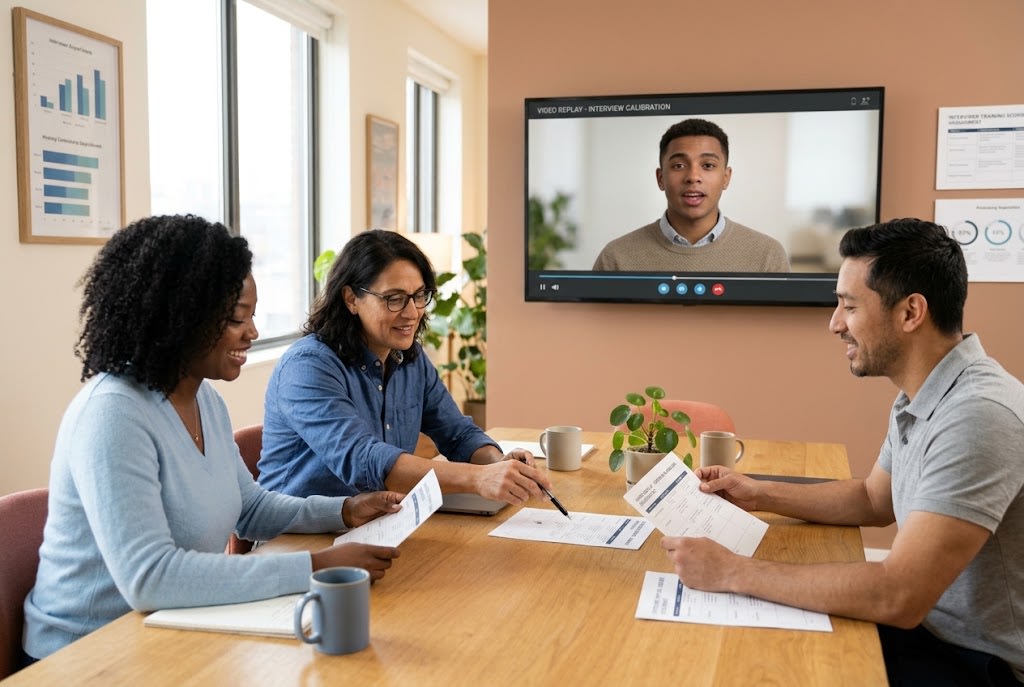
The practical limit has always been reps. HR cannot roleplay a candidate for every manager five times. Peer roleplay is awkward and inconsistent, which is why we compared AI roleplay vs manager roleplay head to head.
How AI Roleplay Fits Interviewer Training
AI roleplay gives every hiring manager an unlimited supply of candidates to practice on. In Rapport, the manager interviews a lifelike, real-time AI avatar that answers in character, hesitates, rambles, or deflects the way a real candidate would. The manager practices the structure until it is automatic.
- Persona variety. Build a rehearsed candidate, a nervous candidate, an overconfident one, and one who gives "we" answers to every question. Managers learn to probe each.
- Scored on behavior. The platform tracks whether the manager asked every planned question, how many follow-ups they used, how much of the time they talked, and whether they rated during or after the answer.
- Face-to-face realism. The avatar has a face, voice, and expression, so the manager also practices pacing, eye contact, and reading discomfort. That matters for the candidate-experience half of the job.
- Private reps. Managers can fail in private. Nobody from HR is watching the first clumsy attempt, which is why completion rates are high.
- Consistent across the company. Every manager practices the same scenario set, so your structured process is actually structured in practice, not just on paper.
For HR teams evaluating platforms, our roundup of the best AI HR tools covers where roleplay fits alongside ATS and assessment software. The short version: assessment tools score the candidate, and roleplay trains the interviewer. Most companies have the first and not the second.
How to Measure Whether Interviewer Training Worked
Satisfaction surveys will tell you managers liked the session. They will not tell you interviewing improved. Track these instead, and look at them 90 days after the program.
- Rubric usage rate. Share of interviews with a completed scorecard submitted within 24 hours. Target 90 percent or better.
- Inter-rater agreement. How often two interviewers on the same panel land within one point of each other. Rising agreement means the rubric is real.
- Practice reps per manager. Number of completed AI roleplay interviews. Managers below three reps rarely change behavior.
- Offer acceptance rate. Candidate experience shows up here first.
- 90-day new hire quality. Manager rating of the hire at 90 days, compared with interview score. If the correlation rises, your interviews are predicting better.
These are the same readiness signals we recommend in measuring training readiness for any skills program. The interview is just a conversation with a scorecard, and roleplay scenarios that change behavior are how you move the scorecard.
Interviewer Training FAQ
What is interviewer training?
Interviewer training teaches hiring managers and panel members how to plan, conduct, and score job interviews consistently. It usually covers structured questions, follow-up probing, rubric-based scoring, bias awareness, candidate experience, and hands-on practice.
How long should interviewer training take?
A four-week program with one 60-minute session per week and two or three practice interviews between sessions is enough for most managers. The practice reps matter more than the session length.
Why are structured interviews better than unstructured ones?
Structured interviews predict job performance about twice as well. The 2022 meta-analysis by Sackett and colleagues put structured interview validity at .42 and unstructured at .19, and structure also reduces bias because every candidate gets the same questions and scoring scale.
Can AI roleplay really train interviewers?
Yes. AI roleplay lets a manager run full mock interviews with a lifelike AI candidate, then scores observable behaviors like questions asked, follow-ups used, and talk ratio. Simulation-based training has been shown to improve procedural skill by about 14 percent over comparison methods.
How do you measure interviewer training ROI?
Track rubric completion, inter-rater agreement, offer acceptance rate, and 90-day new hire quality before and after the program. Compare the cost of the program against the cost of bad hires avoided, which averaged $14,900 each in the CareerBuilder survey.
Who should receive interviewer training?
Anyone who sits on a hiring panel, including line managers, senior individual contributors, and executives. Non-HR interviewers are the least likely to have had any training and the most likely to rely on gut feel.
Give Every Hiring Manager Practice Before the Real Thing
Give every hiring manager practice before the real thing
Build a candidate persona, hand managers a structured question set, and let them rehearse with a lifelike AI avatar until the scorecard fills itself in. See how Rapport runs interviewer training at scale.
Try Rapport