Sales Soft Skills Training: Programs That Actually Work
Sales soft skills training builds the human side of selling: empathy, communication, negotiation, and trust. Product knowledge gets your team in the door. Soft skills close the deal. This guide shows what effective programs include and how to choose one.
August 26, 2026
Key takeaways
Soft skills like empathy, communication, and negotiation drive win rates as much as product knowledge
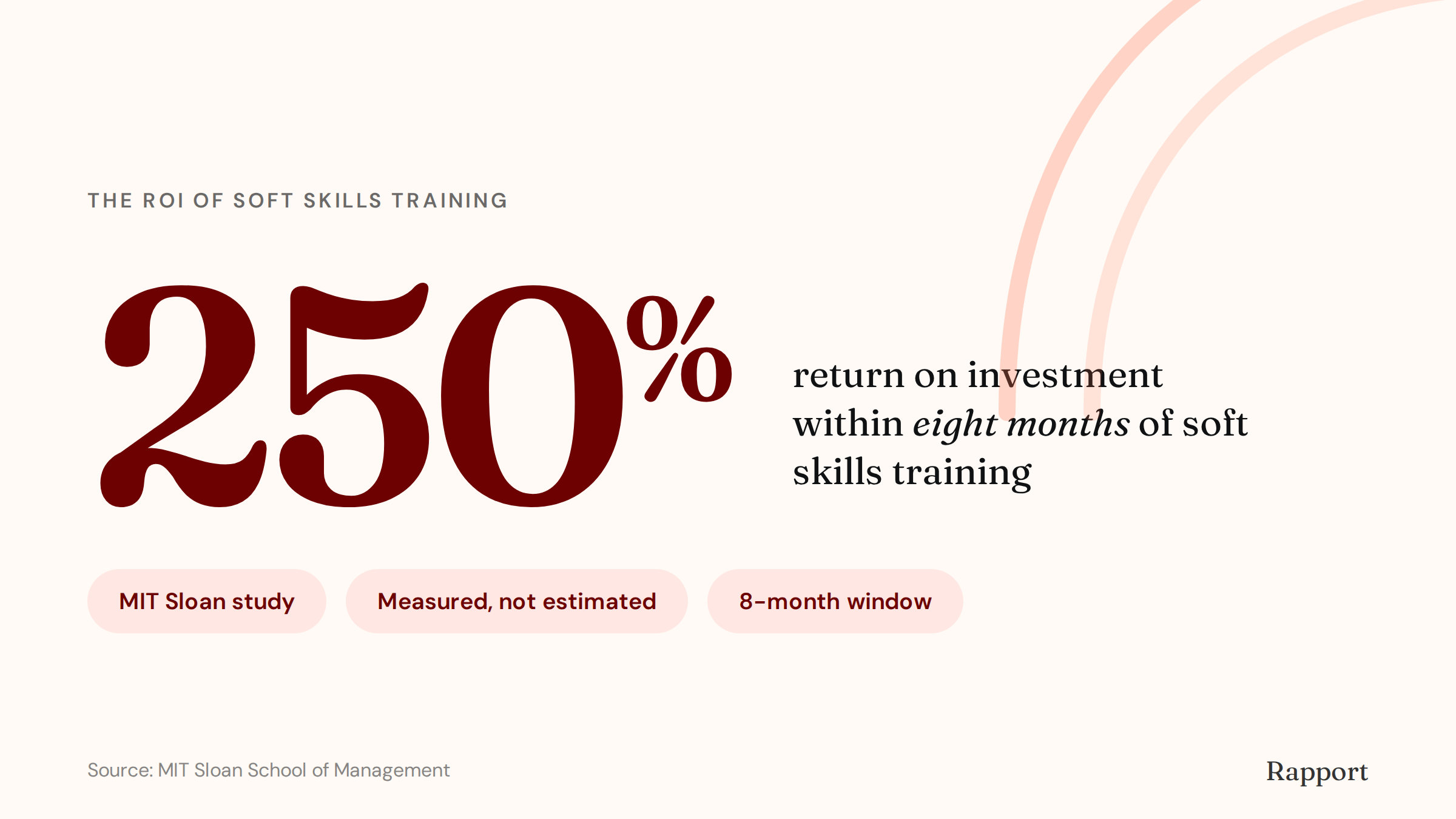
MIT Sloan measured a roughly 250 percent ROI within eight months of soft skills training
The best programs combine role play, coaching, feedback loops, and measurement
Practice beats theory. Reps improve fastest when they rehearse real conversations
Use pre and post training assessments plus sales metrics to prove impact
What are sales soft skills and why do they matter?
Sales soft skills are the interpersonal abilities that build and grow client relationships. They include empathy, clear communication, and emotional intelligence. Hard skills sell the product. Soft skills sell the trust behind it.
These skills separate a salesperson from the competition. They help reps connect with buyers on a human level, which turns one-time deals into repeat business. Most teams also misjudge where their gaps are. Our research on sales team skill gap analysis found the weakest skill is often not the one being trained.
Strong sales soft skills deliver:
Higher customer satisfaction and loyalty
Better negotiation outcomes
More confidence handling objections
A buying experience competitors cannot copy
Key sales soft skills every professional needs
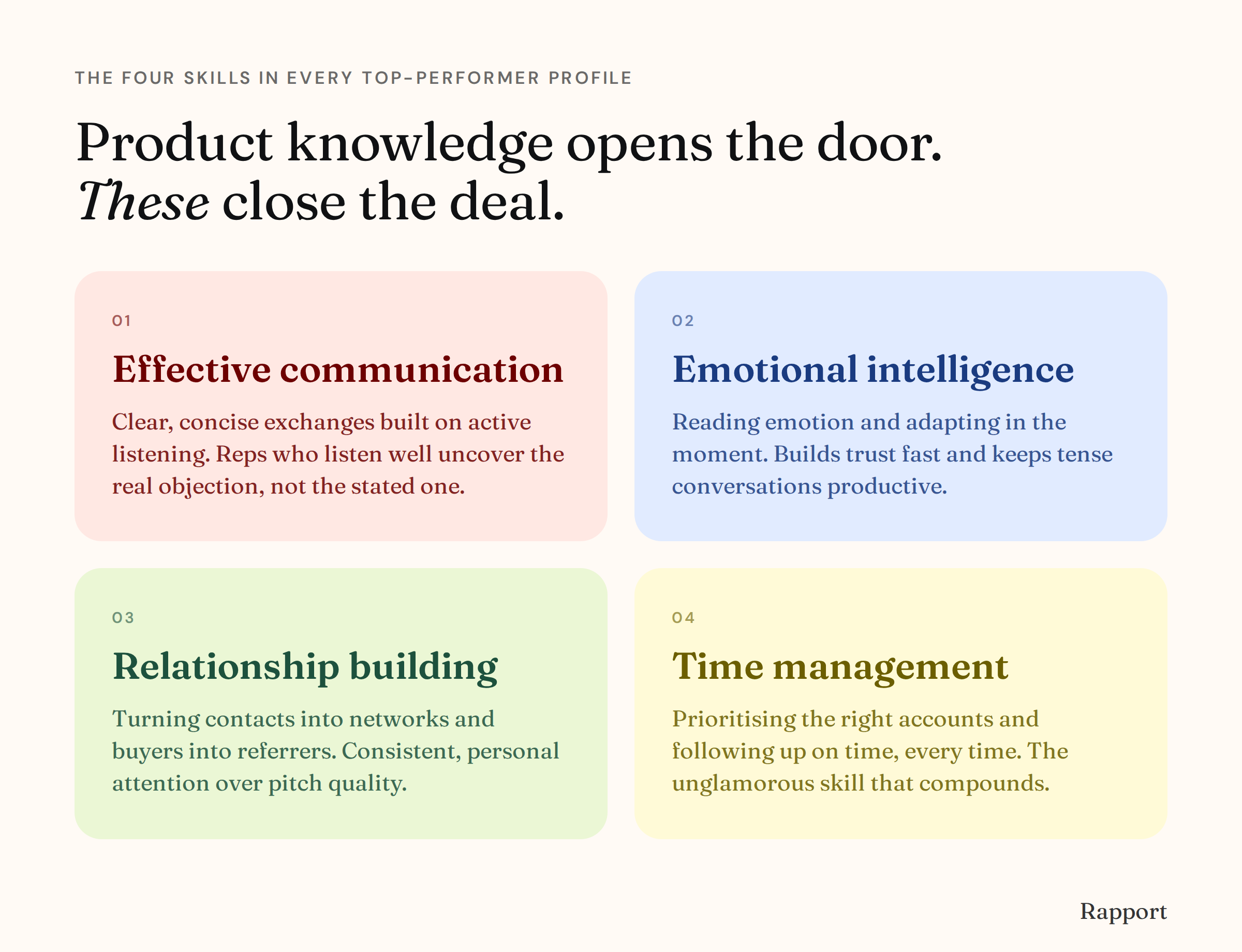
Four skills come up in nearly every top-performer profile:
Effective communication. Clear, concise exchanges built on active listening. Reps who listen well uncover the real objection, not just the stated one
Emotional intelligence. Reading emotions and adapting in the moment. This builds trust fast and keeps tense conversations productive
Relationship building. Turning contacts into networks and buyers into referrers
Time management. Prioritizing accounts and following up on time, every time
Each of these improves with structured practice. None of them improves from a slide deck.
The impact of soft skills training on sales performance
The evidence here is strong. Talent leaders overwhelmingly rank soft skills at the top of what makes hires succeed or fail.
In LinkedIn's Global Talent Trends research (opens in new tab), 92 percent of talent professionals said soft skills matter as much or more than hard skills, and 89 percent said bad hires usually lack them. For sales teams, trained soft skills show up directly in the pipeline:
Better customer interactions and higher trust
Higher close rates on competitive deals
Stronger objection handling that saves at-risk deals
More renewals and referrals from satisfied buyers
Give your team a place to practice
Reading about soft skills builds awareness. Practicing them builds skill. Rapport lets reps rehearse cold calls, discovery, and objection handling with lifelike AI avatars that listen and respond in real time. More than 610,000 role plays have been run on the platform.
Start your free 14-day trial (no credit card) | See the platform
Core components of effective sales soft skills training programs
Effective programs share four traits. They are tailored to your team, interactive, measured, and continuous. One-off workshops fade within weeks. Systems stick.
Interactive exercises such as role play scenarios and simulations
Continuous feedback loops after every practice session
Learning modules tailored to your playbook, ICP, and deals
Practical application on real accounts, not generic scripts
Technology raises the ceiling here. AI-powered simulations give reps unlimited practice without burning manager hours. Visual, face-to-face practice matters too. About 55 percent of communication is nonverbal, which is why avatar role play outperforms voice-only practice.
Popular sales training techniques for soft skills development
Different techniques do different jobs. Most strong programs combine two or three.
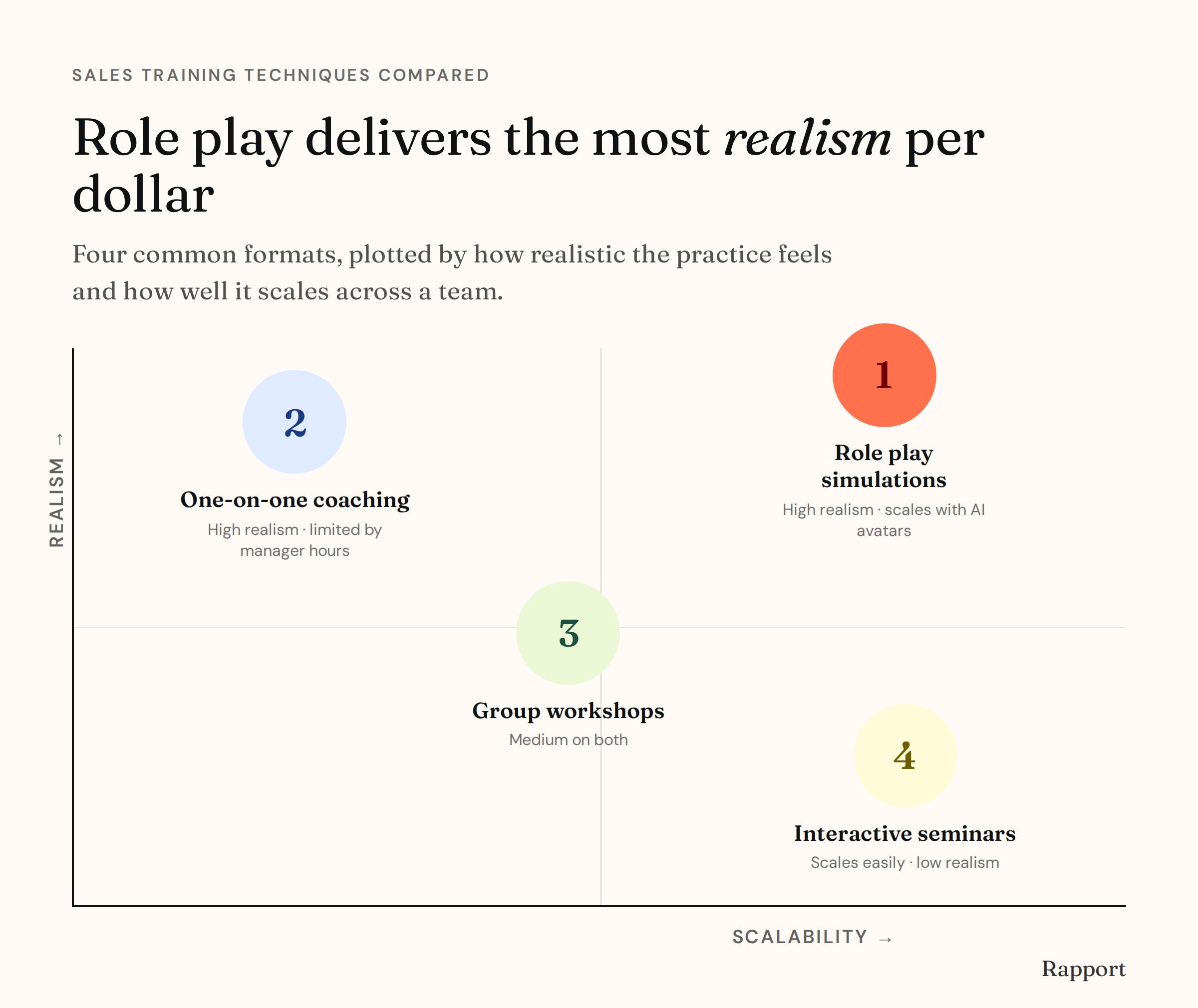
Technique | Best for | Scalability | Realism |
|---|---|---|---|
Role play simulations | Building conversation reps and muscle memory | High with AI avatars | High |
Group workshops | Team alignment and peer learning | Medium | Medium |
One-on-one coaching | Personalized feedback on specific gaps | Low | High |
Interactive seminars | Introducing new frameworks and concepts | High | Low |
----
Role play delivers the most realism per dollar. This is especially the case when reps can practice on demand. If you are comparing options, see our breakdown of the best AI roleplay platforms for training teams.
Relationship building skills: the foundation of sales success
Trust is the bedrock of every long client relationship. Reps earn it through consistent, personal attention, not through pitch quality alone.
Active listening that proves you heard the real concern
Regular follow-ups that arrive before the client asks
Personalized communication tied to the client's goals
Buyers who feel understood come back, and they bring referrals with them.
Effective communication skills in sales: practical strategies
Clarity closes deals. Three habits make the biggest difference:
Practice active listening and confirm what you heard
Use positive, collaborative language
Adapt your style and tone to each buyer
Reps who match the buyer's communication style build rapport faster and surface hidden concerns earlier in the deal.
Negotiation skills training: turning conversations into deals
Negotiation balances assertiveness with empathy. Good training covers three moves:
Finding mutual interests that set up win-win outcomes
Persuasion techniques that guide, not push
Flexibility to adapt when the buyer's needs shift mid-deal
Reps who negotiate this way close more and protect margin while doing it.
The role of sales coaching programs in soft skills development
Coaching turns practice into progress. Strong programs pair every practice rep with targeted feedback, so improvement compounds week over week. Sales leaders use Rapport to see exactly which skills each rep needs coached, from discovery to closing.
Developing emotional intelligence for tough conversations
Sharpening listening skills with session-level feedback
Building resilience under pressure
How to choose the right sales soft skills training for your team
Start with a skills assessment to find your real gaps. Then evaluate programs against your goals. L&D teams typically score options on three criteria:
Alignment with your sales goals and playbook
Flexibility and access, so reps can practice on demand in any language or time zone
A measurable track record with teams like yours
Explore how learning and development programs scale this across an entire organization.
Measuring the effectiveness of sales soft skills training
Prove impact with a mix of numbers and feedback. Capture a baseline before training starts, then track:
Pre and post training skill assessments
Feedback from participants, peers, and managers
Sales metrics such as close rate, deal velocity, and retention
Review these on a set cadence. Real measurement also justifies the budget to stakeholders and shows you where to refine the program next.
Frequently asked questions
What are sales soft skills?
Sales soft skills are interpersonal abilities such as empathy, communication, active listening, negotiation, and emotional intelligence. They determine how well a rep builds trust and guides buyers, separate from product or technical knowledge.
Are sales soft skills training programs effective?
Yes, when they include practice and feedback. MIT Sloan research measured a roughly 250 percent return on investment within eight months of soft skills training. Programs built on role play and coaching outperform lecture-style training.
What is the best way to train soft skills in sales?
Repeated, realistic practice. Role play simulations let reps rehearse cold calls, discovery, and objection handling in a safe space, then apply feedback immediately. AI avatar platforms make this available on demand without scheduling.
How do you measure soft skills training ROI?
Compare pre and post training assessments, gather participant and manager feedback, and track sales metrics like close rate and retention against your baseline. Improvement across all three confirms the program is working.
Conclusion: invest in sales soft skills for long-term growth
Sales soft skills are trainable, measurable, and directly tied to revenue. Teams that practice consistently win more deals, keep more customers, and adapt faster when the market shifts. The companies that treat soft skills as a system, not an event, build an advantage that compounds.
Ready to turn training into muscle memory?
See how teams at Qualcomm, NBC, and KDDI use Rapport's AI avatars to make soft skills practice a daily habit. Set up your first role play in minutes.