The Best AI Roleplay Platforms for Pharmaceutical & Life Sciences Sales Teams (2026 Guide)
Your reps get minutes, sometimes seconds, of a physician’s attention, and more than half of HCPs now restrict rep access entirely. The teams that win those shrinking windows aren’t the ones with the thickest e-learning library; they’re the ones who practiced the hard conversation before it happened.
August 8, 2026
Here’s an honest look at the five platforms pharma and life sciences commercial teams are evaluating for AI role play training in 2026: where each one is strong, where it isn’t, and what to verify before you sign.

Why pharma sales training is at a breaking point
Three forces have collided to make traditional pharma sales training; the annual workshop, the launch-meeting binder, and the click-through module... all of which can be structurally inadequate.
Pressure on the field force | What the evidence shows |
Physician access | More than 50% of US physicians place moderate-to-severe restrictions on pharma rep access |
Launch performance | About two-thirds of drug launches miss their pre-launch sales expectations (McKinsey) |
Knowledge retention | Unreinforced training decays within days, per forgetting-curve research |
Access is shrinking. More than half of US physicians now restrict access to sales reps (opens in new tab). Every conversation your reps do get is higher stakes, with less room to warm up on a live HCP.
Launches can’t absorb slow ramp-up. McKinsey’s launch research (opens in new tab) finds about two-thirds of drug launches fail to meet pre-launch expectations, and message adherence in the first two quarters is exactly where field execution slips.
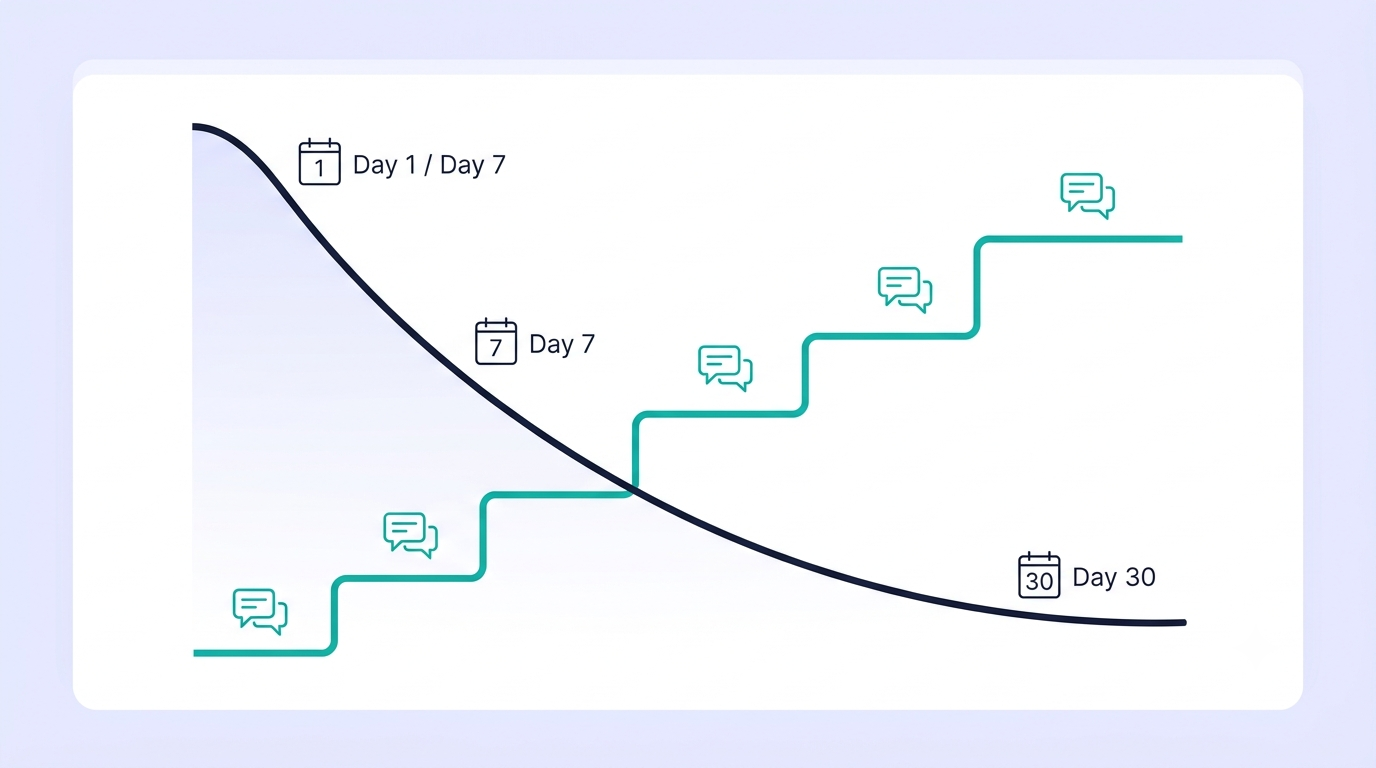
Training doesn’t stick on its own. Studies replicating the Ebbinghaus forgetting curve (opens in new tab) confirm that most newly learned material decays within days without active reinforcement. A launch meeting in January is not a capability in March.
Live coaching can’t scale. Workshops and manager ride-alongs work — for the handful of reps who get them. Across a field force of hundreds or thousands of reps in multiple territories and languages, high-touch practice has always been rationed. AI roleplay removes the rationing.
What is AI roleplay for pharmaceutical sales?
AI roleplay for pharmaceutical sales is simulation-based training in which reps practice HCP conversations against an AI-powered virtual physician that objects, hesitates, and pushes back the way a real doctor would.
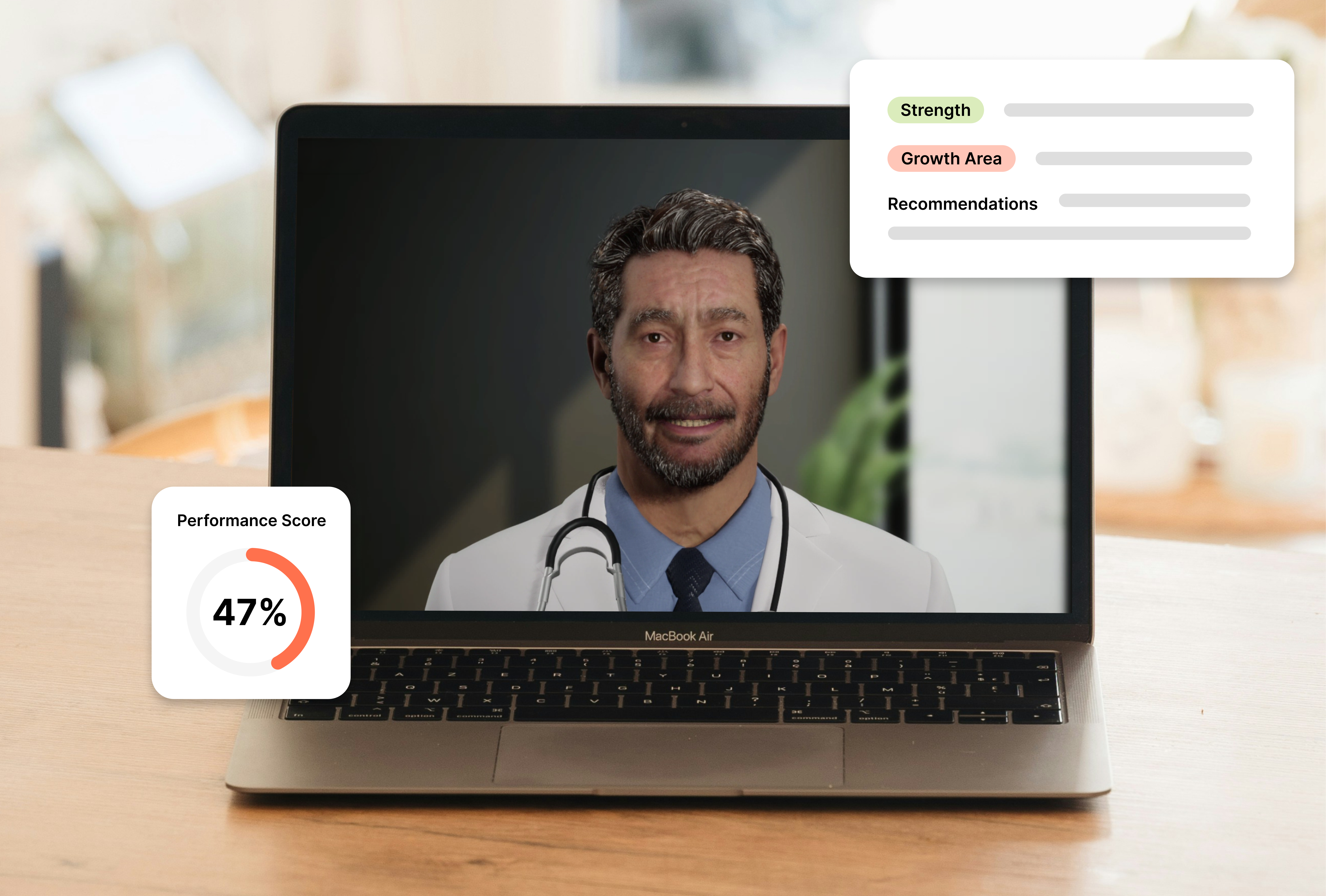
Each attempt is scored against a rubric (like clinical accuracy, messaging adherence, and discovery skill) so reps get unlimited, consistent practice and coaching at field-force scale, without burning live physician access on rehearsal.
The category has moved fast. Early tools were essentially scripted branching quizzes with an avatar on top.
The platforms in this guide are a different generation: live, unscripted conversation with personas that hold character under pushback, scoring engines that can ingest a company’s own definition of “good,” and compliance layers built for medically regulated environments.
In practice, that means a rep can run a two-minute corridor conversation with a skeptical oncologist at 7am, get scored on discovery quality and fair balance, and run it again before the first live call of the day. That is the shift this category is really selling: from knowing the message to being able to deliver it under pressure.
How to evaluate AI roleplay platforms for life sciences
Marketing pages in this category all sound alike. The differences show up under operational scrutiny, and life sciences buyers consistently evaluate across three areas.
1. Realism and technical foundation
Does the persona stay in character under conversational pushback, or break into generic LLM patterns the moment a rep goes off-script?
Is there real clinical reasoning behind the physician personas? A skeptical oncologist should argue differently from a receptive PCP.
Can it simulate the emotional texture of high-stakes dialogue: impatience, skepticism, time pressure, polite disinterest?
2. Customization and compliance
Can the platform ingest your rubrics and your definition of “good,” rather than imposing vendor-standard feedback?
How fast is the path from MLR-approved assets to live, scoring simulations — days or months?
Does it flag off-label language in real time and hold reps to fair balance and medical-legal-regulatory standards?
3. Analytics, reporting and global operations
Are insights cohort-level and aggregate (readiness by region, team, and competency), or individual surveillance-style tracking that managers won’t use?
Is non-English roleplay medically accurate in-market (Japan, Brazil, Germany), or basic UI translation?
Does the infrastructure pass procurement: SOC 2, regional data residency, clear LLM data-handling policies, and integration with Veeva, Salesforce, and your LMS (including SCORM)?
One practical rule for the shortlist: make each vendor prove all three in the pilot, using your scenarios and your assets. Every platform in this category demos well.
The 5 best AI roleplay platforms for pharma & life sciences in 2026
The short version: platforms in this category cluster into two camps — those built for conversation realism and practice volume, and those built for workflow administration and ecosystem integration. Know which problem you are solving before you shortlist.
Platform | Core focus | Life sciences differentiators | Best for |
|---|---|---|---|
Rapport (realism) | Emotionally realistic personas and domain-specific scenarios | Rubric-based skill scoring, cohort competency and compliance views, 50+ languages, SCORM/LMS integration | Authentic HCP discovery practice at global scale |
Quantified.ai (realism) | Adaptive AI agents and behavioral scoring | Private models for regulated industries; 1,400+ behavioral dimensions | Deep behavioral analytics on rep delivery |
SmartWinnr (workflow) | Retention, compliance and gamification | Fair-balance and medical compliance guardrails; 30+ languages | Reinforcement programs across large, gamified field forces |
ACTO (CxZone) (workflow) | Self-service simulation authoring | Separate Clinical IQ and messaging scores; Veeva Vault auto-sync | Teams deep in the Veeva ecosystem who author scenarios in-house |
Atomus (aCoach) (workflow) | Workflow, analytics and KPI dashboards | LMS/HR compliance integration; Microsoft Gold Partner; predictive insights | Analytics-led programs inside Microsoft-centric IT estates |
Comparison based on vendor-published positioning and buyer-side evaluation notes, August 2026. Verify all claims in your own pilot.
1. Rapport: emotional realism and rubric-based scoring, at global scale
Best for: authentic physician conversation practice across a global field force.
Rapport approaches the category from the conversation itself: personas with genuine emotional range — the skeptical KOL, the time-pressed PCP, the receptive-but-distracted specialist — built as domain-specific scenarios rather than generic objection bots. Scoring runs on your rubrics: teams define the competencies and compliance behaviors that matter, and every practice session is scored skill by skill against that definition, rolling up into cohort-level views of competency and compliance that leadership can defend to the executive team.
Emotional realism: personas hold character under pushback and replicate the texture of real HCP dialogue, built on the Speech Graphics / University of Edinburgh research lineage.
Your definition of “good”: ingest internal rubrics and brand messaging frameworks instead of accepting vendor-standard feedback.
Cohort analytics: aggregate competency and compliance views by team, region and skill — insight for management, not surveillance of reps.
Global by design: 50+ languages for in-market practice, SCORM compatibility and LMS integration for enterprise rollout.
Proven at volume: over 1.1 million minutes of practice conversation logged, with life sciences teams at Teva and GSK among the enterprises training with Rapport.
Verify in your pilot: SCORM/LMS integration and SSO against your specific stack — the same operational test you should run on every vendor here.

Pharma scenario demo CTA (mid-article)
2. Quantified.ai: behavioral science depth
Best for: granular behavioral analytics on how reps communicate.
Quantified builds adaptive AI agents with a heavy behavioral-science layer, scoring rep delivery across a very large set of behavioral dimensions (the company cites 1,400+). For regulated industries it emphasizes private models. It is a strong fit when your central question is “how do our reps actually come across?” and you want measurement depth on delivery mechanics.
Verify in your pilot: scorecard clarity — 1,400 dimensions has to roll up into something a manager can coach from — and what “private” data isolation means contractually.
3. SmartWinnr: reinforcement and gamification at scale
Best for: gamified reinforcement and compliance programs across big field forces.
SmartWinnr comes at the problem from retention: gamified reinforcement, quizzes and AI roleplay with fair-balance and medical compliance guardrails, in 30+ languages, with a substantial pharma (and financial services) footprint. It is built for programs where sustained engagement across a large, distributed field force is the core challenge.
Verify in your pilot: the medical fluency of non-English roleplay in your priority markets. In-market clinical accuracy is a much higher bar than translation.
4. ACTO (CxZone): self-service authoring in the Veeva ecosystem
Best for: in-house scenario authoring with Veeva Vault content sync.
ACTO’s CxZone emphasizes self-service simulation authoring with automatic sync from Veeva Vault, and separates Clinical IQ from messaging scores — a useful distinction for medical versus commercial stakeholders. If your content operation lives in Veeva and you want enablement teams building simulations without vendor services, ACTO is built for that motion.
Verify in your pilot: the “instant build” claim against your most complex MLR-approved assets, not the demo deck.
5. Atomus (aCoach): analytics and workflow integration
Best for: KPI dashboards and LMS/HR compliance integration in Microsoft environments.
Atomus positions aCoach around workflow, analytics and predictive KPI dashboards, with LMS/HR compliance integration and Microsoft Gold Partner status — attractive for IT organizations standardized on the Microsoft stack that want readiness data flowing into existing reporting.
Verify in your pilot: that live conversational AI roleplay is genuinely included in the package you are buying, rather than sitting on the roadmap.
Matching the platform to your objective
The honest selection heuristic, based on how these five actually differ:
If your problem is conversation quality — reps who know the data but lose the room, launch messaging that does not survive contact with a skeptical physician — prioritize the realism-first platforms: Rapport and Quantified. This is where structured skill-by-skill coaching and high-volume authentic practice live.
If your problem is program administration — keeping thousands of reps engaged, syncing content from Veeva, feeding readiness KPIs into existing dashboards — the workflow-first platforms (SmartWinnr, ACTO, Atomus) offer broader administrative control and ecosystem synergy.
If you need both, run a two-platform pilot and force the trade-off into the open: score realism with your toughest personas, and score operations with your gnarliest MLR asset and your real LMS. The pilot that survives both is your answer.
Whatever you choose, connect it to targeting. Your ICP criteria scoring already tells you which account personas your reps will face most; those Tier A personas are exactly the scenarios to build first.