The Complete Guide to ICP Criteria Scoring (with a Free Template)
Most teams argue about which accounts feel promising instead of reading what their own data already proves. ICP criteria scoring turns your best-fit customer patterns into a weighted 0-100 rubric, so reps know exactly which accounts to chase first.
August 7, 2026
It's less complicated than it sounds. ICP criteria scoring iranks your target accounts against an ideal customer profile (ICP) using weighted criteria. It looks at data points like industry, company size, revenue, tech stack, geography, growth signals, and sales motion fit.
Each account is scored on every criterion, the weighted results are summed into a 0–100 score, and accounts are tiered so your team pursues the best fits first.
The logic is borrowed from your own history. Somewhere in your sales data, there's an obvious pattern: the customers who bought fastest, expanded most, and churned least share a set of observable traits. ICP criteria scoring turns that pattern into a rubric, so instead of arguing about which accounts "feel" promising, your team reads a number (and knows right away).
When a brand can pull this off well, the payoff is absolute:
Outreach lists sorted by fit instead of alphabet
Marketing spend aimed at accounts that can actually buy
A shared definition of a "good account"
ICP criteria scoring enables an environment that makes it easy for sales, marketing, and RevOps to all agree, because it's coming from concrete data (and not emotions or opinion).
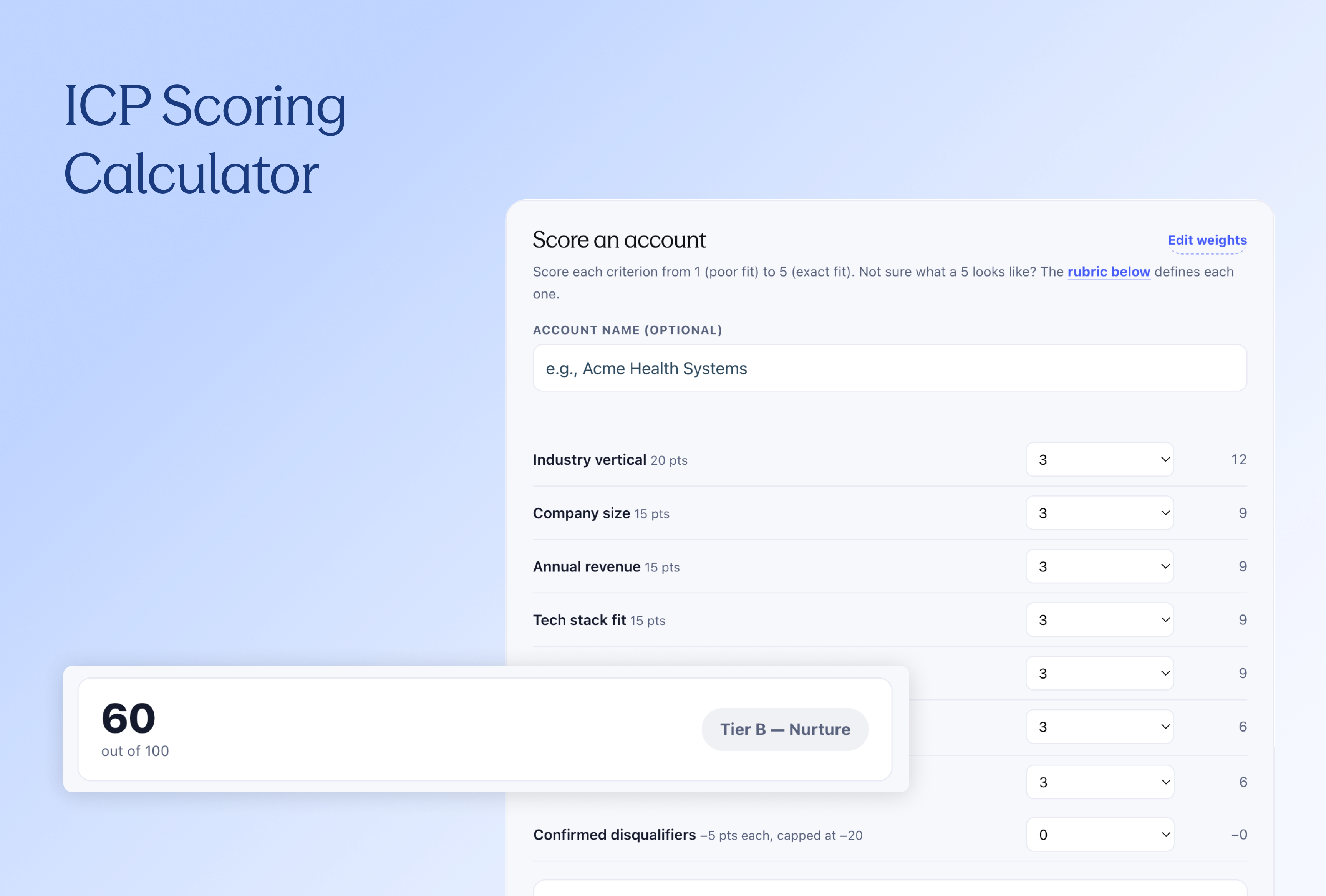
ICP scoring vs. lead scoring: fit is not behavior
These two are always compared, and the confusion is expensive.
ICP scoring measures fit: does this account look like your best customers?
Lead scoring measures behavior: is this specific person showing buying intent right now?
One exists before any interaction; the other only exists because of interaction.
Dimension | ICP criteria scoring | Lead scoring |
|---|---|---|
What it measures | Account fit | Person's intent |
Data source | Firmographics, technographics | Page visits, downloads, replies |
When it exists | Before any contact | Only after engagement |
Answers | Who should we target? | When should we act? |
Owned by | RevOps / sales leadership | Marketing ops |
Fit tells you who to target
Behavior tells you when to act
Mature teams run both, but fit comes first, because intent from a bad-fit account is a distraction, not a signal.
The order matters. A high-intent lead at a terrible-fit account will still burn a quarter of your rep's time and end in a no-decision. Score fit first, then let behavioral signals decide the timing inside your A and B tiers.
The 7 criteria that belong in your scoring model
Every business weighs these differently (that's the point of the weights), but almost every B2B model is built from the same seven ingredients.
On a 100-point scale, here's a proven starting split:
Criterion | Weight | What a 5/5 looks like |
|---|---|---|
Industry vertical | 20 | Exact target vertical with the buying motion you've already won in |
Company size | 15 | Inside the headcount band where your deals close fastest |
Annual revenue | 15 | Big enough to fund the purchase, small enough to actually decide |
Tech stack fit | 15 | Runs the systems you integrate with: CRM, LMS, data stack |
Growth signals | 15 | Hiring in target roles and recent funding or expansion |
Geography | 10 | Primary market, covered territory, workable timezone |
Sales motion fit | 10 | Reachable buying team and a deal size that matches your motion |
Don't skip the negative signals
The strongest models also subtract. A confirmed disqualifier (competitor lock-in through next year, no budget authority in the buying group, a churned lookalike in your history) should cost an account points (we deduct 5 per disqualifier, capped at −20).
Negative scoring is what keeps a superficially perfect account from wasting a quarter of selling time.
Growth signals deserve more weight than most teams give them
Firmographics tell you an account could buy; growth signals tell you it might buy now. A company hiring twelve sales reps has a training problem arriving in ninety days, whether they've named it yet or not. Watch hiring pages, funding announcements, and expansion news; they're the closest thing fit data has to a timing signal.
How to build a 100-point ICP scoring model in 5 steps
Analyze your closed-won deals. Pull your last 20–50 wins and your ten best customers. The traits they share (vertical, size, stack, region) are your criteria. Your losses and churns tell you the disqualifiers.
Pick your seven criteria and define 5-3-1. For each criterion, write down what a 5 looks like, what a 3 looks like, and what a 1 looks like. If two people would score the same account differently, the definition isn't specific enough yet.
Assign weights that sum to 100. Start from the split above, then move points toward whatever your closed-won analysis says predicts wins. Weights are a hypothesis; the data gets the final vote.
Set tier thresholds. A = 80+, pursue now. B = 50–79, nurture until signals improve. C = below 50, deprioritize without guilt. Tiers turn a score into a decision.
Validate quarterly. Compare win rate, deal size, and cycle time by tier. Tier A should win meaningfully more often than Tier B. If it doesn't, adjust the weights; the model serves the data, never the reverse.

Worked example: scoring a real account
Here's the model applied to a realistic target: Let's call them Acme Health Systems, a medical device company an enablement platform might score.
Acme is squarely in the target vertical (5/5 on industry, worth the full 20 points) and shows strong momentum.
They're hiring twelve sales reps and closed a funding round last quarter (5/5 on growth signals, 15 points).
At 800 employees and $120M revenue, they sit one band above the sweet spot, so size and revenue each score 4/5, 12 points apiece.
Their CRM matches, but the LMS is mid-migration (3/5 tech stack, 9 points)
The VP of Sales is reachable only through a warm intro, and no enablement owner has been identified (3/5 sales motion fit, 6 points)
US headquarters in covered territory takes the full 10 for geography.
Sum the weighted points, and Acme lands at 84, at least until the disqualifier check. They're locked into a competitor contract through Q1, and one confirmed disqualifier deducts 5.
Final score: 79. Tier B, by a single point. That last point is the entire value of the exercise.
Without a model, Acme looks like an obvious pursue-now account (great vertical, great momentum), and a rep burns a quarter discovering the contract lock-in the model already priced. With the model, Acme goes into nurture with a calendar reminder for Q1, and the rep's time is spent on an account that can actually sign. Scoring doesn't make accounts better or worse; it makes the truth about them cheap to see.
Try it: score one of your own
Pick one real account from your pipeline and score it against the same 7 criteria. Here's how the Acme example above breaks down on the 100-point model:
Criterion | Score (1-5) | Weighted points |
|---|---|---|
Industry vertical | 5 | 20 |
Company size | 4 | 12 |
Annual revenue | 4 | 12 |
Tech stack fit | 3 | 9 |
Growth signals | 5 | 15 |
Geography | 5 | 10 |
Sales motion fit | 3 | 6 |
Disqualifier (competitor lock-in) | n/a | −5 |
Total (Tier B) | 79 |
After the score: fit gets you the meeting, readiness wins it
Here's where most ICP scoring guides stop, and where most teams stall. Scoring tells you who to pursue. It says nothing about whether your reps are ready for the conversations those accounts require.
Every criterion in your model has a persona attached to it. Score high on "pharma vertical" and your rep is walking into an HCP conversation with minutes of a physician's attention. Score high on "growth signals" and they're selling to a VP mid-reorg with no patience for a generic pitch. Your ICP doesn't just define your target accounts; it defines the exact hard conversations your team needs to be able to hold.
That's a practice problem, and it's the same one that breaks passive training everywhere: knowing the persona on paper and handling the persona in the room are different skills.
With AI role play training, teams turn their ICP tiers into rehearsal: build a scenario for each Tier A persona, let reps practice against a live, reactive avatar that pushes back the way that buyer actually would, and score the attempts against a rubric, the same discipline you just applied to accounts, applied to readiness.
You can try that in the browser before you build it: run a live discovery call demo, practice a difficult employee conversation, or work through managing client expectations, each with a real-time avatar that answers back.
The pipeline math only works when both halves do. Fit scoring puts the right accounts on the list; conversation practice makes sure the meetings you win convert.
Live discovery call demo CTA
Frequently asked questions
What is ICP criteria scoring?
ICP criteria scoring is a method of ranking accounts against your ideal customer profile using weighted, objective criteria such as industry, company size, revenue, tech stack, growth signals, geography and sales motion fit. Each criterion gets a score and a weight, and the weighted total tells your team which accounts deserve attention first.
What criteria should be included in an ICP scoring model?
Most B2B teams get the best results from seven criteria: industry vertical, company size, annual revenue, tech stack fit, growth signals, geography and sales motion fit. Add explicit disqualifiers too, such as competitor lock-in or a buying committee you cannot reach, and subtract points when they appear.
What is a good ICP score?
On a 100-point model, 80 and above is a Tier A account worth immediate, personalized outreach. Scores from 60 to 79 are Tier B and belong in a nurture or lighter-touch sequence. Anything under 60 is Tier C and generally should not consume rep time until something about the account changes.
What is the difference between ICP scoring and lead scoring?
ICP scoring measures fit: whether an account looks like the customers you already win. Lead scoring measures behavior: whether a specific person is showing buying intent through demos, pricing pages or email replies. Fit exists before anyone raises a hand, so ICP scoring tells you who to target while lead scoring tells you when to act.
How often should you update your ICP scoring model?
Review the model quarterly. Pull the deals you closed and lost in the last 90 days, score them retroactively, and check whether your Tier A definition actually predicted the wins. If high scorers are losing or low scorers are closing, your weights are wrong and need adjusting.
How do you weight ICP scoring criteria?
Start from your closed-won data rather than intuition. Look at the attributes your best customers share, then give the heaviest weights to the criteria that separate wins from losses most sharply. A workable default is 20 points for industry vertical, 15 each for company size, revenue, tech stack fit and growth signals, and 10 each for geography and sales motion fit, for 100 points in total.
Put your scores to work
A scoring model only earns its keep when it changes what your team does next. Score your top accounts, agree on what Tier A actually means, and route the best-fit accounts to the reps who can handle a real discovery conversation.
The free ICP scoring template is a spreadsheet with the seven criteria, weights and tier thresholds already set up. Copy it, adjust the definitions to match your business, and score your top 20 accounts this week.
Want to see what happens after the score? Browse our scenario templates to see how teams rehearse discovery calls against their highest-scoring accounts, or book a live demo and we will walk through it with you.