How to Overcome Cold Calling Fear: A Practice Plan That Works
Overcoming cold calling fear starts with one honest reframe. The fear is not about the phone. It is about not knowing what to say in the first 20 seconds, and no amount of motivation fixes a skills gap.
Sales leaders know it too. In a 2026 ValueSelling survey, 39% said their reps are afraid to pick up the phone, and 46% said reps give up too easily. The reps are not broken. They have never had a safe place to practice until the opener, the objection, and the recovery feel automatic. This guide gives them one.
October 25, 2026
Key Takeaways
Key Takeaways
- Cold calling fear is a skills gap, not a character flaw. Reps freeze because the first 20 seconds are unrehearsed, not because they lack courage.
- Leaders see it clearly. 39% of sales leaders say their reps are afraid to pick up the phone, and 46% say reps give up too easily (ValueSelling, 2026).
- The math is unforgiving. Only 9.9% of dials connect, and about 370 dials go into every booked meeting (Belkins, 2025). Hesitation shrinks the funnel further.
- Confidence follows reps, not the other way around. You practice first, and the calm shows up after the fiftieth rep, not before the first.
- A 14-day practice plan works. Short daily roleplay reps against realistic objections build the automaticity that kills the fear.
Why Cold Calling Feels So Scary
Cold calling fear has a clinical name in sales research. Behavioral Sciences Research Press calls it call reluctance, and their long-running studies found that 40% of established salespeople hit stretches of reluctance severe enough to threaten their careers. That number includes veterans, not only new hires.
The fear is rational on the surface. A stranger can hang up, snap at you, or expose a gap in your knowledge. Your brain treats a possible social rejection the way it treats a physical threat, so your heart rate climbs before you even dial.
Three triggers show up again and again when you ask reps what they dread:
- The blank opener. Not knowing the exact words for the first 10 seconds, so every call starts with a stumble.
- The sharp objection. "Not interested," "send me an email," or "how did you get this number," delivered with an edge.
- The silence after a fumble. Losing the thread mid-call and having no recovery line ready.
Notice that none of these are confidence problems. They are rehearsal problems. A rep who has handled "send me an email" 60 times in practice does not feel the spike when it happens for real.
What Call Reluctance Costs
Fear is expensive because cold calling is a volume game with thin margins. Belkins analyzed more than 175,000 B2B dials in 2025 and found a 9.9% connect rate. Of the conversations that followed, 4.6% booked a meeting, which works out to roughly 370 dials per meeting.
A reluctant rep does not just dial less. They also hang up faster, accept the first brush-off, and skip the second and third attempts that produce most connects. Belkins found the average prospect needs about three attempts, and per-prospect connect rates climb to 24.5% when reps keep going.
The older Behavioral Sciences Research Press figure is blunter. The average call-reluctant salesperson loses more than 15 potential accounts to competitors every month. That is pipeline leaking out of a fixable skills gap.
Why this matters for training budgets: a team of 10 SDRs that each loses one connect a day to hesitation gives up about 2,500 connects a year. At the Belkins conversation and meeting rates, that is roughly 65 lost meetings. Run the numbers for your own team with the Sales Ramp Time Calculator.
The Confidence Myth
Most advice on cold calling fear gets the order backwards. It tells reps to "believe in the product," "visualize success," or "remember rejection is not personal." Those ideas are fine, but they ask for confidence before the rep has earned it through reps.
Confidence is a lagging indicator. It shows up after a behavior becomes automatic, the same way a new driver stops gripping the wheel once merging feels routine. Nobody talks a new driver into calm; they drive until the fear fades.
The learning science backs this up. Benjamin Bloom's famous 1984 research found that mastery learning with feedback and correction moved students a full standard deviation above conventional instruction, and one-on-one tutoring moved them two. The mechanism was practice with immediate correction, not pep talks.
- Motivation decays in days. Gartner-cited research puts training forgetting at 70% within a week and 87% within a month.
- Automaticity lasts. A rep who has rehearsed an objection 50 times does not need to remember the answer. It arrives on its own.
- Behavior change is rare without practice. Robert Brinkerhoff's research found only about 15% of training participants sustain a behavior change, and that minority had chances to practice and get feedback.
So the goal is not to feel brave. The goal is to make the scary moments boring through repetition. Our piece on why most skills programs do not stick covers the same failure in more depth.

The 14-Day Practice Plan
This plan is built for 15 minutes a day. It does not require a manager on every rep, and it works with a peer, a recorder, or an AI roleplay partner. The sequence matters more than the tool.
| Days | Focus | Daily drill | Done when |
|---|---|---|---|
| 1 to 3 | The opener | Deliver your 10-second opener 20 times out loud. Record it. Cut every filler word. | You can say it without reading and without "um." |
| 4 to 6 | The brush-off | Practice three responses each to "not interested," "send me an email," and "we already have a vendor." | Each response is under 12 seconds and ends in a question. |
| 7 to 9 | The hard persona | Roleplay against a rushed, skeptical buyer who interrupts. Hold the thread without apologizing. | You stay calm through two interruptions in a row. |
| 10 to 12 | The recovery | Have your partner throw a question you cannot answer. Practice the bridge: acknowledge, park, redirect. | You recover within one sentence, three times in a row. |
| 13 to 14 | Live reps | Make 20 real dials a day with a scorecard open. Review the two toughest calls immediately. | Your self-rated anxiety drops by at least 3 points on a 10-point scale. |
- Keep sessions short. Fifteen focused minutes beat a one-hour session you dread and skip.
- Practice out loud, standing up. Silent review does nothing for vocal confidence. Your voice needs the reps.
- Make the practice harder than the real thing. If your practice buyer is tougher than any real prospect, the real call feels like a break.
- Review immediately. Feedback delivered the same minute is worth ten times the same note a week later.
If you want to build your own scenario for a roleplay partner, our guide on how to design an AI roleplay scenario walks through persona, objective, and difficulty settings.
Scripts for the Three Scariest Moments
Scripts do not make reps robotic. They make the scary moments predictable, which frees attention for actually listening. Use these as starting points and rewrite them in your own words.
The opener (10 seconds): "Hi Dana, this is Sam with Rapport. I know I'm calling out of the blue. Can I take 30 seconds to tell you why, and you can tell me if it's worth more?"
Why it works: it names the awkwardness, asks for a tiny commitment, and gives the buyer control.
"Send me an email": "Happy to. So I send something useful instead of generic, what's the one thing your team is working on this quarter that an email would need to speak to?"
Why it works: it agrees, then turns the brush-off into a discovery question.
The question you cannot answer: "Good question, and I don't want to guess. Let me park that and get you the exact answer today. Can I ask one thing first so I send the right one?"
Why it works: honesty builds trust faster than a confident wrong answer, and the bridge keeps the call moving.
For a deeper library of objection responses, see AI objection handling training. For full cold call structure, start with AI cold call training.
How AI Roleplay Removes the Fear
The hardest part of the 14-day plan is finding a practice partner who is available every day, never gets bored, and can play a truly difficult buyer. Peers are busy and managers are busier. That gap is exactly where AI roleplay fits.
An AI roleplay avatar can play the rushed CFO, the skeptical IT lead, or the friendly gatekeeper on demand. It interrupts, pushes back, and reacts to tone in real time. Because it is not a coworker, reps stop performing and start practicing.
- Unlimited reps with zero social cost. A rep can fail the opener 30 times at 7 a.m. and nobody on the team knows.
- Difficulty that scales. Start with a warm persona and dial up hostility as the rep improves, the same way a coach adds weight to the bar.
- Face-to-face realism. Rapport avatars show facial reactions, so reps learn to read hesitation and irritation, not just hear it. Our comparison of avatar roleplay versus voice roleplay explains why that matters.
- Instant, observable feedback. Scoring on talk ratio, filler words, and whether the rep asked a question after the objection. See observable behavior feedback for the rubric logic.
How to Measure Progress
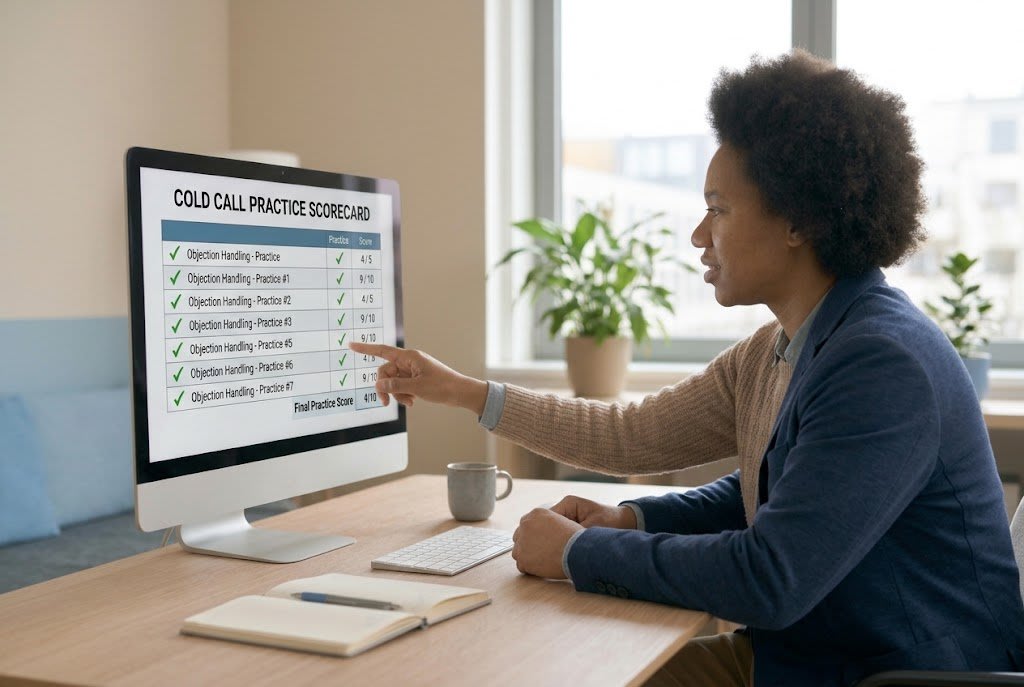
Fear is invisible on a dashboard, so measure the behaviors that fear suppresses. Pick four numbers and track them weekly for every rep in the program.
- Dials per hour. Reluctant reps pad the gaps between calls. Rising dials per hour is the first sign the fear is lifting.
- Second-attempt rate. What share of prospects get a second and third call? Belkins data shows connects more than double when reps keep going.
- Objection-to-question rate. After an objection, did the rep ask a question or end the call? This is the single best proxy for composure.
- Self-rated anxiety. A simple 1 to 10 rating before each call block. It is subjective, and it is still the most honest early signal.
Layer these over your practice scores and you get a readiness picture, not just an activity report. Our guide to measuring training readiness shows how to combine practice and live data.
What Managers Should Do
Managers often make cold calling fear worse without meaning to. Public call reviews, leaderboards that shame the bottom, and "just dial more" feedback all raise the social cost of failing. Here is what helps instead.
- Separate practice from performance. Make it explicit that practice reps are never scored for comp or ranking. Reps need one place where failing is free.
- Review the recovery, not the fumble. When a call goes sideways, ask "what did you do next" instead of "why did that happen." It trains the bridge instead of the fear.
- Model it. A manager who makes five cold calls in front of the team once a month, including the bad ones, does more for reluctance than any speech.
- Protect the 15 minutes. If practice time gets eaten by pipeline reviews, the plan dies in week one. Block it on calendars.
Teams that pair this with a structured soft skills program see the fear fade faster. See sales soft skills training programs that actually work for the broader framework.
Frequently Asked Questions
Why am I so afraid of cold calling?
Because your brain treats possible rejection like a threat, and because the first 20 seconds of a call are usually unrehearsed. The fear is a skills gap wearing a confidence costume. Practice the opener and the top three objections until they are automatic and the fear shrinks.
How common is cold calling fear?
Very. In ValueSelling's 2026 survey, 39% of sales leaders said their reps are afraid to pick up the phone, and Behavioral Sciences Research Press found 40% of established salespeople go through career-threatening call reluctance.
How long does it take to get over cold calling fear?
Most reps feel a clear drop within two weeks of daily 15-minute practice, which is why this plan runs 14 days. The fear does not vanish on day one. It fades once the scary moments become routine, usually somewhere around 50 practice reps.
Does cold calling still work?
Yes. About 47% of sales leaders rank a cold call from a rep among the most effective prospecting methods, second only to referrals (ValueSelling, 2026). The connect rate is low, around 9.9%, so persistence and composure decide who wins.
Can AI roleplay really help with call anxiety?
Yes, because it removes the two things that keep reps from practicing: an available partner and the social cost of failing. An AI avatar plays a difficult buyer on demand, reacts in real time, and scores the rep instantly, so reps get the 50 reps that build automaticity.
CTA
Give your reps 50 safe reps before their next real dial
Rapport's live AI avatars play the rushed buyer, the skeptic, and the gatekeeper on demand, react to tone and wording in real time, and score every rep instantly. Build a cold call scenario in minutes and watch the fear fade by week two.
Start a free trial