How to build a skills development program
By Fara Rosenzweig June 8, 2026

Intro to skills development
Soft skills training is one of the most consistently underfunded, under-measured, and misunderstood investments organizations make.
Leaders know it matters. Teams feel the gap. But when it comes time to show the return on investment (ROI), learning and development (L&D) professionals are often left pointing to completion rates and quiz scores (neither of which tells you whether anyone actually improved).
Here's the harder truth: the problem isn't commitment to training. It's the gap between learning and doing.
The learning gap
Think about the last time you prepared for a difficult conversation: a tough performance review, delivering bad news, navigating conflict. You might have read about it, practiced in your head, or even role-played it with a colleague. And then you walked into the room and it felt nothing like the preparation.
That's the gap. The space between the training world and the real world.
In the training world, you have scripts, frameworks, videos, and workshops. These are valuable — but they're controlled. In the real world, people walk in with hidden motivations written all over their faces. Emotional tones shift mid-conversation. The person across from you may shut down, push back, or get emotional in ways no workshop fully prepares you for. Your best performers aren't just using a framework — they're reading a room, adjusting in real time, and making it look effortless.
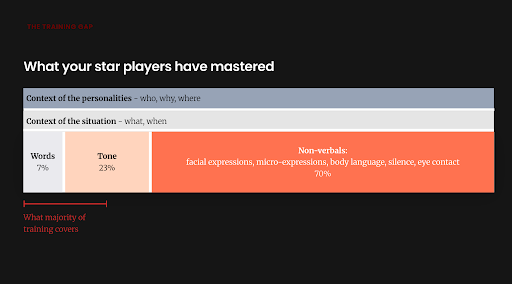
the gap continue
That gap between knowing and doing is where most talent development programs lose their impact. And closing it typically relies on one thing: time. More meetings, more reps, more exposure to high-stakes conversations over months or years.
That's a slow, expensive, and uneven path to building a capable workforce.

Why difficult conversations are hard to train
Difficult conversations share a few defining characteristics that make them uniquely hard to replicate in training:
High emotional stakes. Delivering tough news, navigating conflict, or addressing poor performance all carry real emotional weight — for both parties.
Power imbalances. Whether it's a manager and a direct report, a seller and a buyer, or a junior employee pushing back on a senior leader, the dynamics in the room shape everything.
Hard-to-reverse outcomes. Unlike a quiz you can retake, a poorly handled conversation about a structural change or a missed promotion can damage trust in ways that take months to rebuild.
And the skill required to navigate all of this is deeply layered. You need to hold context about who you're talking to and why, stay clear about your goals, read verbal and non-verbal cues simultaneously, and still deliver your message with precision and empathy. Your top performers do this naturally. Most people need to practice.
The problem is that most organizations don't have a good way to let people practice.
Give one of our role play conversations a try.
The limits of today's practice formats
In-person workshops are effective. Flying teams together for a quarterly training session creates shared language, real engagement, and genuine takeaways. But they're expensive, infrequent, and by design, temporary. The learning fades when the environment changes.
Peer role-plays are another common approach (and almost universally dreaded). There's no psychological safety when you're performing in front of your manager or colleagues. The fear of judgment is real, and it gets in the way of honest practice. Your manager is probably not a great actor either, which makes the whole exercise feel awkward and low-stakes in the wrong ways.
Even newer AI-powered tools — voice-based or text-based conversation simulators — solve part of the problem. They offer a safe space to practice and can track things like talk time or language patterns. But they miss something critical: the nonverbal cues.
Research (opens in new tab) has long established that the majority of what we communicate isn't spoken. Microexpressions, body language, emotional shifts in someone's face — these cues drive how we feel and how we respond in real conversations. A text-based simulation doesn't give you the gut-level experience of watching someone's expression fall when they hear bad news, and then having to hold the conversation together anyway.
What objective, scalable practice looks like
To truly close the gap between training and performance, organizations need practice environments that provide:
Psychological safety. People need to be able to fail without being judged. When practice feels low-risk, people take it seriously and push themselves further.
Repetition without ceiling. A workshop can happen once or twice a year. Real skill development happens over many, many practice reps — more than most calendar and budget constraints allow.
Objective, personalized feedback. "That was pretty good, but think about your next steps" is the kind of feedback most people get today. It's subjective, inconsistent, and dependent entirely on who delivers it. The same person doing the same thing will get different feedback from different evaluators. Feedback needs to be standardized, specific, and tied to measurable skills — not just the impressions of whoever happened to be in the room.
Aggregate data that actually means something. Moving from activity metrics (who completed the module) to behavioral competency metrics (who demonstrated empathy under pressure, who handles pushback well) is the shift that turns training into a business investment. When you can see that one team consistently struggles with collaborative problem-solving while another excels at active listening, you can target development where it will have the most impact.
Subscribe to our newsletter
Keep updated with Rapport and receive blog posts direct to your inbox
Measuring what matters
One of the most actionable shifts L&D leaders can make is changing what they measure.
Instead of asking "Did they complete the scenario?" , ask "Were they able to hold a high-pressure conversation when it got emotionally charged?"
Instead of asking "Did they pass the quiz?" , ask "Is there a measurable difference in how this cohort handles conflict compared to last quarter?"
Instead of declaring a first-time manager "ready" for performance review season because they attended the training, use data to compare where individual cohorts actually are, and where they need more time with the material.
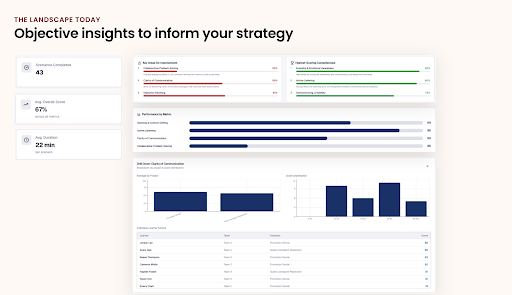
This kind of measurement isn't just possible, it's what separates programs that drive results from programs that generate reports.
The questions worth asking at your organization
If you're evaluating your current approach to durable skills development, here are a few honest questions to sit with:
What conversations is your team consistently losing? Not losing in a dramatic way — just the ones where you sense from observation or feedback that something isn't landing right. What's driving that?
Can you actually simulate those moments? Does your training environment replicate the emotional tension, the power dynamics, the nonverbal complexity of those real conversations? Or does it approximate them with scripts and good intentions?
How do you tell the difference between a manager who's ready and one who just finished training? If the answer is "we mostly assume," that's worth examining.
How long does it take your average new manager to become genuinely excellent? And what's happening — or not happening — in the meantime?
These aren't easy questions. But they're the right ones. Because the organizations that answer them honestly are the ones that build workforces where difficult conversations become a competitive advantage, not a liability.
Skills development has always been hard to measure. That doesn't mean it has to stay that way.
Webinar: Watch on-demand: How to make skills development objective and scalable.

Fara Rosenzweig, VP of Marketing
Fara Rosenzweig is the VP of Marketing at Rapport.
Related articles

What your LMS can’t show you about soft skills
Completion rates tell you someone clicked through a module, not whether they can handle a difficult customer. Here's how to measure real behavior change with scenario-based practice and reporting that stands up to a CFO's questions.
How to write a strong prompt for your AI avatar
Your avatar is only as good as the brief you give it, and vague prompts produce vague conversations. Here's how to set the scene with context, tone, and purpose so your avatar can think on its feet instead of reading a script.

The science of engaging soft skills training
You can't learn to swim by reading about water, and you can't learn hard conversations by watching a video. This is the learning science behind why passive training fails and what makes experiential practice actually stick.