Rapport vs Yoodli: Which AI Roleplay Platform Fits Your Team in 2026?
Comparing Rapport vs Yoodli for AI roleplay training? Both platforms let teams practice real conversations with AI, and both sell to the enterprise. They grew from different roots, and that difference decides which one fits your team.
August 31, 2026

Key takeaways
Rapport animates a face in real time from audio. Yoodli personas use a configured voice and a static avatar image. That is the single biggest functional difference between the two.
Both platforms publish pricing. Yoodli starts free and runs $8 to $20 per month for individuals. Rapport publishes a free 14-day trial, $19 Pro, and $99 Business. Enterprise is quoted on both.
They price in different units. Rapport bills usage minutes; Yoodli bills sessions and seats. A headline price comparison will mislead you.
Yoodli is strongest in go-to-market enablement, pitch certification, interview and presentation practice, and it has the stronger published security posture in SOC 2 Type 2 and GDPR.
Rapport is strongest where the conversation is face-to-face and emotionally difficult, and it spans sales, L&D, customer service, higher education, and clinical readiness,
Rapport vs Yoodli at a glance
Rapport and Yoodli are both enterprise AI roleplay platforms, but they solve different halves of the same problem. Rapport simulates the person you are talking to. Yoodli analyzes the way you talk. Everything below follows from that.
Comparison point | Rapport | Yoodli |
|---|---|---|
Core approach | Interactive AI avatar roleplay with real-time facial animation driven by audio | AI roleplay and experiential learning with speaking and content feedback |
Roots | Facial animation research at Speech Graphics, spun out of the University of Edinburgh | Speech and delivery coaching, founded by two former Google product leaders |
What the learner faces | An avatar whose expression changes as the conversation moves, with no pre-recorded video or scripts | A persona configured with name, voice, tone, demeanor and an avatar image |
Nonverbal training | Yes. Facial reaction and social presence are part of the practice | Delivery focus: pacing, conciseness, filler patterns, structure |
Scenario setup | Prebuilt scenario templates or custom scenarios tied to your ICP, products, pricing and real deals | Prompt-based builder with AI generation, multi-persona mode up to three personas, custom content and URL context |
Scoring | Role-specific dashboards across discovery, objection handling and closing, with rubric-based scoring | Six goal types including rated, binary, compound, knowledge-based and screensharing goals |
Languages | 50+ languages and dialects | Multiple languages, switchable in the practice experience |
Named customers | Qualcomm, NBC, KDDI, NEC, NetEase, Madame Tussauds, plus Boise State, UC San Francisco, Edinburgh and Simon Fraser | Google, Snowflake, SAP, Databricks, Korn Ferry, Sandler Training, FranklinCovey, BDO, RingCentral |
Scale proof | 610,000+ roleplays completed | $40M Series B led by WestBridge, at a reported valuation above $300M |
Security posture | Data encrypted, never sold, never used to train AI models. SCORM compliant. On-premises and private cloud available at Enterprise | SOC 2 Type 2 certified and GDPR compliant. SSO and enterprise admin controls on team plans |
Entry pricing | Free 14-day trial with 50 minutes. Pro $19/mo. Business $99/mo. Enterprise quoted | Free Starter with 5 lifetime sessions. Pro $8/mo annual. Advanced $20/mo annual. Team and Enterprise quoted |
Best for | Face-to-face, high-stakes conversations across sales, L&D, customer service, education and healthcare | GTM enablement, pitch certification, interview and public speaking practice at scale |
All pricing, customer, and security claims on this page were read from each vendor's own website. Vendors change these pages often, so re-verify before you quote anything in a board deck.
Origin Story
A platform's origin story is not marketing trivia. It predicts what the product is good at three years later, because the hardest engineering problem a company solves first tends to stay its moat.
Where Rapport Came From
Rapport came out of Speech Graphics, a facial animation company spun out of the University of Edinburgh School of Informatics. Its animation technology drove character performance in games including Hogwarts Legacy and The Last of Us Part II before it was ever pointed at corporate training.
The hard problem it solved was making a face move believably from audio alone, in real time, with no pre-recorded video. That is why the avatar layer is strong, and why the platform reaches use cases that have nothing to do with sales.
Where Yoodli Came From
Yoodli started as a speech coach. Its founders, both former Google product leaders, built a tool that told you how you sounded: pace, filler words, conciseness, sentence structure.
The hard problem it solved was measuring delivery accurately and giving feedback that people would act on. It has since grown into enterprise roleplay and now describes itself as an experiential learning platform, raising a $40 million Series B on reported 900% revenue growth.
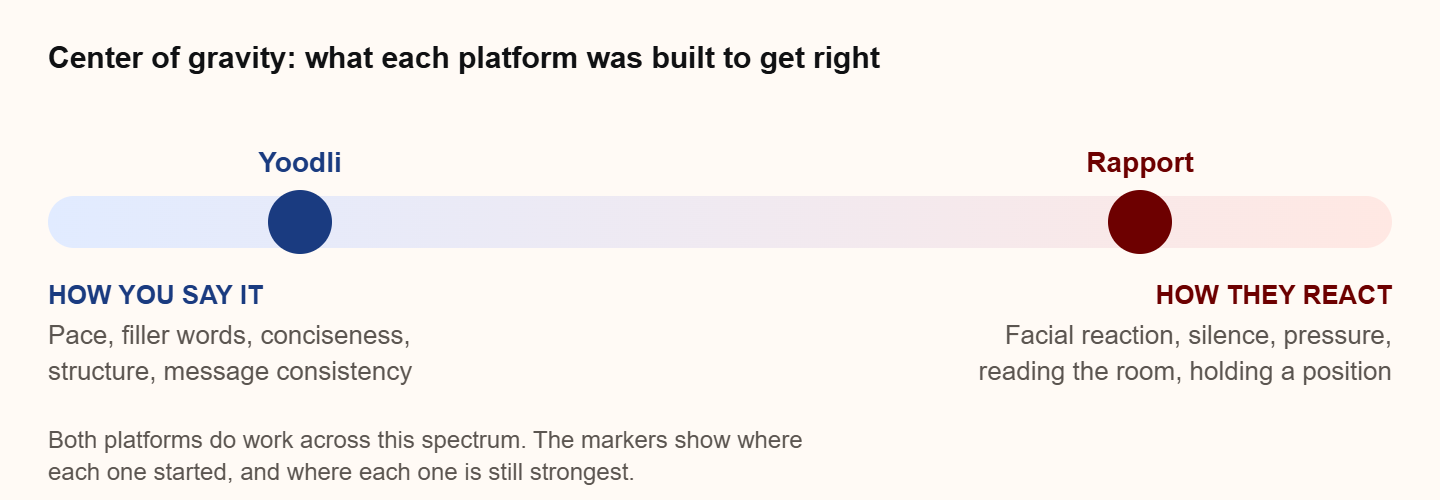
The chart below shows each platform's center of gravity, read from its own product and pricing pages. Both do work across the spectrum. This is an editorial assessment, not a vendor-published claim.
The core difference: a reacting face vs a persona image
The functional difference between Rapport and Yoodli is what the learner sees while practicing. This is verifiable from both vendors' own documentation, and it is the thing most comparison pages get vague about.
Yoodli Functions
Yoodli builds a persona by configuring a name, a voice, a tone, a demeanor, and an avatar image. The image is a fixed representation of who you are talking to.
The intelligence sits in the voice, the conversational content, and the feedback the platform gives you afterward. It is a genuinely good voice-first practice experience, and for a rep rehearsing a pitch, it is often exactly enough.
Rapport Functions
Rapport animates the avatar's face in real time from the audio of the conversation, with no pre-recorded video and no scripted animation.
When the learner overexplains, the face can register impatience. When they land a point, the face can soften. The avatar can hold states like skeptical, hesitant, frustrated or receptive across a conversation rather than resetting each turn.
What this changes in practice
A rep who has only ever practiced against a voice has rehearsed what to say. A rep who has practiced against a reacting face has also rehearsed what to do when the room turns. Those are different skills, and only one of them is what fails in a live meeting.
This is the same distinction we drew in AI avatar roleplay versus voice roleplay, and it is why the choice between these two platforms is really a choice about which conversations you are trying to fix.
The nonverbal statistic you should stop quoting
You will find "55% of communication is nonverbal" on almost every page in this category, including, until recently, some of ours. It does not mean what it is used to mean, and a comparison page that leans on nonverbal realism should be the first to say so.
The figure is based on two small 1967 studies by Albert Mehrabian (opens in new tab) and colleagues. Those studies asked how people infer someone's feelings and attitudes when the words and the tone contradict each other.
In that narrow situation, the visual channel carried the most weight. Mehrabian himself has said repeatedly that the 7-38-55 split does not generalize to communication as a whole.
Applied to a discovery call or a performance review, it is simply not a finding.
Worth checking before your next business case
The same caution applies to the "X% faster ramp" and "X% more deals closed" numbers attached to AI roleplay tools, including ones you will see quoted about both platforms. We could not trace a defensible primary source for any of them. A number you cannot source is a number a procurement team can use against you.
Here is what does hold up, and what a nonverbal training argument can actually stand on:
Demand for social and emotional skills is projected to grow 26% in the United States by 2030, per McKinsey's Skill Shift research (opens in new tab). The skills at issue are the ones that only show up in live conversation.
Leadership and social influence rose 22 points as an employer-prioritized skill in the World Economic Forum's Future of Jobs 2025 report (opens in new tab).
Managers account for 70% of the variance in team engagement (opens in new tab), per Gallup. The mechanism is conversational, and it is exactly the kind of conversation that is hardest to rehearse.
Simulation with deliberate practice outperformed traditional clinical education, with a pooled effect size of 0.71 across 14 studies, according to McGaghie and colleagues in Academic Medicine (opens in new tab). That research is about clinical skills, not selling. What transfers is the mechanism: rehearsal with feedback beats instruction.
None of those four mention facial animation. They say that conversation quality is a measurable business variable and that rehearsal is how you move it. Whether you need a reacting face to do that rehearsal is a judgment call about your use case, which is what the rest of this page is for.
The four layers of a conversation, and which layer each platform measures
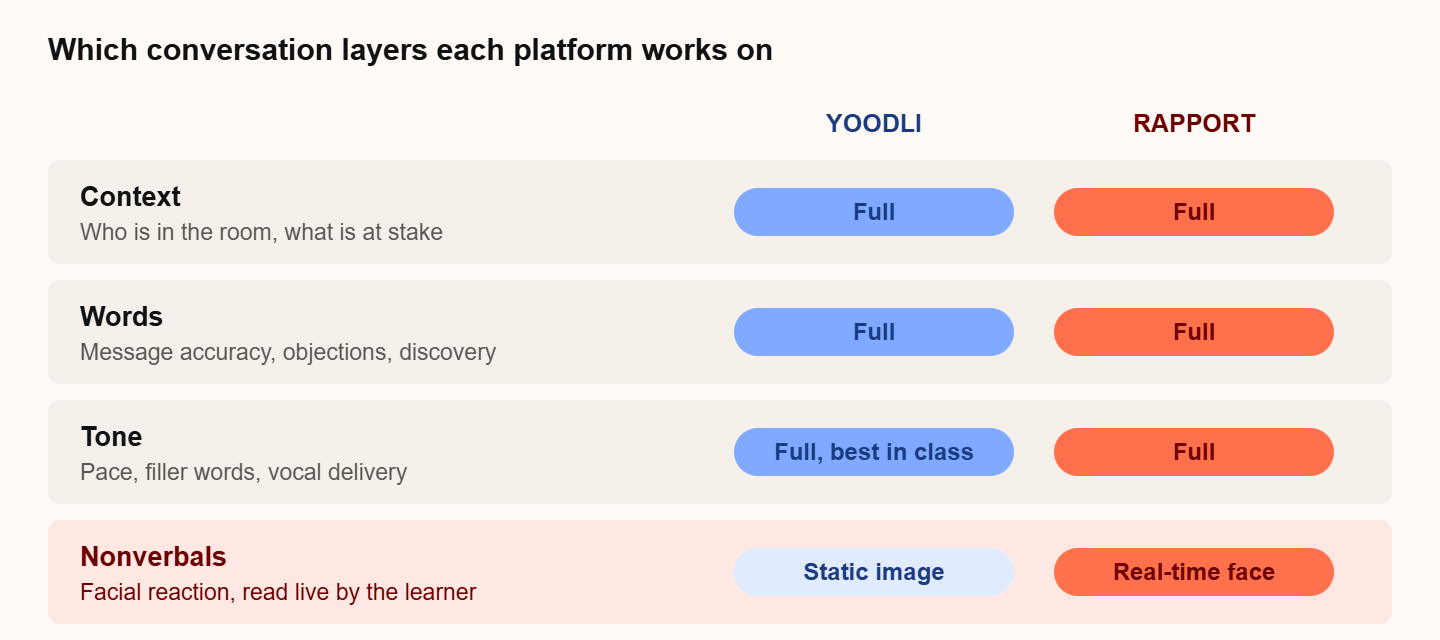
Every workplace conversation runs on four layers at once: the context you bring in, the words you choose, the tone you deliver them with, and the nonverbal signals both sides send. Training tools differ mostly in how many of those layers they can observe.
Read the bottom row of the chart below carefully, because nonverbals is the only layer where the two platforms are doing genuinely different things. Everywhere else the comparison is about depth and packaging.
Coverage assessed from each vendor's published product documentation. "Full" means the layer is directly worked on and reported, not that the two implementations are identical.
Scenario building and who owns it
Scenario building is where AI roleplay programs stall. If creating a new scenario requires a vendor ticket, your program moves at the vendor's speed forever, and the training you needed in Q3 arrives in Q1.
Both platforms put scenario creation in the customer's hands, which is the right answer, and both do it differently.
How Yoodli builds a scenario
An admin or member writes a prompt describing the scenario and clicks to generate it with AI
Personas are then customized by name, voice, tone, demeanor, and avatar image, with up to three personas in multi-persona mode for panels and buying committees
Context is added as pasted text or linked URLs, so an existing product page or battlecard can feed the scenario directly
Goals are set across six types, including rated, binary, compound, knowledge-based, screen-sharing, and unscored
Group assignment controls which cohorts see which roleplay
How Rapport builds a scenario
Start from the scenario template library or build from scratch against your own ICP, products, pricing, and live deals
Character templates cover the personas most training programs need, with custom character uploads available from the Business tier
Difficulty and emotional posture are part of the scenario design, so the same scenario can be run against a receptive buyer and a hostile one
Rubric-based scoring is configured per scenario and maps to role-specific dashboards
Prompt engineering and scenario design services are available at the Enterprise tier if you want the first wave built for you
Yoodli's builder is faster for a first draft. Rapport's is stronger when the scenario has to hold emotional state across a long conversation. If you want a deeper walkthrough of scenario design, we covered it in AI role play training.
Analytics: delivery metrics vs behavior metrics
Both platforms report. What they report is different, and the difference matters more to your L&D team than to your reps.
Question a manager asks | Yoodli answers with | Rapport answers with |
|---|---|---|
Is the rep delivering the message? | Content and delivery feedback per session, with progress tracked over time | Rubric scores per scenario mapped to the behaviors you defined |
Are they improving? | Progress tracking in aggregate and across cohorts | Session-over-session scoring and cohort dashboards |
Which skill is weakest across the team? | Aggregate cohort reporting on the goals you set | Role-specific dashboards splitting discovery, objection handling and closing |
Did they hold up under pressure? | Inferred from the goal outcomes you configured | Observed directly, because the scenario escalates and the avatar's state changes |
Is anyone actually using it? | Team dashboards, roleplay assignment and admin controls | Usage minutes and completion reporting per workspace |
One caution that applies to both. ATD's research found fewer than 25% of organizations measure training effectiveness against organizational goals.
No platform fixes a measurement gap you brought with you, so decide what metric you are trying to move before you look at a single dashboard.
Deployment, integrations and LMS reality
Deployment is the question that decides whether a pilot becomes a program. Ask it early, and get the specific standard rather than a general yes.
Requirement | Rapport | Yoodli |
|---|---|---|
LMS delivery | SCORM compliant, so content drops into an existing LMS | LMS, CMS and HRIS integrations on team and enterprise plans |
Identity | Enterprise SSO, role-based access control from Business tier | SSO and advanced user management at enterprise, with SCIM |
Technical stack | 20+ integrations including OpenAI, Google Gemini, Azure, AWS, Unity, Unreal, ElevenLabs, Speechmatics and Whisper | Enterprise data sync with existing tools, custom content upload |
Embedding | Deploy across platforms and embed in existing learning journeys | Web application, supported in Chrome, Edge, Firefox, Safari 17+ and Brave |
Hosting options | Cloud, plus on-premises and private cloud at Enterprise | Cloud |
The hosting row is where regulated buyers should focus.
If your security team requires the model and the conversation data to sit inside your own environment, that requirement narrows the field fast, and it is worth putting on the table before the first demo rather than after the third.
Rapport's SCORM compliance matters for the same reason: it decides whether your existing LMS is an asset or an obstacle.
Security, data and compliance
Roleplay platforms record people practicing conversations about real deals, real patients and real employees. Treat the data question as a first-round question, not a legal formality at signature.
Yoodli Security
Yoodli states it is SOC 2 Type 2 certified and GDPR-compliant. Its Advanced individual plan excludes your data from AI training, and enterprise controls cover SSO, user management, and admin permissions. That is a clear, published posture, and it clears most enterprise procurement bars.
Rapport Security
Rapport states that customer data is encrypted, stored securely, and never sold or used to train AI models, with responsible AI stated as a design principle. Enterprise customers can run on-premises or in a private cloud, and compliance support is part of the Enterprise tier.
Whichever way you go, ask both vendors the same question in writing: is our conversation data used to train models, and can we opt out. Get the answer in the contract, not the demo.
What each one actually costs
Both platforms publish pricing, which is unusual in this category and good news for buyers. The catch is that they price in different units, so the headline numbers are not comparable.
Yoodli Pricing
Yoodli Starter. Free, 5 lifetime sessions.
Yoodli Pro. $8 per month billed annually, up to 10 roleplays per week.
Yoodli Advanced. $20 per month billed annually, unlimited roleplays plus exclusion of your data from AI training.
Rapport Pricing
Rapport free trial. 14 days, 50 minutes of AI conversation included.
Rapport Pro. $19 per month, 100 usage minutes, 1 creator.
Rapport Business. $99 per month, 500 usage minutes, 3 creators.
Enterprise. Quoted on both platforms.
How to compare two different pricing units
Rapport's usage-minute model quotes an effective rate of $0.19 per minute with overage at $0.21 per minute, which makes cost modeling straightforward once you know how many minutes of practice you actually expect.
Yoodli's session model is simpler for individuals and cheaper at the entry point by a wide margin.
Before you compare anything, do this: estimate the number of practice conversations per learner per month, multiply by average conversation length, and price that volume in each vendor's own unit.
A team that practices twice a week for ten minutes looks very different under a minute model than under a session model, and the answer flips depending on your numbers. We worked through this across seven platforms in the best AI roleplay platforms guide.
Model your own numbers before you talk to anyone
Rapport publishes live demos with no signup, and a free 14-day trial with 50 minutes included, so you can run a real scenario against a real avatar and see the difference for yourself. Try a live demo or start the free trial.
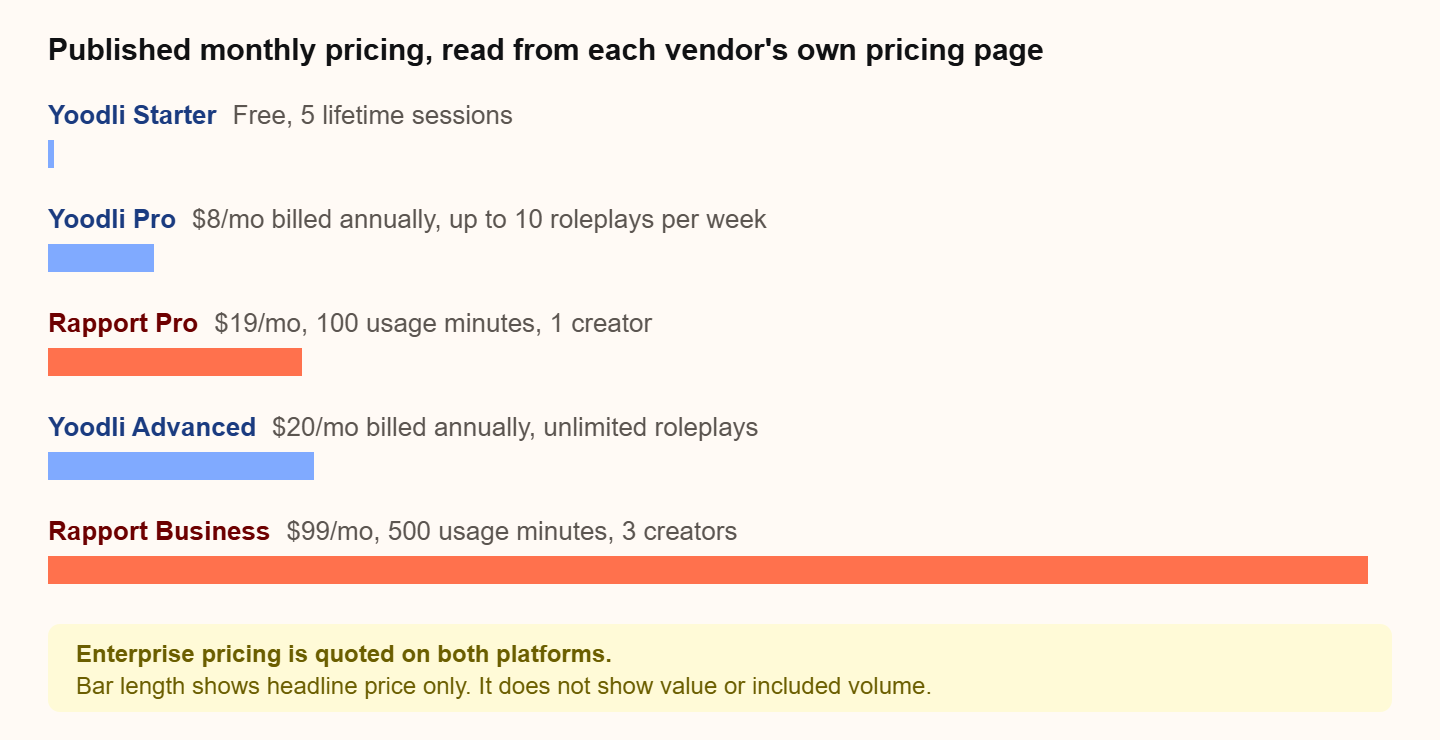
The chart below plots the published headline prices side by side. Bar length shows headline price only. It does not show value or included volume, and Rapport bills usage minutes while Yoodli bills sessions and seats.
Use case fit, team by team
The fastest way to settle this comparison is to find your own team in the table below and read across.
Your team | What you are actually training | Stronger fit |
|---|---|---|
Sales enablement, transactional | Consistent pitch delivery and message compliance across a large rep population | Yoodli |
Sales enablement, complex deals | Discovery, multi-stakeholder objection handling, holding price under pressure | Rapport |
Medical device and pharma | Committee panels, on-label discipline, clinical conversations | Rapport |
Frontline managers | Performance reviews, feedback, difficult employee conversations | Rapport |
Customer service and CX | De-escalation, handling a frustrated customer in real time | Rapport |
Onboarding at scale | Product fluency and first-call readiness for new hires | Either, depending on whether the first call is video or phone |
Higher education | Interview prep, presentation practice, clinical and counseling simulation | Rapport for simulation, Yoodli for interview and presentation prep |
Individuals and self-starters | Personal communication practice with no budget approval | Yoodli |
Global teams | Practice in the learner's own language | Rapport, on 50+ languages and dialects |
Pick Rapport if, pick Yoodli if, and when you need both
Pick Rapport if
The conversations that cost you money happen face-to-face, on video, or in a room
Your training goal is two-way conversation skill: discovery, objections, tough feedback, de-escalation
You need use cases beyond go-to-market, including customer service, education, and healthcare communication
Nonverbal realism affects your learning outcomes, or your learners have told you voice-only practice feels unreal
You need on-premises or private cloud deployment
You want scenarios tied to real deals and playbooks, with role-specific dashboards
Pick Yoodli if
Your main need is delivery feedback and speaking analytics at scale
You are running structured pitch certification across a large revenue organization
Presentation, interview, and public speaking practice are core use cases
A named SOC 2 Type 2 certification is a hard procurement requirement today
You need the lowest possible entry cost to prove reps will use a practice tool at all
When you genuinely need both
Some enablement teams run both, and it can be the right call.
The split that works: Yoodli for high-volume individual delivery practice and certification, where cost per seat matters most, and Rapport for the smaller set of conversations where reading a reaction is the skill.
Run both only if you have a named owner for each and a single view of who has completed what. Two tools with no owner is one tool and one line item.
How to evaluate both platforms: scorecard and demo questions
Two tools do most of the work of a platform decision: a weighted scorecard you fill in yourself, and a short list of questions that cut through a polished demo.
The 10-point evaluation scorecard
Score both platforms 1 to 5 against your own requirements, weight the rows that matter to your program, and let the total decide. The weights below are a starting point, not a verdict.
Criterion | What "5" looks like | Suggested weight |
|---|---|---|
1. Conversation realism | The learner reacts to the avatar unprompted, and says afterward that it felt real | High |
2. Scenario ownership | Your team ships a new scenario in under a day with no vendor ticket | High |
3. Rubric control | You can see and edit the scoring rubric to match your own definition of good | High |
4. Manager reporting | The frontline manager view is useful on Monday morning without training | High |
5. Delivery into the LMS | A named standard: SCORM, LTI or a documented integration, not a general yes | Medium |
6. Identity and admin | SSO, SCIM, group assignment and role-based access already exist | Medium |
7. Data handling | Written confirmation that your data does not train models, plus a named certification | High |
8. Hosting fit | The deployment model your security team already approved | Varies |
9. Cost at your real volume | Priced in the vendor's own unit, at the volume you actually expect, including overage | High |
10. Use case coverage | Covers every team you will roll this out to in the next 18 months, not just the pilot team | Medium |
One scoring note that saves programs. Weight row 10 higher than feels natural. Most platform regret in this category comes from buying for the pilot team and then discovering the second team needs something the tool was never built for.
9 questions to ask on both demos
Every vendor demo goes well. That is what demos are for. These questions surface the difference between a platform that ships and a platform that stalls in month three.
Who builds a new scenario, and how long does it take? If the answer involves a vendor ticket, your program moves at the vendor's speed forever.
Can I see the scoring rubric, and can I edit it? A rubric you cannot change is somebody else's definition of good.
What does the learner see immediately after a session? Feedback that arrives the next day gets ignored.
Show me a scenario where the AI gets harder mid-conversation. Escalation is where practice value lives, and not every platform holds state.
How does this reach my learners? Get the specific standard: SCORM, LTI, SSO, direct link.
What happens to our conversation data? Ask directly whether it trains models, and get it in writing.
What is the unit of pricing, and what happens when we exceed it? Minutes, seats, sessions, and users are not interchangeable.
Show me the reporting a frontline manager sees on Monday morning. Not the executive dashboard. That view is where adoption lives or dies.
What does implementation actually require from my team? Ask for hours, named roles, and a timeline, not reassurance.
Switching from Yoodli to Rapport
If you already run Yoodli and the gap you are feeling is realism rather than analytics, a switch is a scenario migration, not a data migration. Five steps, roughly four weeks.
Inventory what people actually use. Pull your Yoodli usage data and identify the five scenarios with real completion volume. Most libraries have a long tail nobody touches. Do not migrate the tail.
Keep your rubric. Your scoring criteria are the asset, not the scenario text. Bring the rubric across intact so your historical performance conversations still make sense.
Rebuild the top five as avatar scenarios. This is where the design changes: add the emotional posture and the escalation point, because those are the parts a voice-first scenario never needed.
Run one cohort in parallel for two weeks. Same reps, both tools, same rubric. Ask them which practice felt closer to a real meeting. That answer is your business case.
Decide the split before you cancel anything. Either Rapport replaces the program or it takes the high-stakes half. Both are valid. Deciding after renewal is how teams end up paying for both by accident.
Stop guessing whether your team is ready. See a scenario built around your own deals, your own objections and your own rubric, with a face that reacts the way a real buyer does. Book a live demo or explore sales enablement.
Frequently asked questions
Is Rapport a good Yoodli alternative?
Rapport is the stronger Yoodli alternative when the conversations you train for are face-to-face and emotionally difficult, when you need training beyond go-to-market teams, and when nonverbal realism affects your learning outcomes.
Yoodli has coaching, presentation practice, and low-cost individual use, because it publishes a free tier and an $ 8-per-month plan.
What is the main difference between Rapport and Yoodli?
Rapport animates an avatar's face in real time from the audio of the conversation, so the learner practices against a face that reacts while they speak.
Yoodli personas are configured with a name, voice, tone, demeanor, and a static avatar image, so the practice is voice and content-driven. Rapport trains the visual layer of a conversation. Yoodli trains the verbal and vocal layers.
Does Yoodli have a free plan?
Yes. Yoodli lists a free Starter plan with five lifetime sessions. Paid individual plans are $8 per month billed annually for up to 10 roleplays per week, and $20 per month billed annually for unlimited roleplays plus exclusion of your data from AI training. Team and enterprise pricing is quoted.
How much does Rapport cost compared to Yoodli?
Rapport offers a free 14-day trial with 50 minutes of AI conversation included, Pro at $19 per month with 100 usage minutes, and Business at $99 per month with 500 usage minutes and three creators.
Enterprise is quoted. The two platforms price in different units: minutes for Rapport and sessions or seats for Yoodli, so model your expected volume in each vendor's own unit before comparing headline prices.
Can you use Rapport and Yoodli together?
Yes, and some enablement teams do. A common split is Yoodli for individual delivery practice and pitch certification at low cost per seat, and Rapport for the smaller set of high-stakes, face-to-face conversations where reading a reaction is the skill being built.
Run both only if you have a clear owner for each and a single reporting view; otherwise, the second tool becomes shelfware.
What can teams practice with Rapport?
Cold calls, discovery, objection handling, pricing and procurement conversations, value analysis committee panels, performance reviews, leadership one-to-ones, de-escalation and customer service scenarios, and clinical readiness conversations. More than 610,000 roleplays have run on the platform.
Is Yoodli secure enough for enterprise deployment?
Yoodli states it is SOC 2 Type 2 certified and GDPR-compliant, with SSO and enterprise admin controls on team plans, and exclusion of data from AI training available on its Advanced individual plan. That clears the bar for most enterprise procurement.
Regulated buyers who need the model and data to sit inside their own environment should confirm hosting options, since on-premises and private cloud deployment is where the two platforms differ most.
Which platform is better for sales enablement?
It depends on the motion. For structured pitch certification across a large revenue organization, where the goal is consistent message delivery at scale, Yoodli is purpose-built and well proven.
For complex, multi-stakeholder deals where the rep has to read a room, handle silence, and hold a position under pressure, Rapport is the better fit because the reaction the rep is learning to read is actually present in the practice.