Rapport vs Quantified: Which AI Roleplay Platform Fits Your Team?
Rapport vs Quantified is a comparison of two AI roleplay platforms built for different jobs. Quantified is a life sciences specialist that scores what reps say against approved content. Rapport is a domain-agnostic avatar platform that trains how people read a reaction.
Both land on the same shortlist because both say AI roleplay. Then the evaluation splits on one question: is your hardest problem what your people say, or how they read the person across the table? This guide compares avatars, compliance, scenario building, analytics, security, and pricing using only what each vendor publishes, then ends with a scorecard and a 30-day pilot plan.
September 23, 2026
Key takeaways
- Quantified is a life sciences specialist. It is built for pharma, biotech, medical device, and other regulated selling. Its standout feature scores reps against MLR-cleared messaging and fails any session with off-label language.
- Rapport is a domain-agnostic avatar platform. It owns its real-time animation engine, so the avatar's face reacts to how the learner speaks. It works for sales, customer experience, clinical education, leadership, and more.
- Quantified publishes a SOC 2 Type II attestation. Rapport does not publish one. If SOC 2 is a hard procurement gate, request Rapport's security pack in writing on day one.
- Rapport publishes its prices. Quantified does not. Rapport runs from a free 14-day trial to $99 per month for Business. Quantified quotes a Base or Standard package per organization.
- Neither scores recorded customer calls. Quantified positions simulation as the alternative as call recording gets more restricted in pharma.
- Ignore the behavioral dimension count. "1,400+ dimensions" has no published definition, so it cannot be compared across vendors.
Rapport vs Quantified at a glance
Here is the fast version. Everything in this table came from each vendor's own website in September 2026, and both companies update these pages often.
Read the first two rows and you have most of the answer. Quantified goes deep on one industry. Rapport goes wide on one human skill.
Origin story
Both companies took a long route to AI roleplay. The route explains the product.
Where Quantified came from
- Founded in 2012 in Austin, Texas as Quantified Communications by Noah Zandan and Peter Zandan. The company was built on behavioral science research into what makes communication effective.
- Spent a decade analyzing human communication before launching AI Roleplay in 2022.
- Repositioned hard into life sciences. In June 2026 it launched a six-agent AI Sales Coaching Platform for regulated commercial teams.
- States 30+ enterprise customers, including Novartis, Sanofi, Bayer, Johnson & Johnson, Takeda, and Astellas.
- Does not publish its funding. Third-party databases disagree, so treat any figure you find as unconfirmed.
Where Rapport came from
- Started with a hard technical problem: making a digital face move correctly from a live voice. That is why the animation layer is something Rapport owns rather than something it rents.
- Launched its self-serve platform in 2024, so a single trainer can build and share a roleplay without a sales call.
- Acquired Aquifer Motion in 2025, adding full-body real-time avatars. Aquifer co-founder Chen Zhang now leads growth at Rapport.
- Went to market as a platform rather than a vertical product. Customers use it for learning and development, customer experience, sales, clinical communication, and higher education.
- Publishes its pricing openly and offers a free trial, which is unusual in this category.
Put those two lists side by side and the roadmaps write themselves. One company studied what people say and now polices it for industries where the wrong sentence is a regulatory event. The other built the face on the other side of the conversation and puts it in front of anyone who needs practice reading a person.
The core difference: scope, not avatars
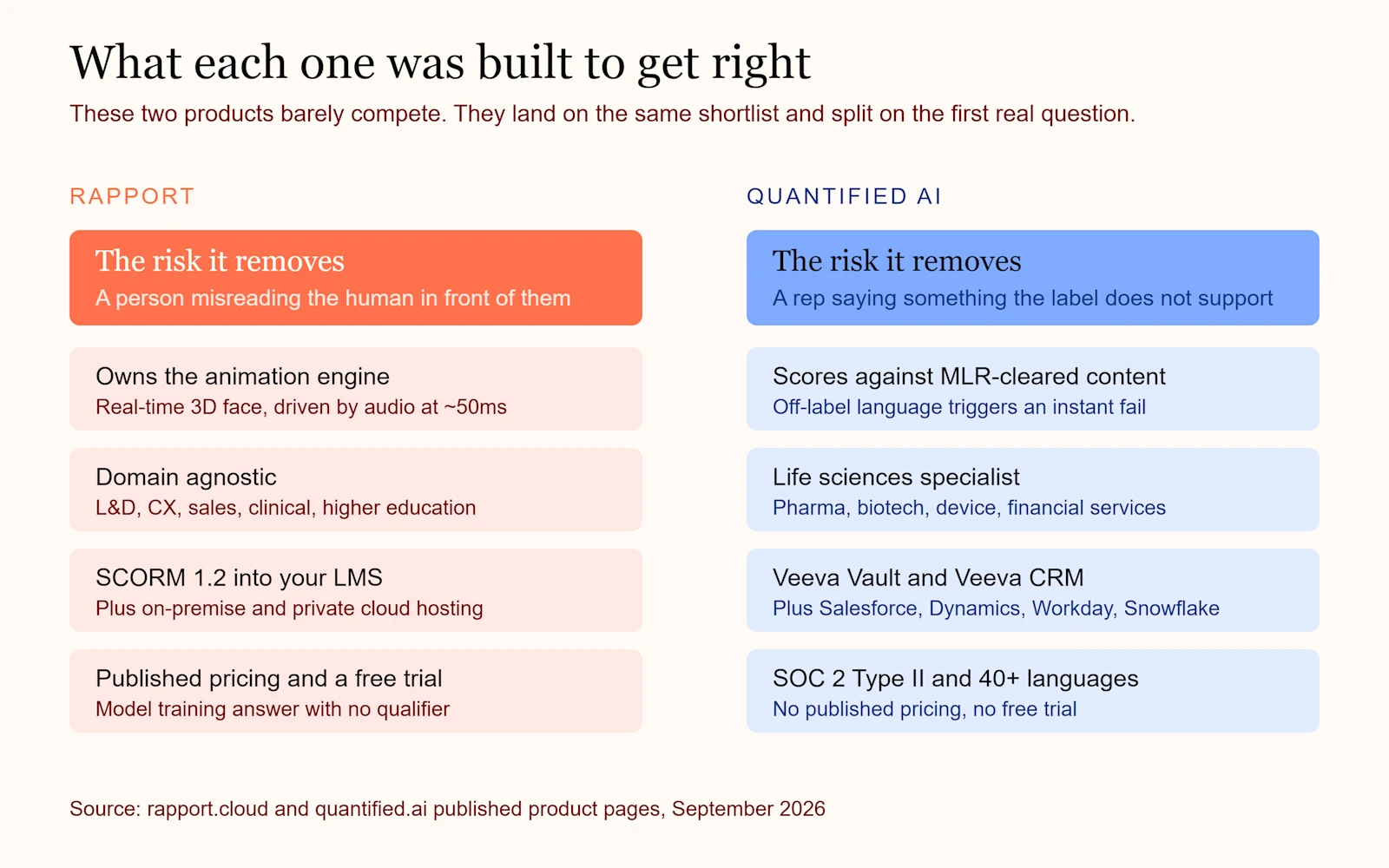
Strip away the feature lists and this comparison is not about who has the better avatar. It is about scope. Quantified solved one industry's hardest problem, and Rapport solved one human problem for every industry.
What Quantified does
- Runs AI roleplay against personas built from your own MLR-approved content, so a scenario cannot drift outside what legal cleared.
- Scores message adherence, tracks required claims, and detects off-label terms. Off-label language triggers an instant fail.
- Keeps an audit-ready record for every session, which is the artifact a regulated organization needs.
- Lets the persona see and respond to a visual aid the rep shares on screen, which mirrors how a detail call works.
- Adds readiness, field coaching, authoring, and insights agents on top of roleplay in its Standard package.
What Rapport does
- Renders a 3D avatar live, with facial animation driven by the learner's audio at roughly 50ms. The reaction lands while the learner is still speaking.
- Owns its animation engine, so the same sentence said calmly and said sharply produces two different faces.
- Lets you pick the character, voice, language, and AI behavior, with characters from a built-in library, MetaHuman, Ready Player Me, or your own upload.
- Scores competencies such as active listening, empathy, and clarity, and rolls attempts up into cohort analytics.
- Ships as a hosted link, an iframe, a web widget, a SCORM 1.2 package, or an Unreal Engine integration.
What this changes in practice
If your biggest risk is a rep saying something the label does not support, Quantified is built for that. The compliance agent, the Veeva integration, and the audit trail are the reason a pharma commercial team can get it through review.
If your biggest risk is a person misreading the human in front of them, a compliance engine does not help. A nurse delivering bad news, a manager running a performance review, and a bank teller calming an angry customer all need the same skill: notice a reaction and adjust.
That is why these two products rarely compete head to head. They land on the same shortlist because both say "AI roleplay," then the evaluation splits on one question. Is your hardest problem what your people say, or how they read the room?
The statistic to take out of your business case
Every vendor in this category eventually quotes how many things it measures. Quantified's roleplay page says it scores every interaction against 1,400+ behavioral dimensions. Stop comparing that number across vendors, because it cannot be done.
Quantified is actually the most transparent vendor here, since it publishes the figure at all. Still, its pages have cited both 1,400+ dimensions and more than 1,000 verbal and nonverbal dimensions. None of those pages link to a taxonomy, a whitepaper, or a validation study.
Worth checking before your next business case
- Can you read the rubric? Ask to see the scoring criteria as an admin sees them. If you can read, name, and change them, the count stops mattering.
- Does a score come with evidence? A score that quotes the transcript holds up in a coaching conversation. A number without a reason does not.
- Does the same input give the same output? Run the same roleplay twice and see how much the scores move. Consistency beats breadth.
- Does the score predict anything you already track? Tie the platform's score to ramp time, certification pass rate, or QA scores during the pilot.
Buy on criteria you can inspect. A number nobody defines is a talking point, not a specification.
The four layers of a conversation, and which one each platform measures
A cleaner way to sort AI roleplay platforms is by the layer of a conversation they measure. Every real conversation has four.
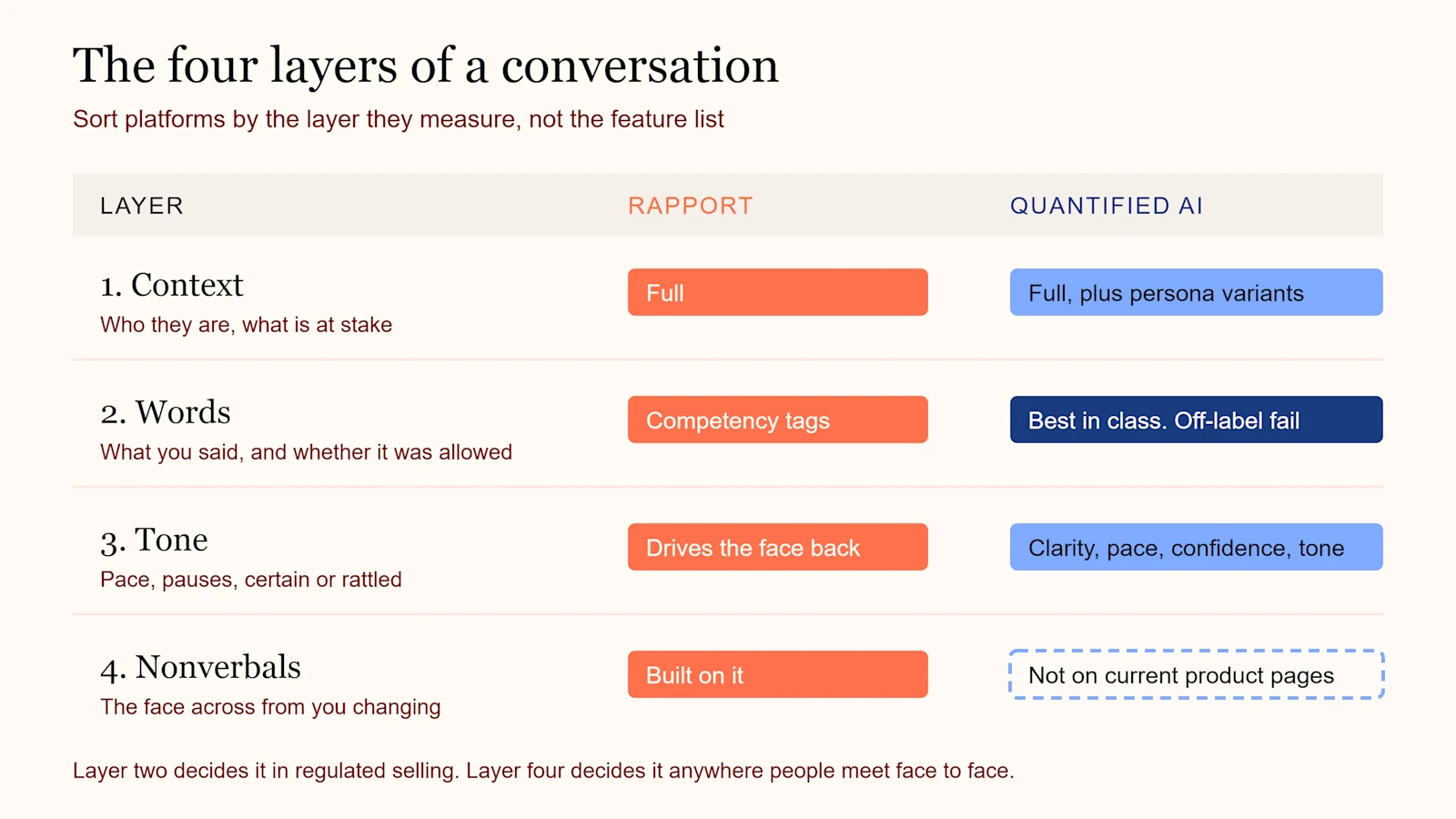
- Context: who the other person is and what is at stake. Both platforms handle this well, and Quantified adds persona variants built from your own content.
- Words: what you said, and whether you were allowed to say it. This is Quantified's home turf, with on-label scoring and an instant fail for off-label terms.
- Tone: pace, pauses, and whether you sound certain or rattled. Quantified scores clarity, pace, confidence, and tone. Rapport uses tone to drive the avatar's face in real time.
- Nonverbals: the face across from you changing as you speak. Rapport's avatar is built on this layer. Quantified's current product pages do not describe a persona whose face reacts in real time.
Match the layer to the job. If the failure you fear lives in layer two, lean Quantified. If it lives in layer four, lean Rapport.
Who builds and maintains the scenarios
Scenario building is where most pilots stall. The question is not "can we build one," it is "who keeps 40 of them current after launch."
- A Self Authoring Agent builds simulations from your approved content library in days.
- Inputs are MLR-cleared claims, on-label language, branded positioning, certification rubrics, and sales playbooks.
- Updates follow your content review cycle, so a label change flows into training.
- A no-code builder with 26+ character templates, so a trainer can go from idea to shareable link in one sitting.
- You choose the character, voice, language, AI behavior, and a custom scoring rubric.
- We built a full conflict scenario live, in minutes, at ATD Demo Day.
What this means for your evaluation
- If legal must approve every word, Quantified's content-first authoring saves review cycles.
- If trainers need to spin up new scenarios weekly, Rapport's builder keeps ownership with L&D. Our guide on how to design an AI roleplay scenario walks through the process.
- In both demos, ask the vendor to build a scenario from your brief while you watch. Time it.
Analytics and reporting compared
Both platforms report on individuals and cohorts. They differ in what they treat as the finish line.
Quantified analytics
- An Insights and Reporting Agent tracks readiness, proficiency, and message adherence.
- Proficiency gates certify a rep before they are allowed in front of a physician.
- Program KPIs include ramp, certification, mastery, manager coverage, and compliance posture.
Rapport analytics
- Competency scores for skills such as active listening, empathy, and clarity, scored against a rubric you can read and edit.
- Feedback tied to observable behavior in the transcript, so a coach can point to the exact moment. See why observable-behavior feedback works.
- Cohort skill data that shows where a whole team is strong or weak. Our guide to measuring training readiness covers how to use it.
The short read: Quantified reports on whether reps are compliant and certified. Rapport reports on whether people are getting better at the human side of the conversation.
Deployment, delivery, and integrations
Integrations tell you who each product was built to sit next to. Quantified plugs into the commercial stack of a pharma company. Rapport plugs into wherever learners already are.
If your training lives in an LMS that is not on Quantified's named list, check SCORM support early. It is often the fastest route to a pilot.
Security and compliance
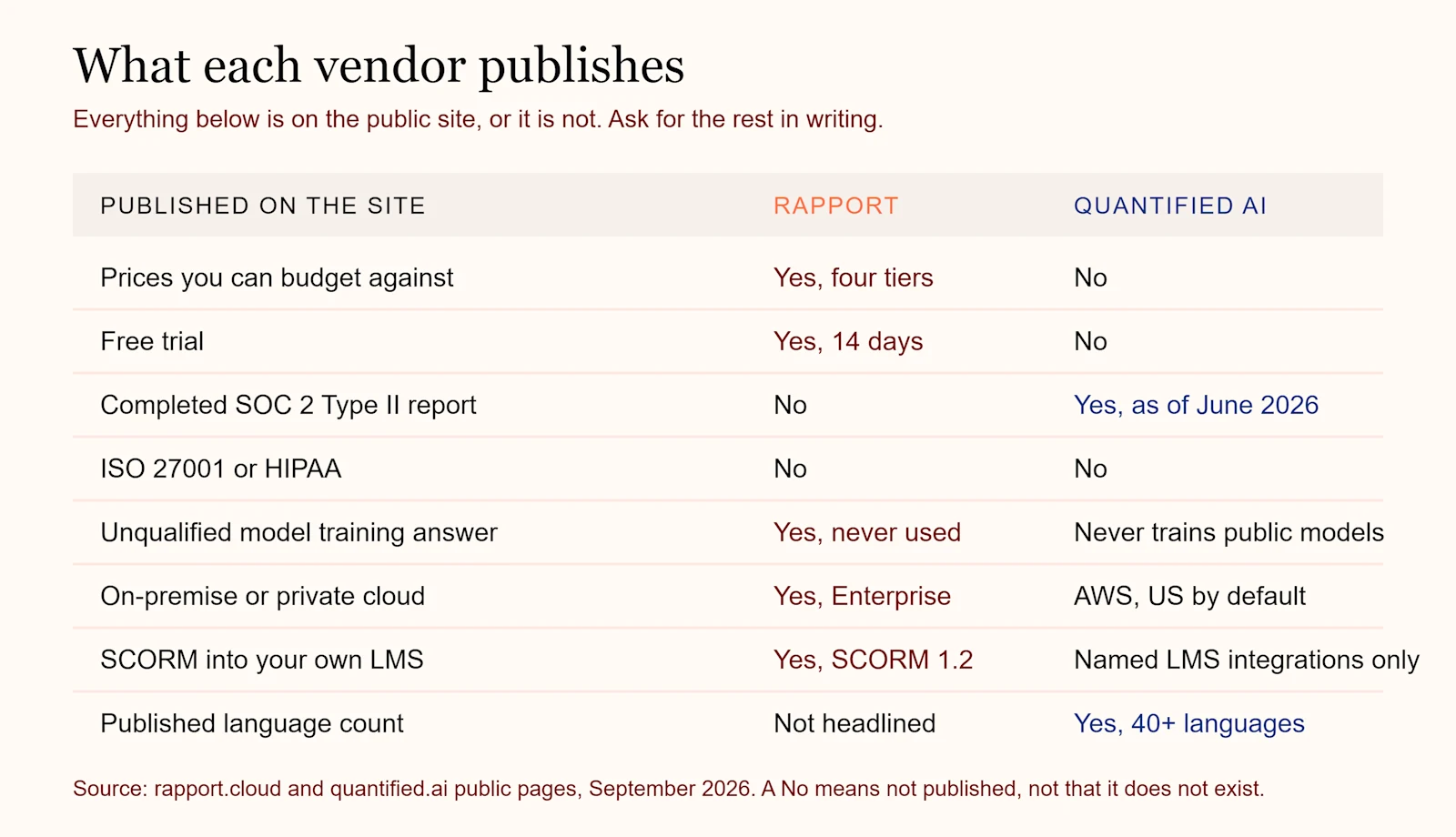
Security is the one area where Quantified publishes more today. The fix for a buyer is simple: ask both vendors for the same documents in writing, at the start.
Quantified security
- States SOC 2 Type II compliance across the platform.
- Offers private LLM deployment and data residency controls for the EU, US, and APAC.
- States that customer content does not train foundation models. Ask how that applies to fine-tuned or private models.
Rapport security
- Publishes its technical security details, including HTTPS and TLS, certificate issuance, and encrypted WebRTC over DTLS.
- States that customer data is never used to train AI models, with no qualifier.
- Offers on-premise and private cloud hosting on Enterprise, plus GDPR compliance support.
How to handle this in a real evaluation
- Send both vendors the same security questionnaire in week one.
- If SOC 2 is mandatory, ask Rapport for its current security pack and roadmap before the demo.
- If data must never leave your network, Rapport's on-premise option is the shorter path.
- Use our 12 data security questions for AI roleplay as the checklist.
What each one costs
Pricing is the easiest place to see the difference in go-to-market. One vendor lets you start today for free. The other starts with a sales conversation.
Published pricing, September 2026
Solid bars are published tiers. Dashed bars are quote-only packages.
Quantified pricing
- Base package (Quantified AI Roleplay): AI roleplay, self-authoring, reporting, and compliance guardrails.
- Standard package (AI Sales Coaching Platform): the full platform, covering onboarding, launch prep, live selling, and post-call debrief.
- Pricing is quoted per team and program. No free trial is published. See the Quantified pricing page.
Rapport pricing
- Trial: free for 14 days, 50 minutes, 1 creator, no credit card.
- Pro: $19 per month, 100 minutes, 1 creator.
- Business: $99 per month, 500 minutes, 3 creators, branding removal, and custom character uploads.
- Enterprise: custom, with unlimited creators, on-premise or private cloud hosting, and a dedicated Customer Success Manager. See Rapport pricing.
How to compare two different pricing units
Rapport prices by conversation minutes, at an effective $0.19 per minute and $0.21 per minute in overage. Quantified prices by team and package. To compare, estimate practice minutes per learner per month, multiply by headcount, and ask Quantified for a quote at the same volume.
Which platform fits your use case
Most teams can answer this in one pass. Find your use case in the left column.
Working in medical devices rather than pharma? Our guide to AI roleplay for pharma and life sciences reps covers where each platform fits across the whole vertical.
The decision guide
- The skill you are training is reading and responding to another person.
- You train across more than one department or industry.
- You want to start this week with a free trial and published pricing.
- You deliver through an LMS, a portal, or an embedded widget.
- You need on-premise hosting or an unqualified "we never train on your data."
- You sell a regulated product and message adherence is the top risk.
- Legal and MLR must sign off on every training scenario.
- Your stack runs on Veeva and Salesforce.
- A published SOC 2 Type II report is a hard gate for procurement.
- You need a published 40+ language count today.
When you need both
A life sciences team can run both. Quantified certifies what the rep is allowed to say, and Rapport trains how the rep reads the physician, nurse, or value analysis committee across the table. Because the two products measure different layers, the overlap is smaller than the shortlist suggests.
Your evaluation scorecard and demo questions
The 10-point evaluation scorecard
Score each vendor 1 to 5 on every line. The totals matter less than the gaps.
9 questions to ask on both demos
- Can you build a scenario from our brief while we watch?
- Show us the scoring rubric exactly as an admin sees it.
- What does a "behavioral dimension" mean in your product, and where is the list?
- How does the avatar react when the learner sounds unsure versus confident?
- What happens to our transcripts and audio, and does any model ever train on them?
- Which security documents can you send this week?
- How do we deliver this in our LMS, and what data comes back?
- What will we pay at our real volume in year one and year two?
- Which customer like us can we speak to?
How to run a side-by-side pilot
The fastest way to settle this is a short pilot with the same scenario on both platforms. Here is a 30-day plan that works for most teams.
- Week 1: Pick one high-stakes conversation and write a one-page brief. Send the same security questionnaire to both vendors.
- Week 2: Have each vendor build the scenario. Record the build time and how much of the work your team did.
- Week 3: Run 10 to 20 learners through both. Ask them which conversation felt more like the real thing.
- Week 4: Compare scores against a metric you already own, such as certification results or manager ratings. Score both on the 10-point scorecard above.
Start your Rapport side of the pilot today
The free trial includes 50 minutes of avatar conversations, no credit card required. Build your first scenario in one sitting.
Start your free trialRapport vs Quantified FAQ
Is Rapport a good Quantified alternative?
Yes, when the skill you are training is reading and responding to another person, or when you train outside life sciences. Rapport is a weaker fit when MLR message adherence is the main requirement, because that is the job Quantified was built for.
What is the main difference between Rapport and Quantified?
Scope. Quantified is a life sciences specialist that scores what reps say against approved content. Rapport is a domain-agnostic avatar platform whose real-time face reacts to how learners speak.
How much does Quantified cost?
Quantified does not publish prices. It quotes a Base package for AI roleplay or a Standard package for the full coaching platform, based on team size and program.
How much does Rapport cost compared to Quantified?
Rapport publishes its pricing: a free 14-day trial, Pro at $19 per month, Business at $99 per month, and custom Enterprise plans. Quantified requires a quote.
Does Quantified have a free trial?
No free trial is published on Quantified's website. Rapport offers a 14-day free trial with 50 minutes and no credit card.
Is Quantified SOC 2 certified?
Quantified states SOC 2 Type II compliance across its platform. Rapport does not publish a SOC 2 report, so request its security pack in writing.
How many languages does Quantified support?
Quantified publishes 40+ languages with localized rubrics. Rapport supports multiple languages with voice and character pairing but does not publish a headline count.
Does either platform score real customer calls?
No. Both focus on simulated practice. Quantified positions simulation as the alternative as call recording becomes more restricted in pharma.
Can you use Rapport and Quantified together?
Yes. A life sciences team can use Quantified to certify on-label messaging and Rapport to train the human side of the conversation, since the two measure different layers.
What can teams practice with Rapport?
Sales discovery, objection handling, customer service de-escalation, clinical and patient conversations, manager feedback, interviews, and any scenario where reading a reaction matters.
Where to go next
See how a real-time avatar changes the practice
Build a roleplay in minutes, share it with a link, and watch the avatar react to how your team speaks.
Try Rapport freeBook a demo